Influencer marketing has evolved beyond brand awareness to become a critical revenue channel for ecommerce brands, but proving its impact is still one of the industry’s toughest challenges. As budgets grow and finance teams demand accountability, measuring influencer marketing ROI has never been more important. According to recent industry research, 79% of marketers struggle to tie their influencer efforts back to clear ROI, and nearly half cite attribution as a leading measurement gap.
Traditional measurement methods like likes, reach, and promo codes alone no longer provide the visibility ecommerce teams need to justify spend or optimize performance. In 2026, accurately measuring influencer marketing ROI requires advanced attribution, real‑time analytics, and automated tracking across customer journeys, not fragmented spreadsheets and manual reconciling.
Modern AI‑powered platforms like Logie.ai are enabling this shift by automating creator discovery, sales attribution, and performance optimization, giving brands the tools they need to tie influencer efforts directly to revenue outcomes rather than surface‑level engagement.
To understand how to measure influencer marketing ROI in 2026, brands must first redefine what “ROI” actually means today, and adopt the right measurement framework to prove it.
What Influencer Marketing ROI Actually Means in 2026
ROI in influencer marketing is no longer just a formula, it’s a strategic measure of revenue impact. At its core, ROI is calculated as:
ROI = (Revenue generated – Total campaign cost) ÷ Total campaign cost
However, modern ecommerce brands must expand this definition to capture the true value influencers deliver. Traditional surface-level metrics such as likes, impressions, or follower counts fail to reveal real revenue impact. Today, ROI should account for:
- Incremental revenue – the additional sales directly driven by influencer campaigns.
- Assisted conversions – purchases influenced indirectly by content, even if not the first touch.
- Customer lifetime value (LTV) – the long-term revenue from customers acquired through influencers.
These expanded metrics provide a clearer, revenue-focused picture of campaign success, helping brands make smarter investment decisions and scale their influencer programs effectively.
Over 78% of marketers struggle to accurately measure influencer ROI due to gaps in attribution and limited visibility into the full customer journey .
Modern platforms like Logie.ai make this easier by tracking revenue, conversions, and customer behavior in real time, moving beyond vanity metrics to quantify the true ROI of every influencer partnership.
By redefining ROI to include incremental, assisted, and lifetime value, brands may finally measure influencer marketing as the profit-driven channel it has become.
Step 1 – Define Revenue-First Goals Before You Launch
To accurately measure influencer marketing ROI, goals must be tied to revenue, not engagement. Before launching any campaign, ecommerce brands should set clear, revenue-focused objectives to ensure every dollar spent can be tracked and optimized.
Key metrics to define include:
- Revenue per creator – the sales generated by each influencer to identify top performers.
- Cost per acquisition (CPA) – the cost of acquiring a new customer through influencer campaigns.
- Return on ad spend (ROAS) – the ratio of revenue earned to campaign spend.
- New vs returning customers – tracking which audiences influencers bring in and how they engage over time.
- Lifetime value (LTV) of influencer-acquired customers – measuring the long-term revenue potential from customers driven by influencer campaigns.
Brands that tie influencer campaigns to revenue-first goals see up to 2.5× higher ROI compared to those focusing on engagement metrics alone.
Platforms like Logie.ai simplify this process by automatically tracking revenue per creator, CPA, ROAS, and LTV in real time. This ensures every campaign is performance-driven, not just content-driven, enabling ecommerce brands to make data-backed decisions and maximize profitability from the start.
Defining revenue-first goals lays the foundation for measurable, scalable influencer programs, ensuring ROI can be tracked, analyzed, and optimized at every stage.
Step 2 – Track the Full Customer Journey (Not Just the Click)
To accurately measure influencer marketing ROI in 2026, brands must look beyond last-click conversions. Traditional approaches that rely solely on promo codes or single-session tracking consistently underreport the true impact of influencer campaigns. Influencer-driven purchases often involve multiple touchpoints, making multi-touch attribution essential for a complete understanding of ROI.
The influencer marketing funnel includes:
Influencer content → Click → Product view → Add to cart → Purchase
Without tracking the full journey, many interactions are invisible, and valuable insights are lost. Multi-touch attribution allows ecommerce brands to see how influencer content assists conversions across channels, devices, and sessions, revealing which creators and campaigns drive the most revenue.
Key practices to implement:
- Track sessions, not just promo code usage – capture every interaction influenced by content, even without a code.
- Attribute conversions across devices and sessions – ensure mobile, desktop, and cross-device purchases are correctly credited.
- Measure assisted revenue, not only direct sales – recognize the incremental impact of influencers on multi-step purchases.
Studies show that brands using multi-touch attribution report up to 15-30% higher influencer ROI compared to last-click models (source).
Platforms like Logie.ai automate multi-touch tracking, capturing revenue across the full customer journey. This ensures every influencer contribution is visible, providing actionable insights and empowering ecommerce brands to optimize campaigns for maximum ROI.
Step 3 – Use Real Attribution, Not Vanity Metrics
In 2026, measuring influencer marketing ROI requires moving beyond vanity metrics. While likes, impressions, and reach may indicate engagement, they rarely translate into revenue. Ecommerce brands that focus solely on these metrics risk overestimating campaign impact and missing critical opportunities to optimize for real results.
Modern measurement emphasizes revenue-first attribution, tracking the true financial contribution of every influencer. Here’s a clear comparison:
| Vanity Metrics (Outdated) | Revenue Metrics (2026 Standard) |
| Likes | Revenue per creator |
| Impressions | Conversion rate |
| Reach | Cost per acquisition (CPA) |
| Comments | ROI by campaign |
| — | Incremental lift |
Why Revenue Metrics Matter:
- Revenue per creator – identifies high-performing influencers driving actual sales.
- Conversion rate – measures how effectively content turns viewers into buyers.
- CPA and ROI by campaign – ensure spend is justified by measurable returns.
- Incremental lift – captures the additional revenue generated beyond baseline sales.
Brands using advanced attribution models report 30-40% more accurate ROI tracking compared to traditional approaches (source).
Platforms like Logie.ai empower ecommerce brands with real-time revenue attribution dashboards, automatically mapping each purchase to the responsible influencer and campaign. This ensures decisions are data-driven, budgets are allocated efficiently, and ROI is measured accurately rather than assumed.
By replacing vanity metrics with revenue-focused attribution, brands gain a clear, actionable view of influencer impact, optimizing campaigns for performance instead of appearances.
Step 4 – Calculate Influencer Marketing ROI Correctly
Accurately measuring influencer marketing ROI starts with using the right formula. The basic calculation is:
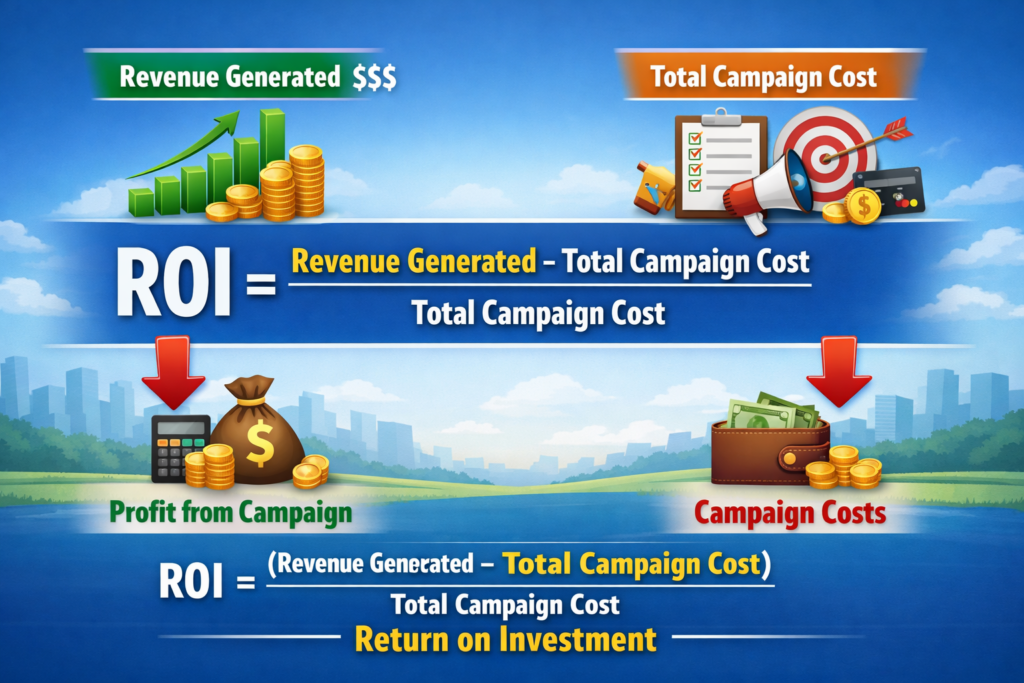
While this seems straightforward, many brands overestimate ROI by omitting key costs. To get a true picture of profitability, all expenses must be accounted for:
- Product seeding costs – the value of products provided to influencers for content creation.
- Creator commissions – affiliate fees or performance-based payouts.
- Platform or agency fees – costs for management, reporting, or software subscriptions.
- Operational overhead – internal time spent coordinating campaigns, tracking metrics, and approving content.
Automation platforms like Logie.ai automatically track all these costs and revenue streams, eliminating manual errors and ensuring ROI calculations are accurate. By factoring in both spend and performance in real time, brands may confidently measure the true efficiency of every influencer campaign.
Overlooking operational and hidden costs leads to inflated ROI numbers, misinformed budget decisions, and missed opportunities to scale profitable campaigns. Accurate ROI measurement allows ecommerce brands to allocate spend strategically, double down on top performers, and maximize revenue per dollar invested.
By integrating all costs and revenue into one real-time dashboard, brands transform influencer marketing from a guessing game into a data-driven growth engine, where ROI is fully transparent and actionable.
Step 5 – Measure ROI at the Creator, Campaign, and Product Level
To fully understand influencer marketing ROI in 2026, ecommerce brands must measure performance across multiple layers, not just at an aggregate campaign level. This granular approach ensures that budgets are allocated strategically and top-performing creators and products are scaled effectively.
Key measurement layers include:
- Per Creator ROI – identify which influencers are driving the most conversions, not just engagement. This reveals true sales impact and helps brands prioritize high-performing creators.
- Per Campaign ROI – evaluate drops, seasonal promotions, and evergreen campaigns individually. Understanding what works in each context allows for smarter planning and timing of future campaigns.
- Per Product ROI – measure which products perform best via influencer marketing. Insights here uncover profitable creator-product pairings and highlight opportunities to optimize inventory and messaging.
Why this matters:
- Enables budget reallocation – invest more in creators, campaigns, and products that generate the highest returns.
- Identifies scalable pairings – discover which influencer-product combinations consistently drive revenue, allowing campaigns to scale predictably.
- Prevents underperforming repeats – avoid wasting resources on campaigns or creators that historically deliver low ROI.
Platforms like Logie.ai automate ROI measurement across all layers, giving ecommerce teams a real-time, multi-dimensional view of performance. By tracking ROI at the creator, campaign, and product levels, brands may make smarter decisions, scale profitable strategies, and maximize every dollar spent on influencer marketing.
Step 6 – Why Manual ROI Tracking Fails in 2026
As influencer marketing evolves into a high-stakes revenue channel, traditional methods for tracking ROI are no longer sufficient. Manual approaches, whether spreadsheets, promo codes, or delayed reporting, introduce inefficiencies, inaccuracies, and missed opportunities.
Key limitations of manual ROI tracking:
- Promo codes miss assisted conversions – many sales influenced by creators go uncredited if customers don’t use a unique code, leaving a significant portion of revenue unmeasured.
- Spreadsheets don’t scale – as campaigns grow to include hundreds of creators and multiple products, manual data consolidation becomes slow, error-prone, and overwhelming.
- Reporting arrives too late to optimize – delayed insights prevent mid-campaign adjustments, wasting budget on underperforming creators and missed opportunities to amplify high performers.
- Human bias affects decisions – manual interpretation may favor subjective impressions over data, leading to misguided allocations and overestimation of ROI.
Report revealed that 45% of the data marketers use to make business decisions is incomplete, or inaccurate causing ecommerce brands to misjudge campaign performance and ROI.
Platforms like Logie.ai eliminate these pitfalls by automating tracking, attribution, and reporting in real time. By moving away from spreadsheets and promo-code-only tracking, brands gain a reliable, scalable, and actionable view of influencer ROI, enabling smarter decisions and more profitable campaigns.
Manual ROI tracking is no longer sufficient for 2026’s ecommerce landscape. Automation and advanced attribution are essential for capturing the full revenue impact of influencer marketing, optimizing campaigns continuously, and maximizing ROI.
Step 7 – How AI Changes How You Measure Influencer Marketing ROI
In 2026, the most accurate way to measure influencer marketing ROI is through AI-powered attribution platforms. As influencer programs grow more complex, involving multiple creators, products, platforms, and touchpoints, AI becomes essential for delivering clarity, accuracy, and scale.
Unlike manual methods, AI doesn’t just collect data. Instead, it connects performance signals across the entire customer journey and turns them into actionable insights.
How AI transforms ROI measurement:
- Real-time attribution – AI tracks revenue as it happens, showing exactly which creators, campaigns, and content pieces are driving sales, without delays or guesswork.
- Automated conversion tracking – every click, view, and purchase is attributed automatically across devices and sessions, capturing both direct and assisted conversions.
- Continuous optimization – performance data feeds back into the system in real time, allowing brands to reallocate budget, pause underperformers, and scale top creators while campaigns are live.
- Predictive ROI forecasting – by analyzing historical performance, AI predicts which creators, products, and content formats are most likely to convert, enabling smarter decisions before spend occurs.
AI replaces fragmented reporting with a single source of truth. Brands no longer rely on assumptions, incomplete promo code data, or delayed spreadsheets. Instead, ROI is measured accurately, continuously, and at scale.
Platforms like Logie.ai apply AI across discovery, attribution, and optimization, allowing ecommerce brands to measure influencer marketing ROI with precision and confidence. What was once reactive becomes predictive. What was once unclear becomes measurable.
In 2026, AI doesn’t just improve influencer marketing performance, it redefines how ROI is measured, proven, and scaled.
How Logie.ai Measures Influencer Marketing ROI Differently
Most influencer platforms report activity, but Logie.ai is built to prove revenue impact.
Designed specifically for ecommerce, Logie.ai approaches ROI measurement with a performance-first architecture that connects influencer activity directly to sales outcomes, not surface-level engagement.
What makes Logie.ai different:
- Built specifically for ecommerce – Logie.ai is engineered around ecommerce conversion funnels, checkout behavior, and revenue attribution, not generic brand awareness reporting.
- Tracks revenue, not engagement – instead of prioritizing likes or impressions, Logie.ai focuses on revenue per creator, conversion rate, CPA, and ROI by campaign and product.
- Attributes every sale to creators and content – AI-powered attribution tracks both direct and assisted conversions across sessions and devices, ensuring no revenue influenced by creators goes unaccounted for.
- Optimizes campaigns while live – performance data updates in real time, allowing brands to scale high-performing creators, reallocate budget instantly, and stop wasted spend before campaigns end.
Marketing attribution enables marketers to optimize their strategies and allocate budget and resources to the channels that generate the most conversions.
Logie.ai doesn’t report on influencer performance, it proves revenue impact. By combining AI-driven attribution, real-time optimization, and ecommerce-native intelligence, Logie.ai gives brands a clear, defensible view of influencer ROI.
In an era where growth teams need speed and finance teams need proof, Logie.ai delivers both transforming influencer marketing into a measurable, scalable revenue engine.
Common Mistakes Brands Make When Measuring Influencer ROI
Even in 2026, many ecommerce brands struggle to accurately measure influencer marketing ROI, not because the data isn’t available, but because of how they approach measurement. The most common mistakes include:
- Relying on engagement metrics – likes, impressions, and comments may indicate visibility, but they don’t reflect revenue impact or profitability.
- Measuring ROI after campaigns end – post-campaign analysis prevents real-time optimization and leads to wasted spend on underperforming creators.
- Ignoring assisted conversions – influencer-driven awareness often leads to delayed purchases. Failing to track assisted revenue significantly underreports true ROI.
- Treating influencer campaigns as one-offs – one-time campaigns limit learning and scalability. ROI improves when influencer programs are continuous and data-driven.
- Using multiple disconnected tools – fragmented systems create data gaps, inconsistencies, and manual work that distort ROI reporting.
Avoiding these mistakes allows brands to move from assumed performance to proven results, turning influencer marketing into a reliable, measurable growth channel.
FAQs
1. What is influencer marketing ROI?
Influencer marketing ROI refers to the measurable business return generated from influencer campaigns relative to the total cost of running them. In practical terms, it answers a critical question for brands: how much revenue, profit, or long-term customer value was created as a direct or assisted result of influencer activity. In 2026, ROI is no longer defined by engagement alone but by verified revenue impact across the customer journey.
2. Why is it important to measure influencer marketing ROI?
Measuring influencer marketing ROI is essential because influencer marketing has evolved into a significant revenue channel with growing budgets and executive scrutiny. Brands that accurately measure ROI may justify spend, defend budget allocation to leadership, and make informed decisions about which creators, products, and campaigns deserve further investment. Without ROI measurement, influencer marketing becomes guesswork rather than a scalable growth engine.
3. How can I maximize my influencer marketing ROI?
Maximizing influencer marketing ROI starts with setting revenue-first goals before campaigns launch and continues with tracking the full customer journey rather than isolated touchpoints. Brands that use attribution, automation, and real-time performance data are able to optimize campaigns while they are live, reinvest in high-performing creators, and eliminate waste. Consistent measurement and optimization are what turn influencer marketing into a predictable revenue driver.
4. What metrics should I track to measure influencer ROI?
To accurately measure influencer marketing ROI, brands should focus on revenue-based metrics rather than vanity metrics. This includes tracking revenue per creator, conversion rate, cost per acquisition, return on ad spend, and assisted or incremental revenue influenced by creator content. These metrics provide a clear picture of profitability and allow brands to compare influencer performance directly against other paid marketing channels.
5. How do I attribute revenue to influencer campaigns?
Attributing revenue to influencer campaigns requires moving beyond last-click attribution and promo codes alone. Modern attribution models track how influencer content contributes to conversions across multiple sessions, devices, and touchpoints. By measuring assisted conversions and multi-touch interactions, brands may properly credit influencers for the role they play throughout the decision-making process, not just at checkout.
6. How does Streak help measure and improve influencer ROI?
Streak helps brands measure and improve influencer ROI by emphasizing structured goal setting, KPI alignment, and performance visibility. By encouraging marketers to define what success looks like before campaigns begin and consistently track outcomes against those goals, tools like Streak help reduce misattribution and improve decision-making around influencer investment and optimization.