

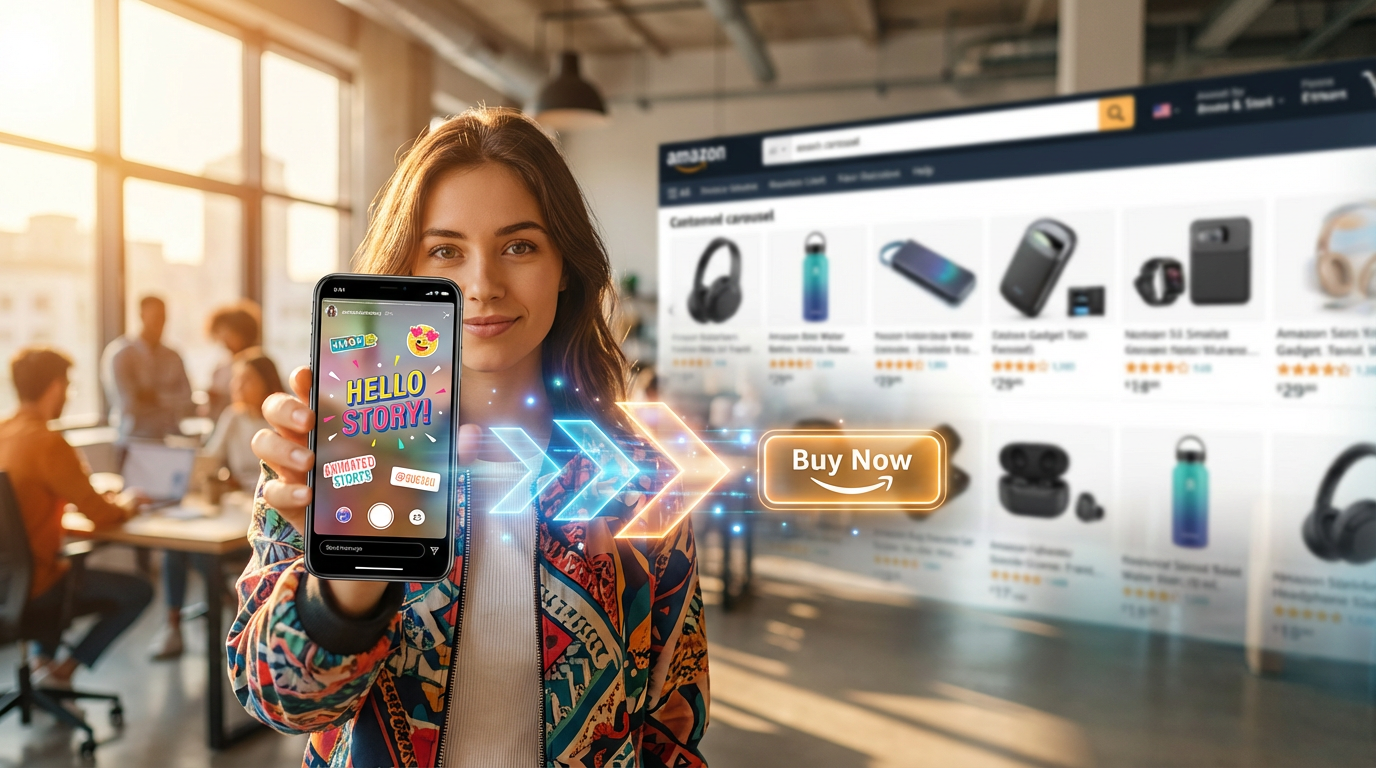
Amazon saturation in 2026 is no longer a phase creators can “outwait.” It is structural. With over 12 million active sellers, an accelerating influx of AI-generated product listings, and a recommendation engine that increasingly prioritizes velocity and historical conversion signals, most niches reach competitive exhaustion faster than creators can adapt if they rely on on-platform visibility alone.
What used to be a workable strategy, posting more shoppable videos, rotating thumbnails, and refreshing copy, now produces diminishing returns because the discovery layer itself is overcrowded.
Even high-quality creators are competing against near-identical visuals, cloned talking points, and algorithmic compression that flattens differentiation.

This is why the most consistent growth patterns emerging across Logie’s creator data in late 2025 and early 2026 are not tied to “better Amazon content,” but to where the buying decision happens before the shopper ever lands on Amazon.
Saturation isn’t killing opportunity. It’s relocating it.
Why On-Amazon Alone Feels Tapped Out for Creators
Creators intuitively feel this shift before dashboards confirm engagement plateaus. Click-through rates soften. Videos that would have converted months ago now disappear into a scroll of sameness.
The underlying reason is not creator fatigue; it’s decision fatigue. Amazon pages are optimized for transactions, not trust formation.

By the time a shopper lands on a product page, they are already comparing alternatives, reading conflicting reviews, and mentally discounting creator endorsements as “just another recommendation.”
That erosion of trust is what off-site content restores.
As Altovise Pelzer articulated during Logie’s 2025 wrap-up session:
“Even if something is overly saturated on Amazon, that’s when we go off of Amazon and do the work there… putting it in Stories, adding the link. I always see an increase when I do that versus when I don’t.” Altovise Pelzer
This matters because off-site content shifts the moment of persuasion upstream, before Amazon’s comparison mechanics take over.
The Conversion Advantage of Off-Site Traffic
Statistics show that traffic originating from Instagram Stories, SEO-driven blogs, and curated landing pages converted 41% higher on average than equivalent clicks originating from on-Amazon placements alone.
This uplift is not incidental. It comes from three structural advantages:
- Pre-qualification
Off-site content filters intent. A shopper who reads a blog post, watches a Story, or consumes a comparison video arrives with context, expectations, and emotional alignment.
- Narrative control
Creators frame tradeoffs before Amazon introduces noise. By the time the shopper lands on the product page, objections have already been addressed.

- Trust transfer
When the recommendation originates in a creator-owned environment, the trust relationship precedes the transaction.
Amazon converts demand extremely well. It does not create demand particularly well in saturated categories. Off-site content fills that gap.
What should I post off-site if the niche is already saturated?
High-performing off-site content in saturated categories focuses on comparisons, constraints, and clarity.
Creators who convert consistently are publishing:
- “Who this is not for” explanations
- Side-by-side tradeoffs between similar products
- Contextual use cases (“why this works for apartments but not large homes”)
- Personal thresholds (“this annoyed me until I changed X”)
This content performs because it mirrors how buyers think when overwhelmed by choice. It reduces cognitive load rather than adding persuasion pressure.
Where should I send people?
This decision should be tactical, not habitual.
- Direct to product page when urgency matters (sales, limited stock, impulse buys).
- To a curated landing page when bundling context, multiple options, or reinforcing trust.
- To a blog post when targeting early-stage buyers or building long-term search traffic that compounds.
Creators who treat links as interchangeable underperform. Traffic destination must match buyer readiness, not creator convenience.

How do I avoid sounding salesy?
Salesiness is not about monetization; it’s about omission.
Creators sound inauthentic when they remove friction from the story. High-trust content does the opposite: it admits flaws, constraints, and compromises, then explains why the recommendation still stands.
Altovise’s guidance during the Influencer Integrity session was direct:
“If it’s not something you’re using, don’t make it seem like it is; give people the honesty.” Altovise Pelzer
Audiences are not rejecting monetization. They are rejecting narrative shortcuts.
How do I prove this works to brands?
Proof is not a single viral spike. It is a repeatable signal.
Creators who secure stronger brand partnerships do three things consistently:
- Use trackable links with clear attribution.
- Document trend lines, not screenshots
- Show examples of off-site content driving stable clicks over time.
Brands increasingly value predictability over virality. Off-site traffic provides both when measured correctly.
Off-Site Channels That Convert in 2026
Instagram Stories
Stories outperform posts because they combine immediacy with intimacy. They feel conversational, not broadcast, and they allow creators to narrate why a product fits their life in real time.
Performance improves when creators:
- Use first-person framing
- Acknowledge downsides briefly
- Add temporal context (“today,” “this week,” “after three uses”)
SEO-Driven Blogs and Niche Content
SEO in 2026 is no longer about ranking for “best X.” It is about owning a decision moment.

Blogs that convert are structured around:
- Use-case narratives
- Problem-solution arcs
- Comparative reasoning rather than product praise
Evergreen posts quietly outperform viral content because they intercept buyers during research, not impulse.
Pinterest and Visual Discovery
Pinterest has re-emerged as a pre-purchase planning engine, especially in home, lifestyle, and gifting categories. Pins work because they meet users before intent hardens.
Creators using Pinterest effectively treat it as a search engine, not a social feed.
Short-Form Video as Traffic Teasers
TikTok and Shorts perform best when used as attention gateways, not conversion endpoints. High-performing creators tease insight, then redirect viewers to richer off-site explanations before Amazon.
This layered approach increases downstream conversion quality.
SEO for Amazon Creators in 2026: Journey Mapping Over Keywords
Keyword targeting alone underperforms because buyer intent is fragmented across platforms.
Effective creators map:
- Early research → blog
- Consideration → Stories or video
- Purchase → Amazon
SEO succeeds when content reflects how decisions unfold, not how platforms categorize them.
Amazon’s Incentives Are Quietly Aligning with This Shift
Amazon’s Brand Referral Bonus and expanded attribution tools are explicit acknowledgments that off-site demand creation matters.
Creators who drive qualified external traffic:
- Earn higher effective commissions.
- Attract a better brand offer.s
- Retain leverage in negotiations.
The Real Advantage in 2026
The creators winning in 2026 are not louder, faster, or more prolific. They are more deliberate.
They build content funnels, not isolated posts.
They treat Amazon as the checkout, not the pitch.
They invest where trust is formed, not where competition is densest.
Off-site content is no longer an edge. It is the baseline for sustainable growth.