

TikTok’s Next 2026 forecast is doing something more interesting: it’s describing how people already behave, then projecting where that behaviour hardens into expectation.
TikTok is saying this: audiences are no longer passively entertained by brands. They are actively evaluating them.
Every scroll, search, comment, and save is part of a decision-making loop that blends curiosity, skepticism, and emotion.

What follows is a practical reality marketers need to design for.
Authenticity Has Shifted from “Vibe” to “Evidence”
TikTok frames Reali-TEA as the fading of fantasy and the rise of real stories. But what’s happening is more specific: people are tired of unearned certainty. Content that presents a product, lifestyle, or brand as flawless now raises suspicion instead of aspiration.
This explains why overly polished ads underperform even when production quality is high. The issue isn’t aesthetics, it’s credibility. Viewers want to know how something fits into real life, not an idealized version of it. They want context. Trade-offs. Boundaries.
That’s why creators who openly say “this didn’t work for me at first” or “this is great, but only if you need X” build more trust than those who deliver perfect outcomes. And it’s why brands that allow that kind of honesty see stronger long-term performance, even if short-term metrics look quieter.
The implication for marketers is subtle but important: authenticity in 2026 is not about being raw, it’s about being verifiable.
Showing the process, responding publicly to criticism, and letting creators express nuance all act as trust signals. In contrast, tightly scripted positivity feels like risk avoidance, and audiences read that as a red flag.
Discovery Is No Longer a Funnel,l It’s a Trail
TikTok describes discovery as intentional and curiosity-led, and that aligns with how the platform now functions as both entertainment and search.
People don’t arrive with a single question and leave with a single answer. They arrive with interest and leave with direction.
A video sparks attention.
A comment reframes it.
A search deepens it.
Another creator complicates it.
This messy, non-linear journey is what TikTok calls curiosity detours, and it fundamentally changes how content should be planned.
Traditional funnels assume control: push awareness, then guide consideration, then close. TikTok’s ecosystem assumes exploration. Control shifts to the user.
This is why content designed only to “introduce” a brand often fails to convert. It creates awareness without capture.
The content that performs best is usually the content that shows up after the first spark, the explanation, comparison, clarification, or counterpoint that helps someone make sense of what they’ve already seen.
Practically, this means brands should stop trying to own trends and start owning questions. If your content consistently answers “Is it worth it?”, “Which one should I choose?”, or “What’s the downside?”, you become part of the discovery trail, not just a passing impression.
Emotional ROI
TikTok’s concept of Emotional ROI is one of the most revealing parts of the forecast. It acknowledges that impulse buying is losing ground to intentional decision-making. But this isn’t just about budgets or economic caution, it’s about emotional risk.
People want to feel confident after engaging with content. Not hyped. Not rushed. Confident.
That’s why calmer, explanatory videos increasingly outperform high-energy sales content. They reduce uncertainty. They validate decisions.
They make people feel informed rather than persuaded. In a crowded marketplace, that emotional reassurance is often more powerful than excitement.
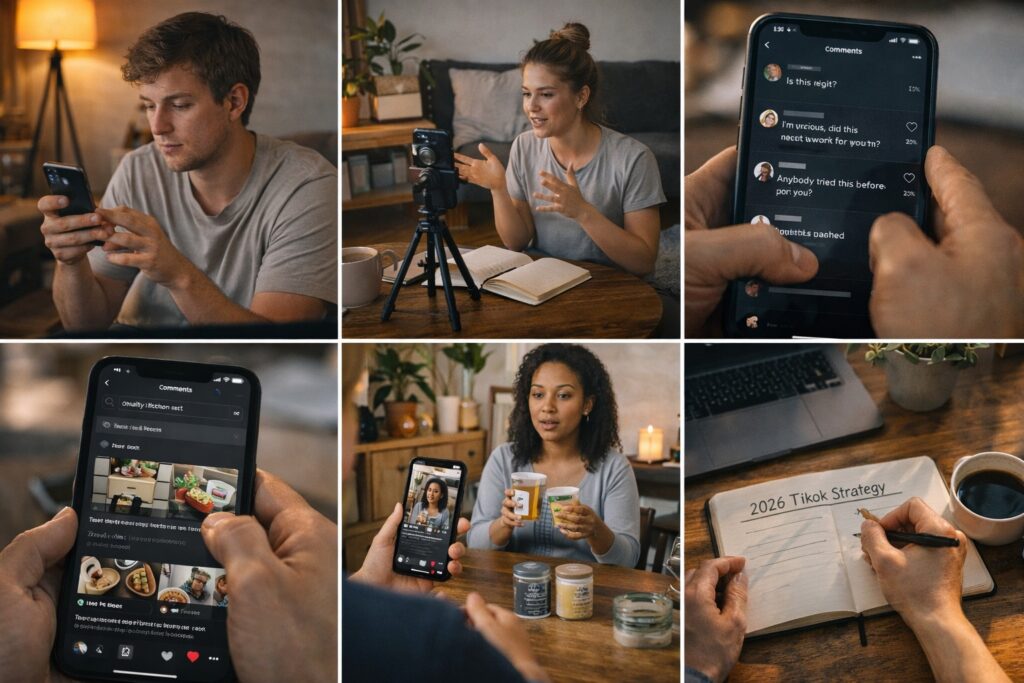
This is also why community validation matters so much. Comment sections, stitched reactions, and creator follow-ups aren’t distractions; they’re proof layers.
When people see others asking the same questions they have and receiving thoughtful answers, emotional friction drops.
For marketers, the takeaway is clear: selling in 2026 isn’t about pushing desire; it’s about resolving doubt. Content that helps someone think through a decision, even slowly, is far more valuable than content that tries to accelerate it.
Comments, Search, and Context
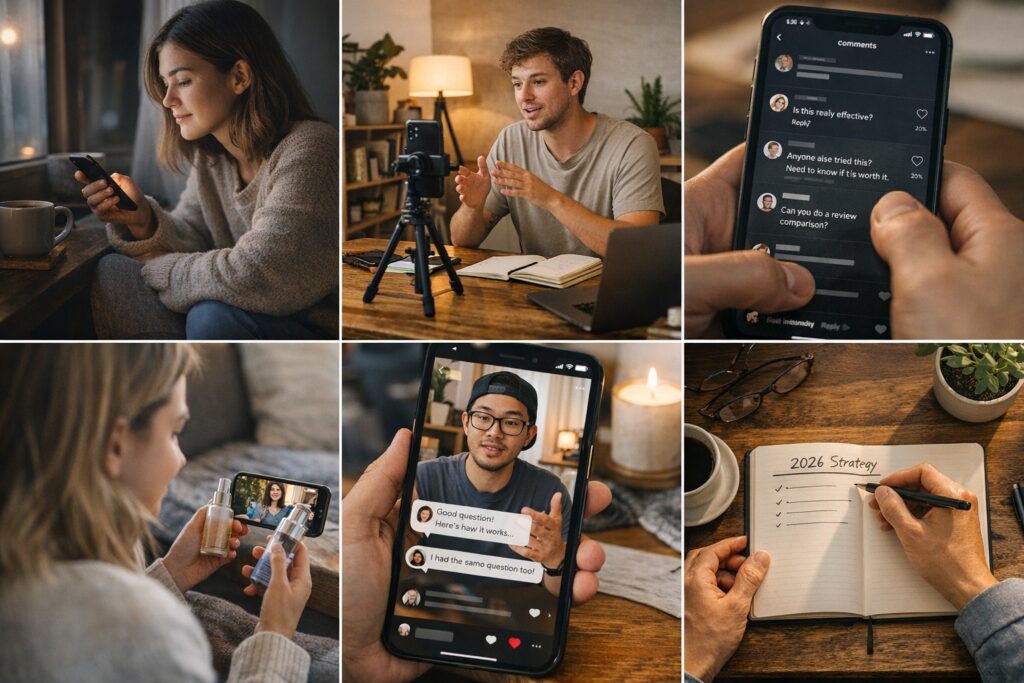
One thing TikTok’s forecast makes obvious, even if it doesn’t say it outright, is that the video itself is no longer the full message. Influence now unfolds across layers, captions, comments, replies, search results, and creator networks.
People often decide whether to trust a video after reading the comments. They mentioned search phrases casually. They watch reply videos for clarification. In this environment, posting without engaging feels like walking away from a conversation you started.
Brands that treat comments as an afterthought lose control of their narrative by default. Brands that engage not defensively, but informatively, gain disproportionate trust. The presence itself signals confidence.
This also reframes metrics. Views show exposure, but saves, searches, replays, and comment depth signal intent. They indicate that someone is thinking, comparing, and considering. That’s where commercial value increasingly lives.
TikTok Is Becoming a Thinking Platform
When you connect all three signals, Reali-TEA, Curiosity Detours, and Emotional ROI, a clear picture emerges. TikTok in 2026 is not becoming louder or faster. It’s becoming more deliberate.
People still want entertainment. But they also want clarity. They want to understand what they’re seeing, why it matters, and whether it fits their life.
Brands that keep chasing attention without offering understanding will struggle to convert that attention into trust.
The opportunity here isn’t to produce more content. It’s to produce more useful content that explains, contextualizes, and respects the intelligence of the audience.
TikTok Next 2026 isn’t asking marketers to reinvent themselves. It’s asking them to grow up alongside their audience.