

In 2026, “post more” is starting to sound like “work harder for the same result.”
Not because creators are doing anything wrong, but because the creator economy has matured into something more selective.
Brands are spending, audiences are still buying, and yet a lot of creators feel like the ground moved under them.

Here’s the shift we keep seeing across creator-led commerce: posting is activity; planning is leverage.
The creators who win in 2026 are the ones who treat content like an asset library built around repeatable audience needs rather than a daily sprint for reach.
That isn’t a motivational line. It’s a market reality.
What does “think like a planner” mean for creators in 2026?
Thinking like a planner means:
- Building content around repeat audience problems (not just trends)
- Creating evergreen assets brands can reuse and trust
- Aligning content to decision timelines (research → compare → buy)
- Measuring success by saves, clicks, search discovery, and repeat views, not only spikes
- Pitching brands with a system (pillars + formats + cadence), not one-off posts
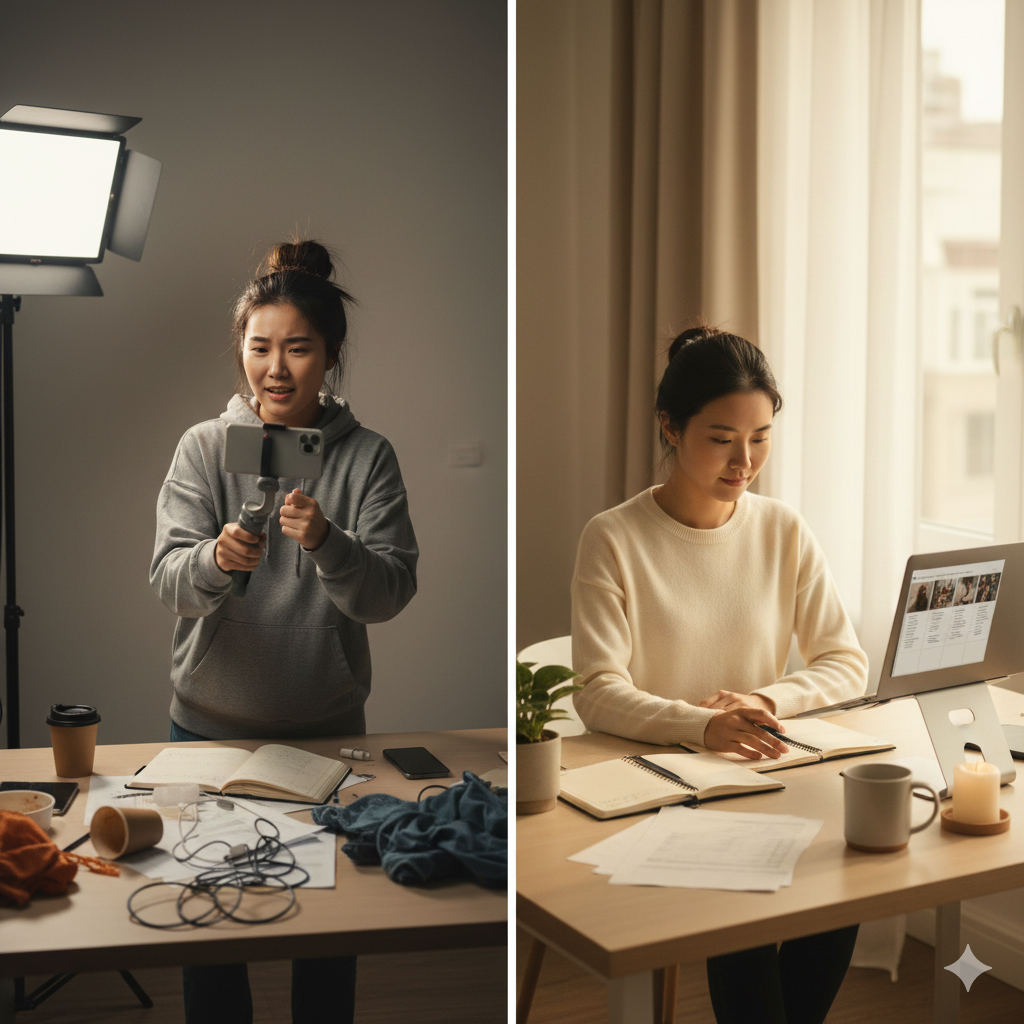
The creator economy didn’t slow down. It was professionalized.
Influencer marketing hasn’t “died”; it’s scaling, but it’s also concentrating.
A recent report covered by Business Insider, citing CreatorIQ findings, highlights a widening earnings gap: in 2025, the top 10% of creators received 62% of total ad payments, up from 53% in 2023, and the top 1% received 21%, up from 15%.
That kind of concentration changes the game. Brands become more risk-aware. They lean toward creators who look reliable, repeatable, and easy to justify internally. In other words: creators who plan.
And from the buyer side, the influence is still real: Sprout Social reports that 86% of consumers make a purchase inspired by an influencer at least once a year.
So this isn’t about whether creator marketing works. It’s about who it works for and why.
Posting is a tactic. Planning is a positioning strategy.
Creators who “post” are usually optimising for:
- What’s trending now
- What gets quick engagement
- What the algorithm rewards today
Creators who “plan” are optimising for:
- what their audience repeatedly searches for
- What brands repeatedly need help explaining
- What will still be valuable 30, 90, 180 days from now
This matters because brands don’t hire creators for energy. Brands hire creators for outcomes, and outcomes are easier to predict when the creator has a consistent system.

Debbie, our Social Media Manager at Logie, sums it up simply:
“Creators who plan don’t just show up in feeds, they show up in decisions. Their content gets revisited, shared, saved, and trusted.”
That’s the difference. Posters compete. Planners compound.
Why planners get brand deals earlier
Here’s the uncomfortable truth: a lot of creators wait for the deal before they build the strategy. Brands want the opposite.
In 2026, brands are increasingly trying to reduce uncertainty:
- Will this creator communicate well?
- Can they hit deadlines?
- Will the content match brand safety expectations?
- Will results be predictable enough to defend internally?
Planning answers those questions without needing a long email thread.
Also, brands are investing heavily in performance-based and measurable creator programs. impact.com reported that during Cyber Week 2025, influencer-driven spend jumped 51%, with creators increasing their share of total orders year-over-year.
When budgets get tied to measurable outcomes, “random posting” becomes less attractive than “repeatable content systems.”
If you want earlier brand selection in 2026, don’t just post deliverables, post proof of a repeatable approach: consistent pillars, consistent formats, consistent outcomes.
The hidden cost of a posting-only strategy
Posting-only feels productive because it’s constant. But it quietly taxes creators in three ways:
1) Burnout risk gets normalised
Burnout is a creator economy constraint. Marketing Week cites data indicating 59% of creators say burnout negatively impacts their careers and 58% say it affects their wellbeing, with financial instability a major driver.
Planning doesn’t magically remove pressure, but it replaces chaos with structure, which is often the real relief creators need.

2) Your value becomes hard to explain
If your content is “a bit of everything,” brands can’t categorise you. If brands can’t categorise you, they delay. If they delay, you lose.
3) You become dependent on spikes
Spiky performance teaches creators to chase novelty. But brands tend to prefer creators who can deliver a baseline reliably because the baseline is what forecasting is built on.
Planning isn’t about posting less. It’s about making sure every post strengthens a consistent identity and a consistent buyer journey.
In 2026, discovery is search-led, and planners win search
Creators don’t always realise how much of their growth now happens through “search behaviour,” not feed luck.
Multiple reports show Gen Z treats social platforms as core information channels, not just entertainment.
Whether it’s “news,” product research, or “how do I…,” the behaviour is the same: people search when they’re planning.
This is where planners quietly outperform posters:
- They use clear titles and hooks that match what people ask
- They create repeatable “answer formats” (explainers, comparisons, checklists)
- They build a catalogue that gets discovered repeatedly
Treat your content like a searchable library. Every week, publish at least one piece that answers a question your audience asks constantly.
Content that converts in 2026 looks more like a guide than a flex
Creators often assume brands want excitement. Brands want confidence.
The creator content that tends to drive decision-making and gets reused by brands is:

- comparisons (“A vs B, here’s who each is for”)
- “Things I wish I knew” breakdowns
- practical routines and step-by-steps
- realistic tradeoffs (“pros/cons,” “this won’t work if…”)
- simple frameworks (“3 options depending on your budget/time/skill”)
This aligns with what we’re seeing across influencer marketing: consumers buy because the creator reduces uncertainty.
Sprout Social’s data about influencer-driven purchasing underscores that influencer content is now embedded in everyday buying behaviour, not just occasional hype.
If your content only shows outcomes, you’ll get applause. If it shows decisions, you’ll get trust. Trust is what brands pay for repeatedly.
How to plan like a creator-business
You don’t need a 12-month content calendar. You need a system that makes your next month easier and your next quarter clearer.
1) Pick 2–3 “decision pillars.”
These are not niches; they’re repeat decisions your audience makes.
Examples:
- “affordable skincare routines”
- “Amazon home upgrades that actually last”
- “work outfits for real life”
- “fitness for busy beginners”
Seamless recommendation: if you can’t summarise your pillar as a decision someone is trying to make, it’s probably too broad.
2) Build 3 repeatable formats per pillar
Formats reduce creative fatigue and increase performance predictability.
High-performing creator formats that age well:
- “What I’d buy again.”
- “3 options depending on…”
- “Beginner checklist”
- “Do this, not that.”
- “My honest setup + what I’d change.”
3) Plan around audience timelines, not brand timelines
If people research before they buy, your content needs to show up before purchase pressure.
A simple rhythm:
- Week 1: awareness explainer
- Week 2: comparison
- Week 3: checklist/how-to
- Week 4: recommendation with context
4) Keep one slot for trends
Trends can help discovery. But planners use trends as distribution, not identity.
Trends should point back to your pillar library. If they don’t, you’re building someone else’s momentum.
Why “planning signals” matter more than views
We’re not saying views don’t matter. We’re saying views can be misleading.
If your content is meant to help someone decide, the strongest signals often look quieter:
- saves/bookmarks
- click-through to product pages or bios
- repeat views
- comments that ask follow-up questions
- people DMing “I needed this”
This is why “viral once” is less valuable than “useful forever.” Brands looking for dependable ROI increasingly prefer creators who can drive intent repeatedly, not unpredictably.
Start tracking “decision intent” weekly: saves, clicks, repeatable FAQs, and which posts lead to deeper questions.
How far ahead should creators plan in 2026?
A practical planning window for most creators:
- 2–4 weeks for weekly content structure (pillars + formats)
- 6–8 weeks for major seasonal pushes
- 90 days for pillar development (what you want to be known for this quarter)
If you plan 90 days at the “pillar level,” you can stay flexible weekly without losing direction.
Conclusion
Posting will always be part of the job. But in 2026, planning is what makes creator careers durable.
The market is rewarding creators who:
- are easier to understand
- are safer to bet on
- create assets that keep working
- help audiences make decisions confidently
And the data supports that this is not a niche strategy; it’s where the industry is going, as brand spend grows and becomes more performance-accountable.