


Amazon Live in 2026 is not what it was when early creators first entered the program, and pretending it is will quietly cost you revenue.
In the early days, placements felt abundant. Visibility felt generous. Many creators could go live frequently and find themselves surfaced across product pages and bestseller feeds. But that phase didn’t last.
As Altovise Pelzer explained candidly during the session:
“When I first started with the program, I was livestreaming just about every day… There were so many opportunities… but a lot of that stuff was taken away because we saw a lot of people come in, and they misused the platform.”
That sentence captures the maturation of Amazon Live in one breath. The ecosystem tightened. Shortcuts disappeared. Passive looping streams were discouraged. Placement became earned rather than assumed.

And when an ecosystem tightens, surface-level creators struggle. Systems-level creators adapt.
The clearest signal of that shift is the post-livestream Idea List.
The Livestream Is Not the Product
Most creators still treat a livestream like an event. They prepare, go live, promote it briefly, and once it ends, they move on to the next idea.
But the more sophisticated operators inside Amazon Live understand something different: the livestream is raw material.

It is persuasion footage.
It is not the final asset.
The real leverage begins when the stream ends.
Altovise described the ability to immediately convert your livestream carousel into an Idea List as “a game changer.”
And that description is not an exaggeration. It collapses what used to be a multi-step rebuilding process into a single action: your curated carousel becomes a structured, permanent collection inside your storefront.
That shift changes the economics of your effort.
Because a livestream disappears in time.
An Idea List remains indexed, searchable, and shareable.
Buying Is Private Even If Persuasion Is Public
One of the biggest misconceptions about Amazon Live is the belief that conversion must happen during the live broadcast window. The reality is far more nuanced.
Viewers use livestreams to evaluate. To compare. To reduce uncertainty. To see texture, scale, use cases, and honest reactions. They gather confidence publicly.
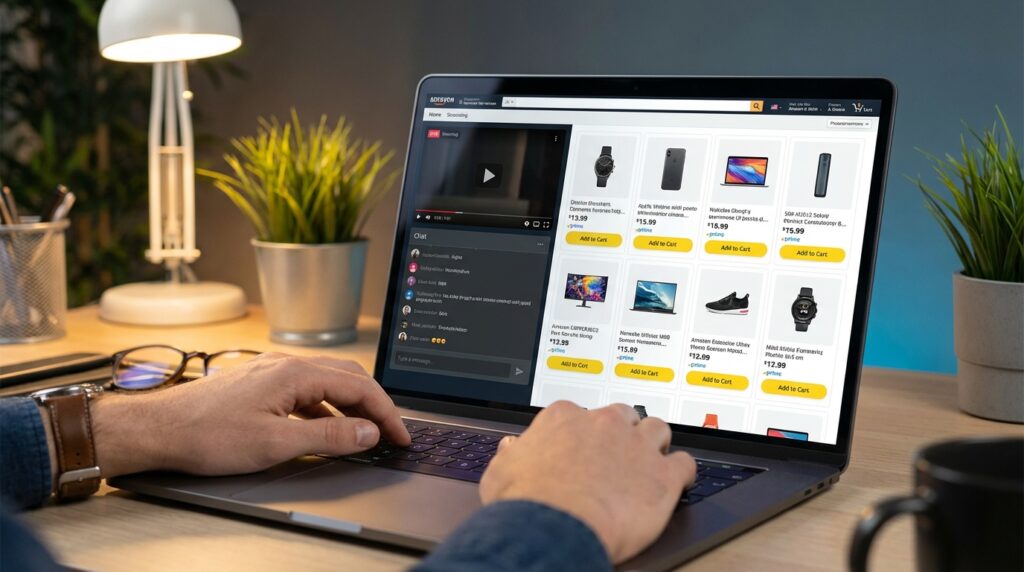
But they often purchase privately.
Altovise acknowledged this pattern directly:
“I’m seeing more sales after the livestream is done… they’re pressing the buy button afterwards.”
That observation reflects how modern e-commerce behavior actually works. People want time to think. They want to check reviews. They want to scroll images calmly. They want to make decisions without pressure.
If you end your workflow when the livestream ends, you interrupt the natural buying cycle.
The Idea List becomes the return path. It captures the exact curated set of products you discussed and makes them retrievable without forcing the buyer to search manually or re-decide among competing listings.
Friction is rarely loud. It’s quiet. It’s the extra step. The extra search. The moment of doubt.
And friction quietly erodes affiliate income.
Amazon’s Infrastructure Tells You What It Values
Amazon is not built like a social network. It is built like a retail engine that thrives on categorization and structured data.
Idea Lists are not decorative features. Amazon’s Influencer documentation positions them as foundational storefront components, structured collections that sit inside the browsing architecture of the platform. They are persistent surfaces, not temporary content bursts.
That distinction matters because platforms amplify what they can organize.

A livestream is temporal.
An Idea List is indexable.
One is momentary visibility.
The other is a structured inventory.
Creators who understand this stop thinking about livestreaming as performance and start thinking about it as retail architecture inside someone else’s ecosystem.
Off-Site Traffic Is a Strategic Direction, Not a Side Tactic
There was another revealing moment in the session when Altovise stated:
“Your commission is actually higher when you do off-site sales than when you do on-site sales.”
That statement reframes the distribution conversation entirely.
Amazon has made structural distinctions between onsite content placement and traffic-driven sales. The message is clear: creators who bring audiences to Amazon matter.
Waiting for placement is a defensive strategy.
Building distribution loops is an offensive strategy.

And the most efficient way to distribute without chaos is through a structured Idea List rather than a scattered collection of individual product links.
An Idea List allows you to send Instagram viewers, YouTube subscribers, Pinterest scrollers, and email readers to one coherent destination, a curated collection that reflects exactly what you demonstrated.
That coherence builds authority.
Random links build noise.
The Operator Mindset
There is a visible divide inside Amazon Live right now.
Some creators go live and move on.
Others extract.
They create clips. They publish the Idea List immediately. They upload the replay to YouTube with timestamps. They deep-link individual products for high-intent viewers. They schedule the distribution.
Amazon has even made clip extraction easier, signaling that repurposing is expected behavior.
The difference between performers and operators is not charisma. It is asset awareness.
The operator sees one livestream as:
- A replay
- A curated Idea List
- Five decision-focused clips
- A YouTube chapter sequence
- A cross-platform distribution cycle

Not because they are chasing volume.
But because they understand compounding.
Precision Is Where Income Stabilizes
Cheryl raised one of the most financially significant points during the session. If your links don’t open properly inside the Amazon app, viewers will search manually, and you lose attribution.
“If it doesn’t open in the app… you’re out.”
This is not cosmetic optimization. It is revenue protection.
She also emphasized timestamping YouTube uploads and linking products at specific moments, because searchable product names and chapter segmentation reduce friction for buyers and increase discoverability for brands.
Precision reduces drop-off.
And drop-off, multiplied over months, explains the difference between inconsistent payouts and predictable income.
Idea Lists function as hubs.
Deep links function as closers.
Serious creators use both deliberately.
Carousel Discipline Signals Authority
Another strategic shift mentioned in the session was carousel size. Altovise explained that she reduced oversized carousels down to roughly 12–15 products
That adjustment is not aesthetic. It is psychological.

A tight carousel communicates curation.
An oversized carousel communicates uncertainty.
When that carousel converts into an Idea List, the difference compounds. A focused list feels intentional. A sprawling one feels overwhelming.
In 2026, clarity is a competitive advantage.
The Bigger Shift
Amazon Live has matured.
Placements are tighter.
Visibility is earned.
Shortcuts are gone.
As Altovise reminded everyone:
“We’re about six weeks in… this is a good time to look and see… is it working? Am I seeing positives?”
That mindset applies beyond Q1. It applies to your entire Amazon strategy.
If you are livestreaming without extracting assets, without building structured lists, without controlling off-site distribution, you are working harder than necessary for inconsistent returns.
The creators who will dominate Amazon Live in 2026 are not simply those who go live more often.
They are those who build infrastructure around every broadcast.
Livestream once.
Convert the carousel into a structured Idea List.
Extract precision clips.
Distribute intelligently.
Reduce friction obsessively.
That is not a feature strategy.
It is an operating philosophy.