

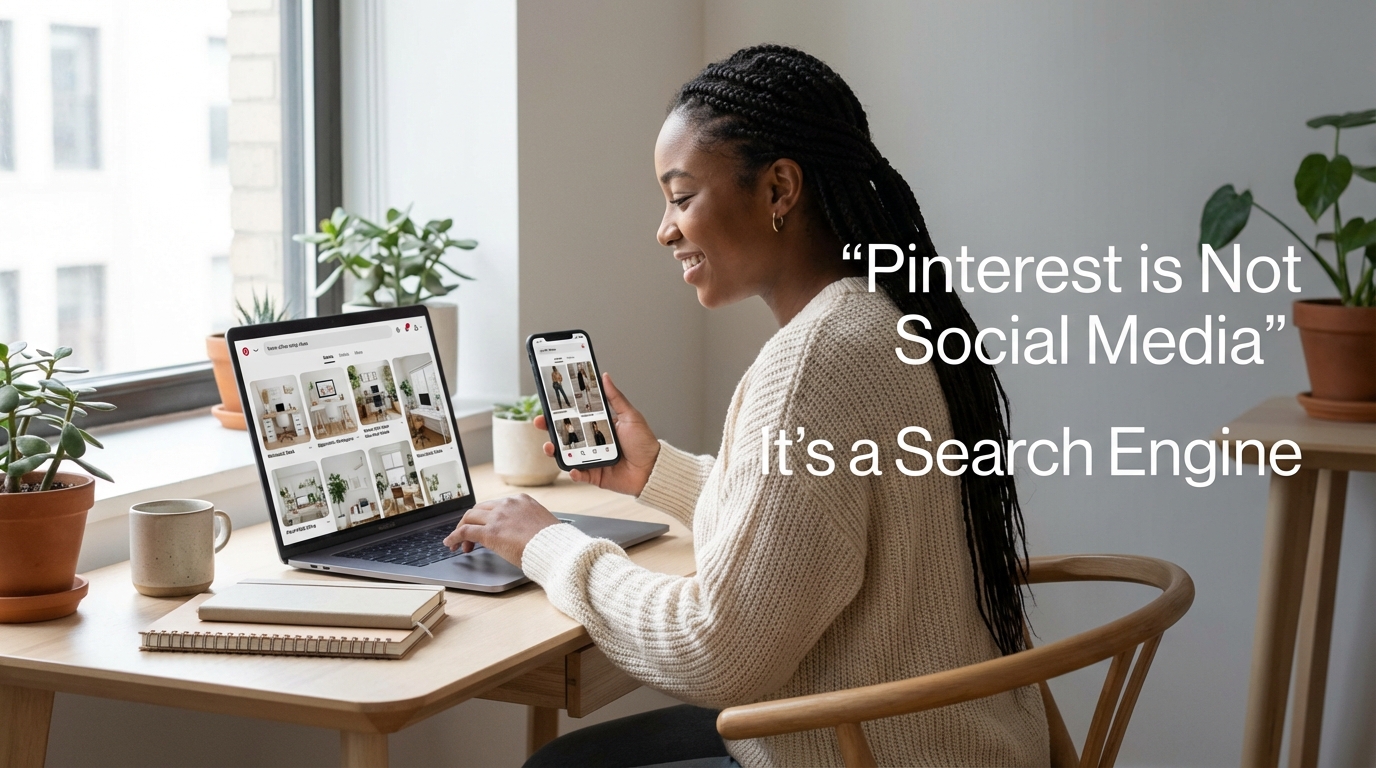
For a long time, Pinterest was treated like a side platform. A place for mood boards, recipes, outfit inspiration, and home décor ideas. Useful, maybe, but not central to serious creator growth.
That view no longer holds up. Pinterest is now a visual discovery engine built around search behavior.
Pinterest itself describes the platform as a visual discovery engine, and its business materials repeatedly position it as a place where people actively look for ideas, products, and new brands. In other words, people do not only scroll Pinterest. They search for it, plan on it, and then act on it.

That distinction changes everything.
Because once you stop treating Pinterest like social media and start treating it like search, your strategy shifts. Followers matter less.
Keyword structure matters more. Random posting matters less. Search intent, board architecture, seasonal timing, and pin relevance matter more.
And that is exactly why Pinterest SEO has become such an important growth lever for creators, bloggers, affiliate marketers, and product-led brands.
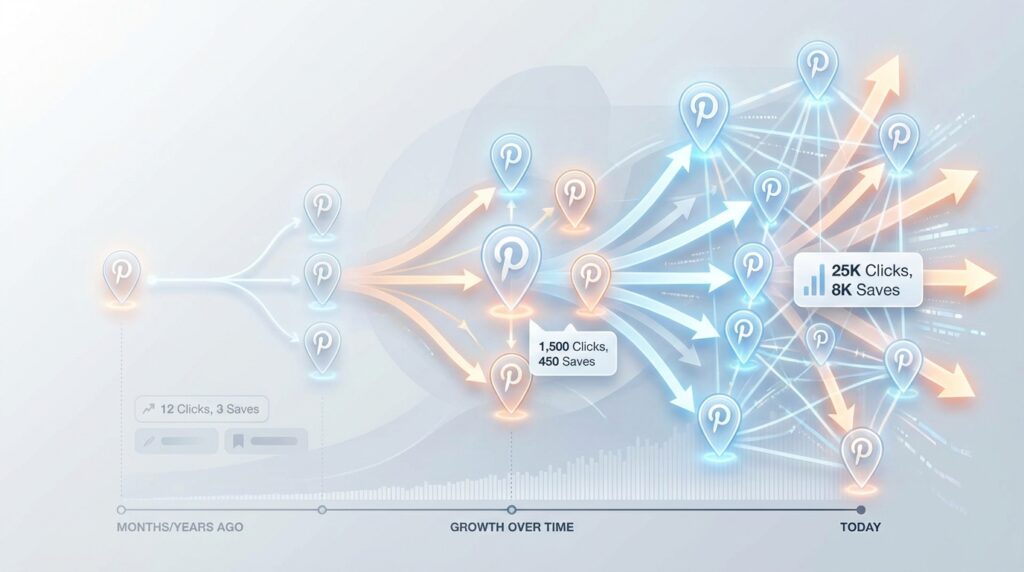
The big opportunity is this: a strong pin can continue surfacing in search, getting saved, and driving clicks long after it is published.
That makes Pinterest one of the few platforms where content can behave less like a post and more like a long-term searchable asset.
Pinterest’s guidance reinforces this search-first logic by advising creators to optimize Pin titles, descriptions, board titles, board descriptions, and URLs with relevant keywords so the platform can better understand and distribute content.

Pinterest is a search-first platform.
Many creators still bring Instagram or TikTok instincts to Pinterest. They think in terms of audience size, aesthetic consistency, and posting cadence alone. But Pinterest works differently.
The platform is built around discovery. Someone arrives with a need, a curiosity, or an intention. They search phrases like “small kitchen organization ideas,” “spring capsule wardrobe,” “birthday table decor,” “healthy high protein lunch,” or “content creation desk setup.” Pinterest then tries to match that user with the most relevant visual results.
As Michelle Johnson shared, “The main thing with Pinterest is that it is SEO heavy. Everything needs to be a circle, and then everything else needs to be a Venn diagram with that… because every little thing you do is telling Pinterest, that’s what this pin means.”
That means every element of your content becomes a signal. Your board title is a signal. Your Pin title is a signal. Your description is a signal. Text on the image can reinforce clarity. Your website URL and destination relevance matter too.
Pinterest’s help documentation explicitly says descriptions help its algorithm determine relevance for delivery, and it recommends entering descriptions to help get Pins in front of the right audience.
The point is not just to “post nice pins.” It is to help Pinterest understand exactly what your content is about so it can place that content in front of people already searching for related ideas.
On Pinterest, clarity beats cleverness surprisingly often. A beautifully designed pin with vague copy may underperform a simpler pin that is unmistakably relevant to a real search query.

What Pinterest SEO actually means
Pinterest SEO is the practice of making your content easier for Pinterest to interpret, categorize, and surface in search and discovery environments.
It is not identical to Google SEO, but the overlap is clear. In both ecosystems, keyword relevance matters.
Topic, Structure, Metadata, and User response matter. The difference is that Pinterest does all of this through a visual interface, where the image, the title, the board context, and topical relevance work together.
A practical way to think about Pinterest SEO is this: Pinterest is trying to answer the question, “What is this pin about, who is it for, and when should it be shown?”
Your job is to make that answer obvious.
Pinterest recommends reviewing previously published Pins and optimizing keywords across Pin titles, descriptions, board titles, board descriptions, and URLs. It also points users toward Pinterest Analytics, individual Pin stats, and Conversion Insights to evaluate what is actually resonating and converting.
So Pinterest SEO is not a narrow keyword trick. It is a full system made up of topic selection, board structure, metadata quality, visual clarity, and performance feedback.
The mindset shift creators need to make
The biggest Pinterest mistake is treating it like a content dump.
A creator makes one board called “My Favorites” or “Products I Love,” uploads a mix of unrelated visuals, writes vague descriptions, posts inconsistently, and hopes for traction. Then, a few weeks later, they conclude Pinterest “doesn’t work.”
But Pinterest usually rewards specificity.

A board called “Products I Love” tells the platform almost nothing. A board called “Small Apartment Kitchen Organization” tells it much more. So does “Minimalist Work Outfits for Women,” “Wedding Guest Dresses for Outdoor Ceremonies,” or “Home Office Desk Setup Ideas.” These are search-aligned topical containers.
Pinterest content needs coherence. Boards, pins, titles, descriptions, and imagery should reinforce one another instead of competing with one another. That thematic consistency helps the platform connect your content to the right search intent.
Think less like a poster and more like an information architect.
Keyword research is the foundation of Pinterest SEO
If Pinterest is search-driven, then keyword research is where the work begins.
The goal is to understand how people phrase their interests, problems, needs, and shopping intentions on Pinterest itself.
Pinterest provides one of the most important tools for this directly: Pinterest Trends. Its business resources describe Pinterest Trends as a way to understand what people are searching for, with filters for demographics, region, season, and more.
That makes it useful not only for idea generation but also for timing and audience alignment.
Third-party platforms such as PinClicks position themselves as Pinterest-focused keyword research and analytics tools, helping users explore popular keywords, related terms, and top-performing pins.
Those tools can be useful for expanding keyword ideas, but the core principle matters more than the software: keyword research on Pinterest should start with the language users actually search.
The strongest Pinterest keywords usually fall into a few categories.

First, there are broad topic keywords such as “meal prep,” “living room decor,” or “summer nails.” These can give you directional visibility, but they are often competitive and too vague on their own.
Second, there are long-tail keywords such as “high protein meal prep for beginners,” “small living room decor ideas apartment,” or “summer almond nails with flowers.” These tend to be more useful because they reflect clearer intent.
Third, there are buyer-intent or action-oriented keywords such as “best desk chair for small office,” “teacher outfit ideas under $100,” or “gift ideas for new moms.” These are especially valuable for creators and brands because they often sit closer to action.
Fourth, there are seasonal and moment-based keywords, which matter a great deal on Pinterest.
Pinterest explicitly encourages planning around seasonal and personal moments, and its marketing calendar materials emphasize that people on the platform are often looking ahead.
A smart Pinterest SEO strategy combines all four: broad relevance, long-tail precision, actionable intent, and seasonal timing.
How to find the right Pinterest keywords
A practical workflow starts with search behavior already visible on the platform.
Begin by typing a core term into Pinterest search and paying close attention to the suggestions that appear.
These suggestions are useful because they are rooted in user behavior and platform language. Then use Pinterest Trends to compare related terms, check whether interest is rising, and understand when the audience tends to search for that topic.
From there, build out clusters.

For example, if your main topic is “home office setup,” nearby keyword clusters may include “small home office setup,” “desk organization ideas,” “work from home office decor,” “minimal desk setup,” and “productivity desk accessories.”
That cluster gives you enough depth to create multiple boards, multiple pins, and multiple content angles without sounding repetitive.
The best keyword choices usually satisfy three tests. They are relevant to your niche, reflect a real use case or desire, and are specific enough that someone searching them would be pleased to land on your content.
That is why chasing only the biggest keywords can be a mistake. A smaller, sharper term with stronger intent often performs better than a broad, crowded term with fuzzy intent.
Boards are part of your SEO structure.
Boards are often treated like filing cabinets. On Pinterest, they are much more than that.
A board helps Pinterest understand the topic environment around a Pin. If you save a Pin about “small patio decor ideas” to a board called “Outdoor Entertaining Ideas,” that context reinforces the theme. If you save it to a vague or unrelated board, that clarity weakens.
Pinterest itself recommends optimizing board titles and descriptions, which confirms that boards are meaningful metadata, not just organizational tools.
This means boards should be intentional.
A good board title is descriptive, search-friendly, and focused on a recognizable topic. A good board description expands that topic naturally using supporting language rather than stuffing keywords awkwardly. The board itself should hold content that genuinely belongs together.
One board does not need to target only one exact keyword forever, but it should clearly represent one topical zone.

That is why segmentation matters. Instead of building one giant board for all fashion content, a creator may get better SEO clarity from having separate boards for “Work Outfit Ideas,” “Spring Capsule Wardrobe,” “Casual Chic Outfit Inspiration,” and “Airport Outfit Ideas.” The same principle applies to food, beauty, home, wellness, parenting, tech, travel, or creator education.
You are not just organizing for yourself. You are organizing for the search engine.
What makes a pin searchable
Pinterest says Pin titles can be up to 100 characters, though only the first portion may show in feed, and descriptions can be up to 800 characters.
More importantly, descriptions do not always display prominently to users, but Pinterest says they are used by the algorithm to determine relevance. That means titles and descriptions are doing both communication work and ranking work.
A high-quality Pinterest pin usually includes the following:
- A clear image or video with one obvious focal point.
- A title that reflects an actual search phrase.
- A description that gives Pinterest more contextual language about the topic.
- A destination URL that matches the promise of the pin.
- Design that supports comprehension rather than obscuring it.
Text overlays can also help because they make the pin’s purpose instantly legible. If the user is searching quickly, a pin that clearly says “Easy High-Protein Lunch Ideas” or “Small Bedroom Storage Hacks” has a better chance of earning the click than a vague visual with clever but non-descriptive text.
This is where many creators over-design. They aim for mystery when they should aim for relevance.
Pinterest is not usually the place to make the audience guess.
Design still matters, but not in the way many people think
Good design matters on Pinterest, but not only because it looks polished. It matters because it improves comprehension, clickability, and savings.
The platform is visual. Your pin has to earn attention in a dense discovery environment. But attention without clarity is weak. The strongest pins often pair good aesthetics with immediate usefulness.
That usually means:
- Clean composition,
- Easy-to-read overlay text
- A clear hierarchy
- An image that directly supports the topic.
Pinterest’s specs also reinforce the importance of format. For video and image ads, it recommends square or vertical formats such as 1:1, 2:3, 4:5, and 9:16, depending on the creative type, and titles remain important because they can surface in the home or search feed.
For creators working organically, the broader lesson is simple: use formats that are native to how people browse Pinterest, and make sure your pin communicates its value quickly.
Timing matters more on Pinterest than many people realize
One of the most powerful things about Pinterest is that users often search ahead of the moment.
They are searching for what matters today and also what they will need next month, next season, next event, next phase of life.
Pinterest’s own seasonal marketing guidance explicitly advises marketers to think beyond traditional calendars and plan around different kinds of moments, including both fixed seasonal occasions and personal milestones.

That matters for SEO because timely content often needs lead time.
A holiday pin published too late may miss the search buildup. A spring wardrobe pin published after everyone has already planned spring purchases may arrive after the peak intent period.
A wedding guest outfit pin needs time to circulate before the event season peaks.
This is why trend-aware creators often work weeks ahead. Pinterest Trends helps here because it gives visibility into what users are searching for and when that interest rises.
A strong Pinterest strategy, therefore, mixes evergreen content, which can perform year-round, with seasonal content, which captures timely demand.
Evergreen content builds the library. Seasonal content captures the wave.
Why followers matter less than people think
This is one of the most freeing truths about Pinterest.
Unlike more feed-dependent platforms, Pinterest discovery is not primarily limited by the size of your follower base.
Because Pins can surface through search and related recommendations, a creator with a small audience can still get meaningful visibility if the topic, keyword structure, and creative are strong.
That does not mean followers have zero value. It means follower count is not the main growth engine.
The main growth engine is discoverability.
This is especially important for newer creators and niche publishers. You do not need to wait until you have a “community” before your content can work.

If your Pin answers a real search need, Pinterest can put it in front of the right person.
That is why Pinterest can feel more meritocratic than some algorithmic social feeds. Strong relevance can travel farther than social clout.
How to measure Pinterest SEO success
Success on Pinterest is often misread because creators focus on whichever metric flatters them most.
Impressions can be useful, but they do not prove business value on their own. Saves can indicate resonance, but they do not always indicate conversion.
Outbound clicks, Pin clicks, downstream traffic quality, and conversion behavior usually tell a fuller story.
Pinterest’s own documentation points users to Pin stats, Analytics overview, and Conversion Insights to understand engagement and which Pins drive stronger conversion activity.
So what should you actually watch?
Start with four layers.
- First, track visibility: are impressions and search appearances rising?
- Second, track engagement quality: are people saving, clicking, or opening the Pin?
- Third, track traffic behavior: are visitors from Pinterest spending time on the destination page, browsing more, or bouncing immediately?
- Fourth, track business outcomes: are those visitors subscribing, shopping, or taking the intended action?
A pin that gets modest impressions but strong clicks may be more valuable than a pin with huge reach and weak action.
A board that grows slowly but sends steady monthly traffic may be more useful than a viral spike that disappears.
Pinterest SEO rewards patience. A pin may not reveal its full value in a few days.

The compounding effect is what makes Pinterest special
This may be Pinterest’s most underrated advantage.
On many platforms, content is temporary by design. It burns hot, then disappears. On Pinterest, useful content can continue to be discovered over time because it remains searchable and savable.
That makes each well-optimized pin part of a compounding library rather than a fleeting post.
The material you shared captured this beautifully through the idea that a Pin can still convert long after publication.
That matches the broader logic of the platform. Because Pinterest is built around future intent and search retrieval, old content can regain relevance when demand returns or when the algorithm better understands where it belongs.
That changes how creators should think about output.
You are not merely posting this week’s content. You are building a long-term searchable asset base.
A practical Pinterest SEO workflow for creators
The most effective Pinterest strategies are rarely random bursts of inspiration. They are systems.
A simple, repeatable workflow looks like this.
- Choose one content pillar at a time. Do not try to dominate ten topics at once.
- Research search language inside Pinterest and with Pinterest Trends.
- Build or refine boards around distinct themes within that pillar.
- Create multiple pins around one topic, each with slightly different angles or visual framing.
- Write direct, keyword-aligned titles and useful descriptions.
- Publish consistently.
- Review analytics and repeat what earns meaningful clicks or conversions.
- Refresh older ideas with stronger titles, visuals, or seasonal angles.

What matters is not just output volume but output relevance.
The creators who do well on Pinterest tend to treat SEO as an editorial discipline. They choose topics intentionally, package them clearly, publish with a plan, and keep learning from results.
The biggest Pinterest SEO mistakes
The first mistake is using vague board names and vague pin titles. If Pinterest cannot clearly interpret the topic, discoverability suffers.
The second is overvaluing aesthetics while undervaluing search clarity. Beautiful pins that do not map to real search behavior often stall.
The third is publishing without keyword research. Guessing is a weak strategy when the platform offers search suggestions and Trends data.
The fourth is mixing too many unrelated topics on the same board. That muddies topical authority.
The fifth is treating descriptions as optional. Pinterest explicitly says descriptions help determine relevance, even when users do not visibly see them in the feed.
The sixth is posting too late for seasonal demand. On Pinterest, waiting until the moment arrives is often waiting too long.
The seventh is giving up too early. Because Pinterest compounds, some of the best-performing content can take time to find its rhythm.
What Pinterest SEO looks like in practice
A creator who understands Pinterest SEO does not simply ask, “What should I post today?”
They ask better questions.

- What is my audience searching for right now?
- What will they be searching six weeks from now?
- Which boards help Pinterest understand this topic cluster?
- Which long-tail phrases match genuine user intent?
- How can I make the pin immediately understandable?
- What type of click am I trying to earn?
- What did my last few winning pins have in common?
That is a very different mindset from casual posting.
It is also the mindset that turns Pinterest from a passive platform into an active growth channel.
Pin like a publisher, not just a creator
Pinterest SEO rewards creators who think structurally.
The creators who win here are usually the ones who understand that every board is a topic signal, every pin is a search entry point, every title is a relevance clue, and every trend window is a timing opportunity.
That is why Pinterest remains so valuable. It allows creators to build content that can keep working after the publish button is hit.
It gives newer voices a way to be discovered through relevance rather than pure audience size. And it rewards those who create with intent instead of posting on instinct alone.
So the real opportunity is not just to “use Pinterest more.”
It is to use Pinterest more intelligently.
Treat it like the search engine it is. Build boards like topical ecosystems. Write titles like Discoverability Matters. Use descriptions like metadata matters. Watch trends like timing matters. And create pins that solve, inspire, or guide with enough clarity that Pinterest knows exactly who should see them.
That is how a pin becomes more than a post.
That is how it becomes an asset.