

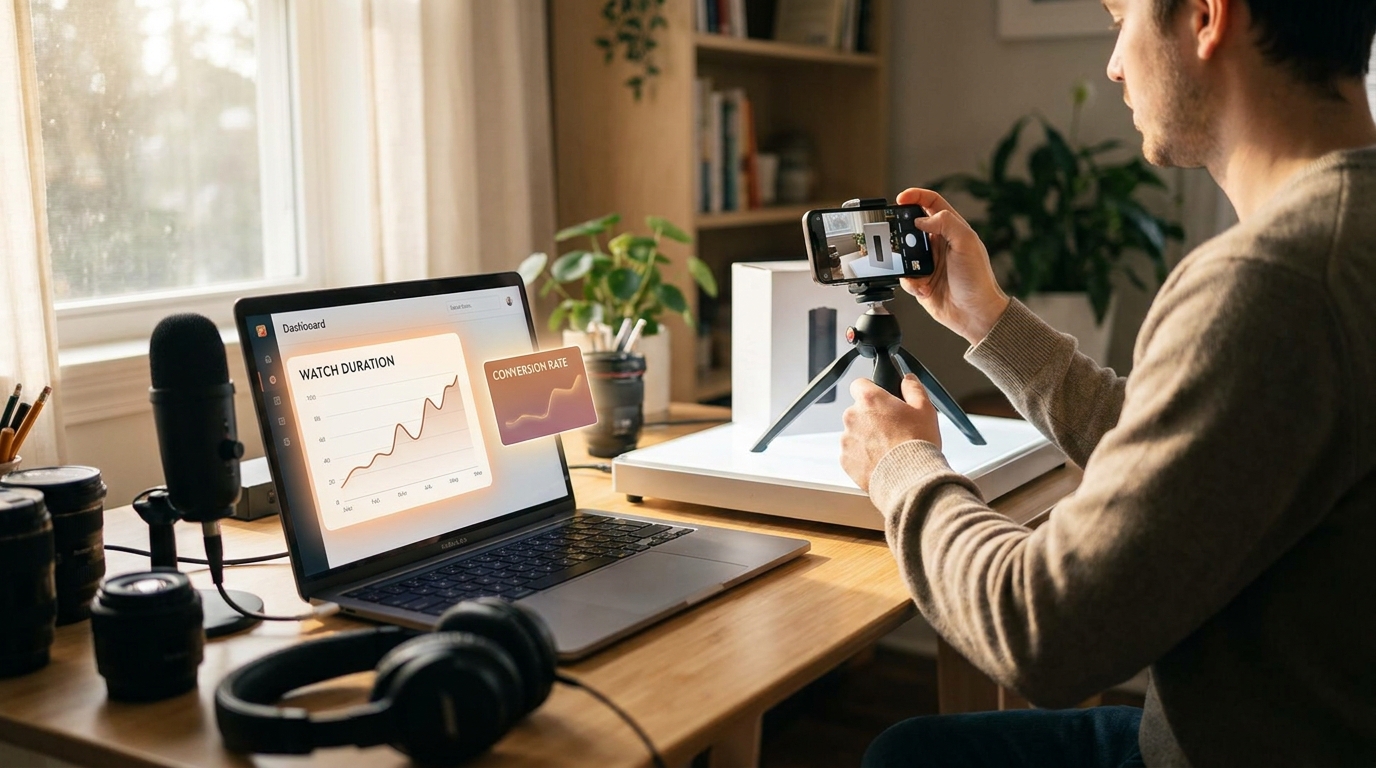
- Watch time, not conversion rate, is now the top predictor of video carousel placement on Amazon.
- Longer, value-packed videos earn more – and data shows creators climbing the ranks by optimizing for watch time, not just production quality.
- Efficient workflows, strategic product selection, and tools to repurpose content across platforms are key to sustaining high performance amid Amazon platform changes.
For years, the advice inside the Amazon Influencer Program was simple and consistent: keep your videos short, optimize for purchase clicks, and let conversion rate do the heavy lifting.
Amazon’s own onboarding materials still tell new creators to aim for 10-to-30-second clips and treat conversions as the primary success metric.
That advice is now costing creators carousel slots and income.

A data-driven shift is quietly reshaping how Amazon ranks influencer videos, and the creators who’ve caught on are pulling ahead.
The central insight: watch time is now the most powerful predictor of Amazon influencer carousel placement, outperforming conversion rate by a factor of six.
This guide breaks down what that means, why it matters, and exactly what to do about it.
What Is the Amazon Influencer Video Carousel?
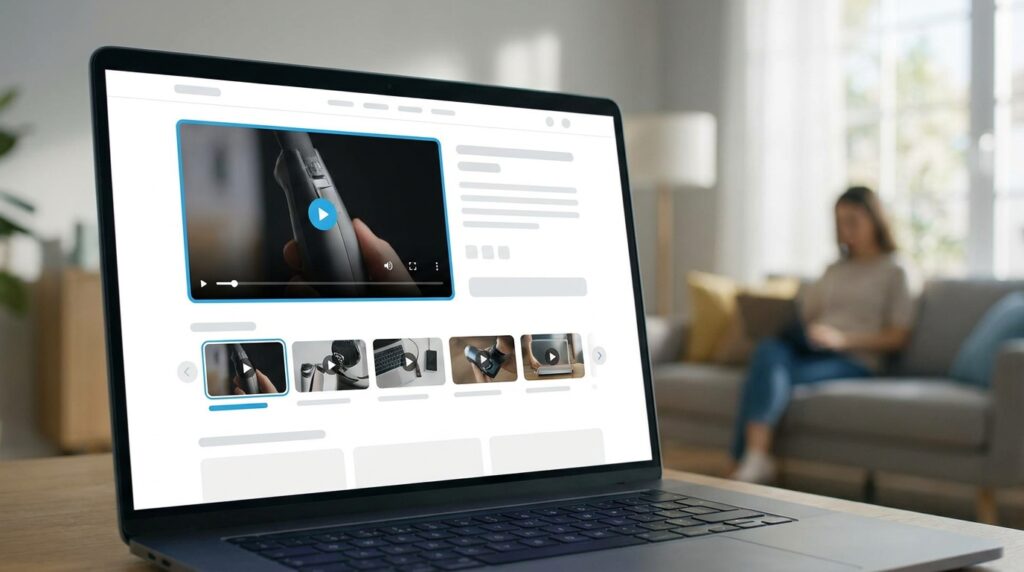
The Amazon product carousel is the row of influencer shoppable videos that appears on product listing pages, typically showing up to six video slots.
For creators in the Amazon Influencer Program, landing in that carousel, particularly in the top one or two positions, is the difference between a video that earns consistently and one that sits idle.
Unlike social media posts that fade after 48 hours, carousel placement creates compounding passive income.
A well-placed video can sit at the top of a busy product page for months, generating onsite commissions every time a viewer watches and buys.
The question is: what determines who gets those top slots?
The Research Behind the Shift: Watch Time as the #1 Ranking Signal
Claire, a data coach and six-figure Amazon influencer, surveyed over 200 active creators to find out which metrics actually correlate with carousel placement and income. Her findings, shared at a Logie Community Webinar, were unambiguous:
“THE BEST PREDICTOR OF CAROUSEL PLACEMENT IS ACTUALLY WATCH TIME, HOW LONG YOUR VIDEOS GET WATCHED… THE VIEW DURATION, THIS WATCH TIME, IS A 6 TIMES BETTER PREDICTOR OF CAROUSEL PLACEMENT THAN THE CONVERSION RATE IS.” Claire, Logie Community Webinar
Six times better. That’s not a minor tweak to the formula; it’s a signal that the entire framework most creators are optimizing for is pointed in the wrong direction.

This finding aligns with a platform-wide trend. Instagram confirmed in early 2025 that watch time is the single most important ranking signal for Reels.
The logic is consistent across every major content platform: algorithms reward content that holds attention, because sustained attention is the clearest signal of genuine value.
Why Absolute Watch Time Beats Conversion Rate for Amazon Carousel Ranking
To understand why Amazon’s algorithm now prioritizes watch time for carousel placement, it helps to think about what the algorithm is actually trying to solve.
It isn’t just predicting purchase intent, it’s trying to surface the most trustworthy and helpful videos for each product.
A 12-second clip with a decent conversion rate tells Amazon very little about whether viewers found it credible or comprehensive. A video that holds a viewer’s attention for two minutes tells Amazon a great deal.
Crucially, what matters is absolute watch time, total seconds or minutes watched, not completion percentage.
A two-minute video watched for 90 seconds outperforms a 15-second video watched in full. The algorithm is accumulating evidence of genuine interest, and sustained engagement is a far stronger signal than a fast click.
This is also why longer videos have more algorithmic staying power in the carousel. Each viewing session adds to a video’s cumulative watch time score, compounding its advantage over competitors over time. Short videos have a ceiling. Substantive, well-structured videos do not.
The Amazon Influencer Program in 2026: How Big Is the Opportunity?
Before getting into tactics, it’s worth understanding the scale of what’s at stake. The influencer marketing industry surpassed $38.2 billion globally in 2026, a 17% year-over-year increase, with Amazon-affiliated creator content accounting for an estimated $4.1 billion of that total.

Shoppable influencer videos now deliver a 2.4x conversion lift over standard Amazon product listing pages, with wellness and home fitness content reaching as high as 3.1x.
Amazon also introduced a tiered performance bonus in early 2026, offering a 2% stacked commission for creators generating over $50,000 in quarterly luxury beauty sales. During Prime Day 2025, Amazon doubled commission rates across 13 categories for a 20-day window.
The program rewards creators who understand its mechanics. The gap between a video in carousel slot five and carousel slot one isn’t just visibility; it’s a meaningful income difference, compounded across every product page where your video appears.
Why Amazon’s “Short Video” Advice Is Failing Creators
The irony is that Amazon’s own onboarding guidance still recommends 10-to-30-second videos, which it optimizes for the wrong metric.
A 15-second clip may complete cleanly, but it gives the viewer almost no time to build trust, understand the product, or get real questions answered. It barely qualifies as a recommendation.
The creators climbing the carousel rankings are making 2-to-5-minute videos. Not because they’re padding time, but because that’s how long it genuinely takes to cover a product properly, walking through real buyer concerns, comparing alternatives, and providing the context that turns a browsing shopper into a confident buyer.
This mirrors what YouTube creators figured out years ago: longer watch times translate directly to deeper trust and stronger buying intent. Amazon’s algorithm is now catching up to the same reality.
Claire’s framework for structuring longer videos without losing engagement is worth following:
“Start engaging, start providing value as quickly as you can, no long, drawn-out intros. But then, your outro… You can recap, add a story, comparison, extend the value, and watch time.“

The structure is: hook fast, broaden slowly. Open with the most immediately useful thing someone researching this product needs to know.
Then earn the extended watch time by layering in a product comparison, a use-case story, or a note on who this product isn’t right for.
These aren’t fillers; they’re the substance that turns a 45-second clip into a two-minute resource and a two-minute resource into consistent carousel placement.
How to Boost Amazon Video Watch Time: 5 Actionable Strategies
1. Open with Immediate Value No Long Intros
The first 10 seconds determine whether someone keeps watching. Skip the introduction, the channel plug, and the “today I’m going to be reviewing…” preamble.
Lead with the most important thing about the product. You can earn the viewer’s patience after you’ve already earned their attention.
2. Use Amazon Reviews to Script Real Buyer Questions
The Q&A and review sections on any Amazon product page are free research into exactly what buyers want to know.
Before filming, identify three or four recurring questions or concerns from the reviews. Answer them directly in your video.
You’re no longer guessing at content; you’re providing documented answers to documented concerns, which is precisely the kind of substance that drives sustained watch time.
3. Build Toward a Longer Outro Recap, Compare, and Extend
The outro is where most creators leave watch time on the table. Instead of ending abruptly, use the final 30-60 seconds to recap key points, add a brief comparison to a competing product, or share a personal use-case story.
These additions feel natural when the opening is tight, and they meaningfully extend average view duration without diluting the video’s quality.
4. Batch Film to Sustain Output Without Burnout
The Amazon carousel algorithm rewards consistent output as well as quality. Top earners are shooting 4-5 videos per session in a single dedicated block, rather than treating each video as a separate production event.
This reduces setup friction, prevents creative burnout, and builds a backlog that keeps income flowing even during slower filming weeks.
Creators who pre-loaded at least 40 product videos in October 2025 saw significantly less income volatility across the following four months compared to those who uploaded reactively, reinforcing that volume and consistency are as important as individual video quality.
5. Prioritize Products with Natural Watch Time Depth
Not all products are equal for watch time. Items with genuine complexity, multiple use cases, common buyer questions, and comparison angles against alternatives naturally support longer, more engaging videos.
Strategic product selection means choosing items that give you something real to say, rather than chasing every free product offer that comes your way.
Workflow and Efficiency: The Habits of High-Earning Amazon Influencers
The tension most creators don’t address openly: the platform rewards output as much as it rewards quality. Not sloppy output but authentic, consistent, timely content.
Multiple creators in Claire’s community surfaced the same pattern: hours spent obsessing over editing rarely produced proportional improvements in performance. As one participant noted during the webinar,

“It was so easy to spend 10 hours a week learning without actually making videos.”
The highest-earning creators have shifted from measuring views per video to measuring dollars per hour. That reframing changes everything about how a workflow gets built:
Batch filming reduces daily setup friction and builds a content inventory
Cross-platform repurposing turns each recording into multiple income streams. The same video can be reworked for YouTube, cut for Instagram Reels, or adapted for TikTok
Strategic product selection focuses filming time on high-commission, high-watch-time categories rather than scattershot volume
Delegating editing tasks frees creator time for the one activity that actually drives income: filming more videos
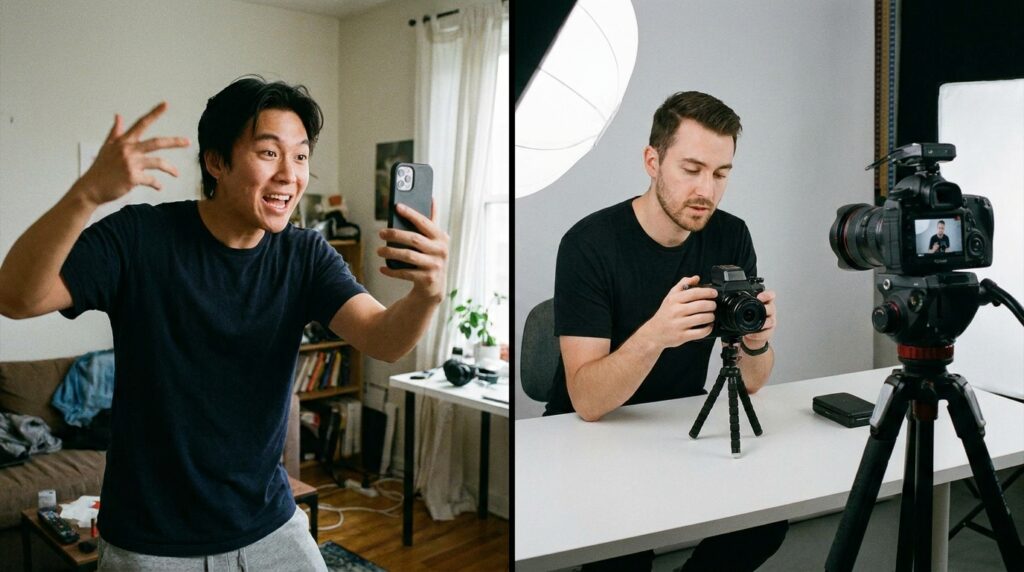
The data confirms that authentic, slightly rough videos routinely outperform over-edited clips because they signal credibility.
You don’t need a studio setup. You need a clear, substantive take on a product and the discipline to film it consistently.
Amazon Influencer Carousel Placement: Frequently Asked Questions
Does Amazon still pay commission if someone watches less than 30 seconds?
Amazon’s commission triggers when a viewer watches at least 30 seconds of your video before purchasing.
For videos under 30 seconds, the entire video must be watched to trigger commission eligibility. This is an additional reason to build videos longer than 30 seconds: it broadens your commission-eligible audience and increases watch time signals simultaneously.
How many videos do I need to start earning consistently?
Most consistently earning creators have 50-200 live videos across a range of products. Volume matters significantly — creators who maintain larger video libraries see more stable monthly income because carousel placement across multiple products diversifies their exposure.
Is conversion rate still worth tracking?
Yes, conversion rate still matters for understanding which products resonate with buyers and for informing product selection.
But it should not be the primary optimization target for carousel ranking. Watch time is the lever that determines placement; conversion rate is the outcome that tells you which placements are worth keeping.
What video length is optimal for Amazon carousel placement in 2026?
Based on current creator data, videos in the 2-to-5-minute range are consistently outperforming shorter content for carousel placement. The sweet spot for most product categories appears to be around 2-3 minutes, long enough to demonstrate authority and generate meaningful watch time, short enough to maintain viewer engagement throughout.
How does Amazon’s algorithm decide carousel order?
Amazon has not publicly disclosed its exact ranking criteria for influencer video carousels.
Based on creator survey data and observed performance patterns, watch time (absolute view duration), video quality, and relevance to the product all appear to be significant signals. Conversion rate appears to play a smaller role in carousel ordering than many creators previously assumed.
What to Do This Week
The gap between reading data and acting on it is where most creators stall. Here’s the shortest path from this article to a better placement:

Audit your last five videos for average view duration, not completion rate, but total seconds watched. If they’re all under 60 seconds, that’s the first thing to address.
Try the start-fast, end-slow structure on your next video. Open with the single most useful thing you know about the product. Then add a comparison, a personal story, a note on who this product isn’t for. Notice how naturally it extends to two minutes.
Pull three buyer questions from the Amazon reviews before filming. Answer them directly. You’ll fill time with substance rather than padding, and the video will be more useful to the exact audience already considering the product.
Block a two-hour batch filming session this week. Shoot four or five videos back to back. Measure the experience against your usual workflow. Most creators who try it don’t go back.
The Bigger Picture for Amazon Influencers in 2026
The Amazon Influencer Program has matured into a legitimate content-commerce channel, one with a sophisticated algorithm that increasingly mirrors the logic of every other major platform: reward content that earns sustained attention, not just fast clicks.
The old playbook kept it short; chase conversions made sense in a simpler system. That system has moved.
The creators who hold top carousel positions in 2026 and beyond will be those who’ve understood that watch time is the primary ranking lever, and who’ve built workflows designed to generate it efficiently and consistently.
The opportunity is real, the data is clear, and the gap between creators who’ve adapted and those still following outdated advice is only widening.