


- Facebook just rolled out deep Amazon Influencer integration, now enabling shoppable Reels and posts with direct affiliate links – if you hit the 5,000-follower threshold.
- Early access is spotty, but real creators are sharing first impressions, best practices, and the small print on using business pages vs. personal profiles.
- This is a big move for diversifying sales channels, but there are several pitfalls – tech bugs, follower gates, and confusion about where (and how) banners actually work.
For years, Facebook has sat in a strange position within the creator ecosystem.
Content performed there. Communities existed there. But when it came to driving actual purchases, most creators looked elsewhere.
TikTok dominated discovery, Instagram handled brand positioning, and YouTube carried long-term conversion.

Facebook was rarely where sales happened.
That is now changing.
Meta’s 2026 rollout of Amazon affiliate integration introduces something fundamentally different: the ability to embed shoppable products directly into Facebook content.
This shifts Facebook from being a passive distribution layer into an active transaction channel, where the gap between seeing a product and buying it is significantly reduced.
What the Meta × Amazon Integration Does
The feature allows creators to:
- Link their Amazon Influencer account to Facebook
- Tag products directly in Reels and posts
- Display a clickable shopping banner within the content
- Send users directly to Amazon with affiliate attribution
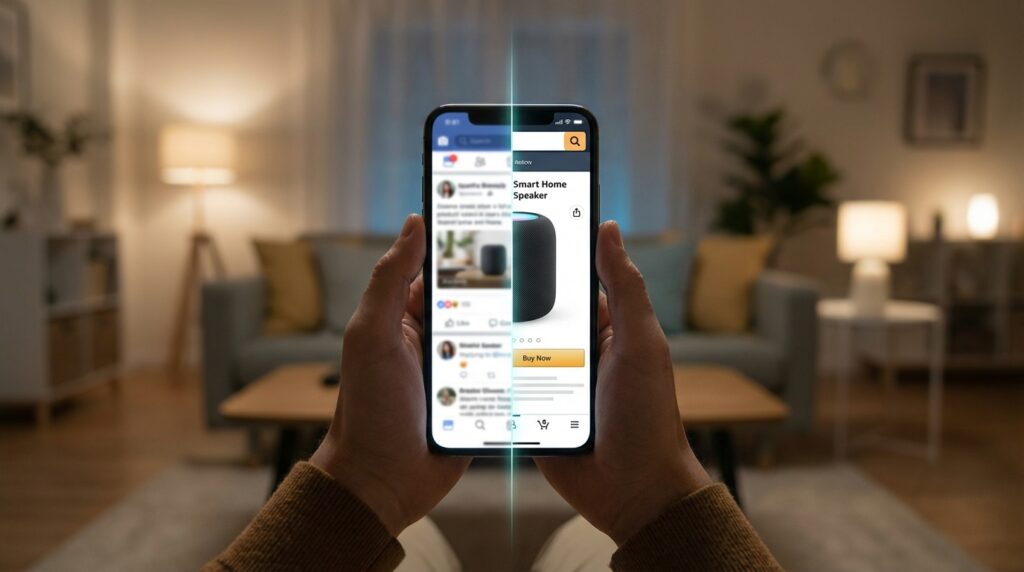
Instead of sending users through multiple steps, the journey becomes:
Content → Tap → Amazon → Purchase
This is a significant improvement over traditional affiliate workflows, which rely on:
- link-in-bio
- comment links
- external landing pages
Each of those steps introduces friction, and friction reduces conversion.
Meta’s approach removes those barriers by embedding the purchase path directly into the content experience.
For a foundational playbook on how to maximize Amazon earnings, revisit How to Make Money as an Amazon Influencer. This integration now brings many of those tactics to Facebook’s billion-plus audience.
Eligibility, Setup, and Current Limitations
The feature is not universally available yet.
To access it, creators typically need:
- A Facebook business page or professional profile
- An active Amazon Influencer account
- Approximately 5,000 followers (based on early rollout conditions)
Setup is handled through:
Meta Business Suite → Monetization → Affiliate Partnerships
Once connected, product tagging becomes available within eligible content formats.

Current Limitations to Be Aware Of
The rollout is still evolving, and several constraints exist:
- Feature access is inconsistent across regions and accounts
- Shopping banners may not appear on desktop
- Some users report delayed activation even when eligible
- The feature is currently limited to Reels and posts, not Groups or all surfaces
These limitations mean that early results can vary significantly between creators.
Why This IS Important
Social commerce has always been a game of reducing steps.
Every additional action required from a viewer, clicking a link, opening a new page, searching for a product, creates a drop-off point.
Meta’s integration directly addresses this:
“The easier it is for someone to go from ‘that looks useful’ to ‘I bought it,’ the better the odds of conversion.”
By embedding the shopping interaction into content itself, Meta is not just adding convenience; it is capturing intent at the moment it appears.
Logie’s Creator community, never shy about testing new tools, has already begun sharing on-the-ground impressions. As host, Ileane Smith explained in a recent community call:
“CONNECT YOUR AMAZON INFLUENCER AND FACEBOOK ACCOUNTS. WOW! ISN’T THAT COOL? BECAUSE, as I SAID, I KNOW A LOT OF YOU GUYS USE FACEBOOK… ENHANCE YOUR FACEBOOK REELS AND PHOTOS WITH A TAPPABLE SHOPPING BANNER.”

What does this change for the Creator Strategy?
The introduction of in-content shopping does not automatically increase revenue. What it does is change where performance is determined.
Previously, conversion depended heavily on:
- external navigation
- link placement
- user patience
Now, performance depends more on:
- content clarity
- product relevance
- audience intent
This shifts responsibility back to the creator.
What Content Works Best in This Model
Not all content benefits equally from embedded commerce.
The formats most likely to perform share three characteristics:
1. Clarity
The viewer immediately understands:
- What the product is
- What problem does it solve

2. Intent Alignment
The content targets viewers who are already:
- considering a purchase
- comparing options
- solving a specific problem
3. Immediacy
The value is communicated early, not delayed.
High-Performing Content Formats
- Product demonstrations
- Before-and-after transformations
- Comparisons (“this vs that”)
- Short, structured recommendations
- Problem-solution hooks
These formats naturally support the next step: clicking to buy.
The Role of Scripting in Shoppable Content
One common misconception is that adding a clickable product removes the need for persuasion.
It does not.
If users do not notice or understand the product, they will not engage with it.

Creators should:
- clearly mention the product
- explain its value in context
- guide the viewer toward action
This becomes even more important because:
- banners may be subtle
- Visibility varies across devices
What About Earnings and ROI?
At this stage, there is limited public benchmark data on conversion rates for Facebook-Amazon integration specifically.
However, one thing is clear:
The advantage of this feature is not higher commission rates.
It is better conversion conditions.
- Fewer steps
- Stronger intent capture
- Cleaner attribution
This creates the potential for improved performance but does not guarantee it.
Where Facebook Fits in a Modern Commerce Stack
This integration does not replace other platforms. It complements them.

A more accurate model looks like this:
- YouTube → builds intent and trust
- Facebook → reduces friction and captures action
- Amazon → completes the transaction
This multi-platform approach is increasingly necessary because:
- No single platform is stable enough to rely on alone
- Audiences behave differently across environments
Who Benefits Most From This Feature
The creators most likely to benefit are those whose content naturally supports product consideration.
This includes:
- home and lifestyle creators
- beauty and wellness creators
- tech and accessories reviewers
- parenting and practical content creators
It also applies strongly to:
- review-based content
- curated recommendations
- “best of” or comparison formats
These content types align closely with purchase-ready audiences.
Who Should Be Cautious

This feature is not a shortcut to monetization.
Creators should avoid over-relying on it if:
- They are below the eligibility threshold
- Their content is not product-focused
- They have not yet built audience trust
Direct shopping tools amplify:
- strong positioning
- clear recommendations
They do not compensate for weak audience relationships.
Key Pitfalls to Watch
As with any early-stage feature, there are risks:
Access and Rollout Issues
Not all creators have access yet, even if they meet requirements.
Visibility Challenges
Shopping elements may not be prominent enough to drive passive clicks.
Overuse
Tagging too many products can reduce trust and content quality.
Platform Volatility
Meta has changed commerce features before and may continue to iterate rapidly.

What Creators Should Do Now
A measured approach is the most effective.
- Test Early
Early adoption creates a learning advantage.
- Focus on Intent-Driven Content
Not all content should be shoppable; only content that supports buying behavior.
- Integrate, Don’t Isolate
Use Facebook as part of a broader system, not a standalone strategy.
- Track Practical Metrics
Focus on:
- clicks
- product interest
- conversion patterns
Rather than vanity metrics like views alone.
Embedded Commerce Is the Direction
Meta’s integration with Amazon is part of a larger trend.
Across platforms, we are seeing:

- product tagging
- in-content shopping
- Reduced friction between discovery and purchase
This is not temporary.
It represents a shift toward embedded commerce, where:
- Content and transactions happen in the same environment
- creators operate across the full funnel
- platforms compete on conversion, not just attention
Conclusion
Meta × Amazon integration marks a meaningful evolution in how creators monetize content.
It does not eliminate the need for strategy.
It does not guarantee higher earnings.
But it does introduce a more efficient path between:
- attention
- intent
- and action
For creators who understand how to align content with that path, the opportunity is clear:
Less friction. Better attribution. Stronger conversion potential.
And in an ecosystem where stability is increasingly rare, that alone makes this channel worth serious attention.