


- YouTube’s 2026 Shopping upgrades – auto-product-tagging, auto-dubbing, and affiliate links – empower product creators to reach more buyers (with just 500 subscribers).
- Set up is straightforward, but optimizing workflow (SEO, language selection, video structure) is key for maximum commissions and cross-border sales.
- Early Logie community adopters confirm: Multi-platform, automation-driven distribution is the edge for future-proofing revenue and brand discovery.
For years, YouTube was where people went to understand products, compare options, and build trust before making a purchase somewhere else.
The platform’s value was in influence, not in transaction. Creators shaped intent, but they didn’t always capture it.
That separation is now disappearing.

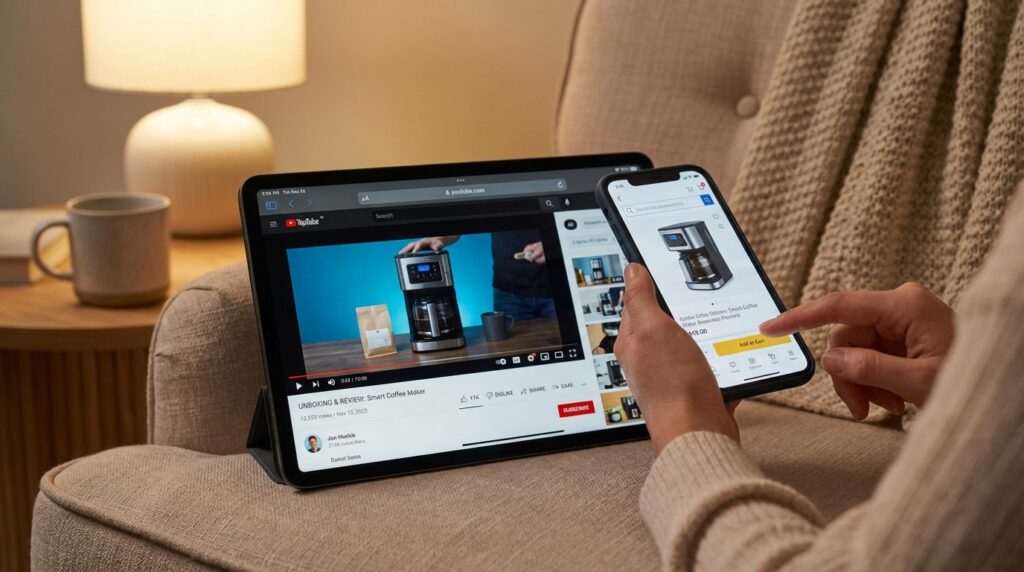
With YouTube Shopping features, auto-product tagging, affiliate links, and automatic dubbing, the platform is no longer just influencing buying decisions.
It is actively participating in them. The distance between seeing a product in a YouTube video and making a purchase through that same video has been reduced to almost nothing.
This is important because in digital commerce, conversion friction directly impacts revenue. The more steps between intent and action, the more drop-off. YouTube is systematically removing those steps.
And once a platform controls both attention and transaction, it stops being a content platform and becomes a creator commerce infrastructure.
Lower Barriers, But a Different Kind of Competition
At first glance, lowering the entry requirement to 500 subscribers for YouTube affiliate shopping feels like an accessibility win. And it is, but not in the way most creators think.
As Ileane said :
“YOUTUBE HAS LOWERED THE REQUIREMENTS FOR THE YOUTUBE AFFILIATE SHOPPING PROGRAM. NOW, YOU ONLY NEED 500 SUBSCRIBERS… AUTO-TAG YOUR PRODUCTS ONTO THE VIDEO FOR YOU.”
This removes the traditional “wait until you’re big enough to monetize YouTube” barrier. But what replaces it is its performance expectation.
When everyone can access YouTube monetization tools, differentiation becomes harder.
You’re no longer competing on access. You’re competing on:
- How clearly you position products in your videos
- how well your content aligns with YouTube search intent
- how consistently you produce structured, monetizable content
And this is where many creators misread the opportunity. They see lower barriers and assume easier wins.
In reality, the YouTube affiliate marketing system is shifting toward rewarding those who can operate with structure and intent.
What this means in practice:
- Smaller YouTube creators can earn affiliate revenue, but only with clear positioning
- Subscriber count matters less than content clarity and intent alignment
- Execution discipline becomes the primary growth driver
Stop thinking in terms of “growing a YouTube channel before monetizing.” Start thinking in terms of monetizing every piece of content through structured YouTube Shopping workflows.
Auto-Tagging on YouTube
Auto-product tagging on YouTube is often described as a convenience feature. That’s misleading.
It fundamentally changes how YouTube content converts into sales.
When YouTube scans your video through speech recognition, visual detection, and contextual AI, it is not just identifying products.
It is connecting viewer intent directly to purchase opportunities within the video experience.
- AI product tagging picks up both spoken product mentions and visuals
- It may tag related or “close match” products automatically
- More tagged products can increase affiliate monetization opportunities

This introduces a shift most creators don’t expect.
Creators tend to optimize for control:
- “I only want to tag this specific product.”
But YouTube’s system optimizes for:
- maximum product discovery and monetization pathways
Creators who over-optimize for precision in product tagging may reduce their earning potential. YouTube’s system rewards coverage and context, not just accuracy.
What this means for YouTube content strategy:
- If product names are not clearly spoken, tagging accuracy decreases
- If products are not visible, AI detection weakens
- If content lacks structure, monetization becomes inconsistent
Recommendation for YouTube Shopping optimization:
- Mention product names clearly within your video
- Show products intentionally, not passively
- Structure videos so products are introduced early
- Allow broader tagging where relevant to increase conversion pathways
Auto-Dubbing on YouTube:
Most creators still think in terms of:
- their YouTube audience
- their niche
- their primary language
YouTube does not.

YouTube operates as a global search engine for video content, and auto-dubbing is designed to unlock that scale.
- Dubbed YouTube videos are driving views and sales from Europe, APAC, and Latin America
- Auto-dubbing enables global reach without additional production
- Quality is increasingly reliable for monetization use
This is about scaling YouTube affiliate revenue across international markets without increasing content production costs.
A single YouTube video can now generate affiliate income across multiple languages and regions simultaneously.
Most creators are still underutilizing YouTube auto-dubbing because they think in terms of audience ownership. The platform operates on global discoverability and search indexing.
Recommendation for YouTube growth and monetization:
- Enable auto-dubbing across all supported languages
- Review translations for high-performing videos
- Focus on globally relevant products and categories
- Treat multilingual reach as a core YouTube growth strategy
How Creators Win on YouTube
The most important shift on YouTube has been creator behavior.
“I feed my Amazon videos to YouTube every single day… my backlog keeps getting bigger and bigger and bigger.”
This reflects a different way of thinking about YouTube content.
Instead of:
- creating → posting → moving on
These creators are:

- building → storing → compounding
This aligns with YouTube’s architecture:
- search-driven discovery
- long content lifespan
- persistent affiliate monetization
YouTube rewards creators who treat videos as long-term monetizable assets, not short-term content.
What this means for YouTube strategy:
- Each video increases your searchable footprint
- Each product adds to your affiliate revenue surface
- Each upload compounds future earnings potential
Recommendation:
- Build a consistent YouTube content backlog
- Repurpose Amazon and product content into YouTube
- Optimize top-performing videos regularly
- Focus on evergreen, high-intent product categories
AI Automation in YouTube Content
There is a growing assumption that YouTube’s AI features, such as auto-tagging, auto-dubbing, and automation tools, will handle monetization automatically.
They won’t.
- AI tagging works best when the content is clear and structured
- YouTube SEO (titles, descriptions, transcripts) still matters
- Top creators manually refine high-performing videos
This reveals something important:
YouTube automation amplifies structure; it does not replace it

Creators who rely entirely on automation will see inconsistent results. Creators who combine automation with intentional structure will build scalable systems.
Recommendation:
- Use automation to increase output volume
- Focus manual effort on optimizing top-performing content
- Maintain strong YouTube SEO practices (titles, descriptions, keywords)
YouTube Copyright Protection
One of the most overlooked aspects of YouTube monetization is its copyright system.
- Unauthorized re-uploads are detected
- Content misuse is flagged
- Creators have documentation for enforcement
This gives creators something rare in the social media ecosystem:
control over how their content is used and monetized
Why is this important:
- You can track the brand usage of your content
- You can negotiate licensing and usage fees
- You retain ownership of monetizable assets
Recommendation:
- Monitor your YouTube copyright dashboard regularly
- Track unauthorized usage
- Use this data to strengthen brand negotiations

YouTube Is Becoming the Center of Affiliate and Product Monetization
This is a shift in how creator revenue is generated.
From:
- content → exposure → external conversion
To:
- content → discovery → direct conversion inside YouTube
The creators who will win in this environment are not:
- the most viral
- the most aesthetic
- the most active
They are the ones who:
- understand YouTube Shopping and affiliate systems
- structure content for discovery and conversion
- build repeatable monetization workflows
- treat videos as scalable revenue assets
Because the shift is already clear:
YouTube is no longer just a video platform. It is a global affiliate commerce engine
And the difference between creators who earn occasionally and those who build a consistent income will come down to one thing:
Whether they are uploading videos or building monetization systems on YouTube.