


Ads, Policy & The Hidden Hierarchy
What creators need to know about uneven enforcement, paid promotion rules, private equity deals, and how to protect their business
TL;DR Quick Strategy

▶ Amazon’s ad and promotion policy is selectively enforced. Top creators often get privileges that regular creators simply cannot access.
▶ Large private equity and agency deals mean financial muscle and compliance teams sometimes trump talent and ethics.
▶ To stay safe and profitable, understand your terms, document every permission, and diversify across platforms. Never depend on Amazon alone.
A Tale of Two Rule Books
The Amazon Influencer Program once promised a level playing field where the best content won, and the rules were the same for everyone. That promise has quietly eroded.
Today, a handful of top creators run ads to their livestreams, Storefronts, and videos without consequence, while most influencers, especially those newer to the game, risk account penalties for doing the exact same thing.
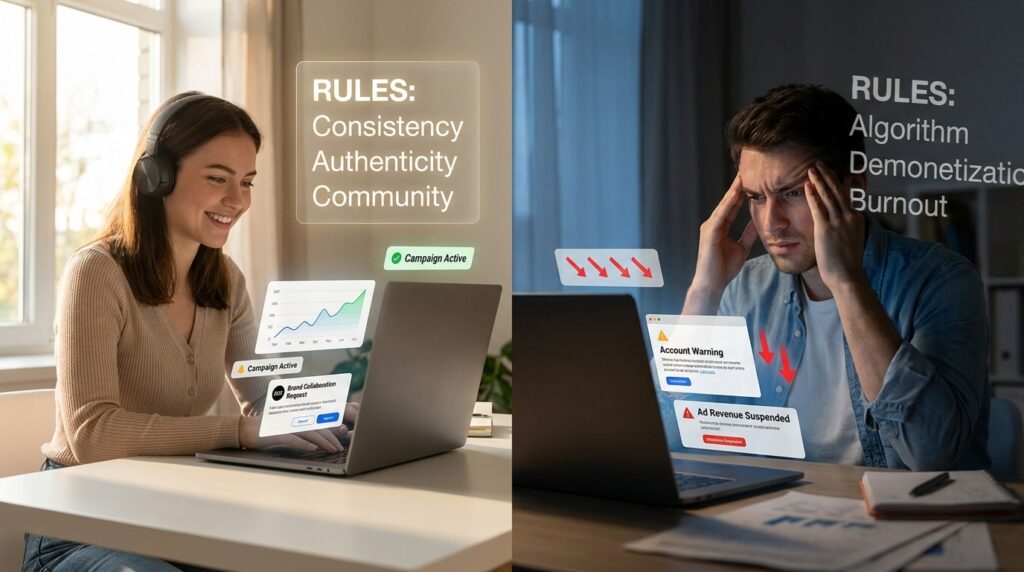
The result? Confusion, resentment, and a steady stream of public callouts across creator communities.
When you see someone doing something Amazon supposedly prohibits, it’s natural to wonder: are they cheating, or do they simply have a deal you don’t know about?
| “THERE ARE DIFFERENT RULES FOR DIFFERENT PEOPLE IN THIS PROGRAM. YOU SEE THEM DOING IT BECAUSE THEY HAVE PERMISSION! … WHEN WE SEE SOMEONE DOING SOMETHING THAT AMAZON HAS SAID WE CAN’T DO, YOU KNOW, THERE’S THAT LITTLE PIECE THAT SAYS ‘WITHOUT PERMISSION, OR WITHOUT AUTHORIZATION.’ Ileane Smith, Amazon Influencer |
Seasoned community members have watched top earners receive dedicated Amazon account managers, negotiated contract addenda, and pilot program invitations while everyone else is left second-guessing vague, ever-changing terms of service.
The Official Creator Ads Framework
To be clear: Amazon does have an official, legitimate ad program for influencers. The Creator Ads program and its sub-feature, Creator Ads Boost, allow Amazon Influencer Program members to have their best content extended across social platforms like Facebook, Instagram, TikTok, Pinterest, Snapchat, and Reddit.
Here’s what the official policy actually says: Influencers can opt in or out of Creator Ads at any time.
Amazon uses its own ad budget to amplify your content, and you earn commission income on resulting sales, grouped into your standard on-site commissions.
Creator Ads Boost, meanwhile, is currently focused on Instagram Stories for members who have authenticated their Instagram handle to their Amazon Influencer Program account.
The critical distinction and the source of most community confusion is this: Amazon runs these ads on your behalf using Amazon’s budget.

Creators themselves running paid ads to their own storefronts or content, using personal ad spend, is a completely separate (and far more legally murky) situation.
| Key Distinction: Who’s Running the Ads?Official Creator Ads: Amazon boosts your content using Amazon’s budget. Opt-in, commission-based. This is allowed. Self-funded Storefront Ads: A creator personally running paid ads to their own storefront or livestream. This is where policy gets grey, and enforcement gets uneven. Third-Party Ad Boost Services: External agencies or private equity groups offering to buy ads on a creator’s behalf. This is where serious compliance risk lives. |
Where Private Equity Enters the Picture
The drama extends well beyond influencer hierarchies. Some creators have described being approached by private equity funds and agencies offering to pour serious money, we’re talking six figures per month, into ad campaigns on their content, in exchange for a cut of any Amazon bonuses generated. It sounds lucrative. But the compliance question is where things unravel.
| “WE WERE APPROACHED BY A PRIVATE EQUITY FUND … RUNNING A GROUP WHO WOULD PUT UP TO 6 DIGITS A MONTH OF ADS ON OUR CONTENT … THEY WANTED A PERCENTAGE OF WHATEVER BONUS WE GOT FROM AMAZON. BUT WHEN IT CAME TO COMPLIANCE, NOBODY WOULD PUT IN WRITING THAT IT WAS AMAZON COMPLIANT … SO WE NEVER DID THE DEAL. Doug, Review Business Academy |
That’s the tell. Any agency or fund genuinely operating within Amazon’s rules should have no problem confirming compliance in writing.
When that confirmation never comes, it’s because they can’t give it. Creators with large legal teams or inside relationships sometimes proceed anyway, betting that their revenue footprint makes them too valuable for Amazon to penalize. For most creators, that bet is not worth making.
Understanding the Tiered Creator Ecosystem
Amazon’s Creator Stars program, launched in August 2024, makes the tiered nature of the program explicit. Creators earn points based on shipped revenue and link clicks, and are sorted into Bronze, Silver, Gold, and Platinum tiers.

Each tier unlocks progressively better benefits: early access to deals, seasonal gift boxes, event invitations, and even the ability to co-design Amazon Private Brand products at the Platinum level.
This formal tier structure helps explain partially why some creators appear to operate under different rules. Higher-tier creators have more direct relationships with Amazon’s internal teams, more access to pilot programs, and more leverage to negotiate contract addenda.
That access is real, and it is earned through performance. What it does not mean is that the rules themselves are different: it means those creators have negotiated specific written permissions that most creators have not.
The community frustration is valid. When those permissions are not publicly disclosed, and when other creators observe behavior that appears policy-violating, the natural assumption is that there’s favoritism at play. Sometimes there is. Sometimes, there’s simply a written agreement the observer doesn’t know about.
The Policy Landscape Is Tightening
Amazon has updated the Associates Program Operating Agreement multiple times between late 2024 and 2025, often via help page edits rather than loud announcements.
Three major shifts stand out: stricter intellectual property enforcement (no more modified logos or screenshots from product pages), changes to commission calculations and category eligibility, and expanded ineligible product categories that can quietly eliminate a creator’s top earners overnight.
Enforcement is increasingly automated. Amazon’s policy now explicitly reserves the right to monitor, crawl, and investigate your content and to permanently withhold commissions if the platform considers you in breach.
The shift from manual review to algorithmic enforcement means even well-intentioned creators can get flagged without warning, and appeals are slow.

The FTC adds another layer. Disclosure requirements for affiliate content are non-negotiable, and both Amazon and external regulators are paying closer attention.
Compliance has quietly become one of the most important competitive advantages a creator can build. Creators who treat it as an afterthought are increasingly the ones who lose accounts or commissions without understanding why.
What Smart Creators Are Doing Right Now
The creators who are weathering policy changes and community drama without losing their income share a few consistent habits:
• Investigate before you copy. Before copying a strategy you see another creator using, research whether they’ve publicly acknowledged specific permissions. Ileane Smith’s point stands: if you see someone doing something Amazon says requires authorization, investigate before you imitate.
• Demand written compliance confirmation. If an agency or fund approaches you with an ad-boost offer, require written confirmation that the arrangement is Amazon-compliant. If they can’t provide it, walk away. No six-figure promise is worth a permanent account ban.
• Build loophole-free content systems. Build content workflows that do not depend on loopholes, pilot programs, or special deals you haven’t officially been granted. Evergreen, cross-platform content ages well. Exploits don’t.
• Stay active in creator communities. The Logie community, along with other trusted creator networks, often surfaces policy changes and enforcement patterns faster than official Amazon communications do. Active community membership is not a nice-to-have; it’s an early warning system.

• Treat platform diversification as non-negotiable. Amazon can change its commission structure, its category eligibility, or its enforcement posture at any time. Creators who treat Amazon as their only income source are one policy update away from a serious problem. Diversify early and continuously.
The Bottom Line
The Amazon Influencer Program is not a level playing field. It never fully was, and with the Creator Stars tier system and increasing back-channel negotiations, it is becoming less so over time. That is frustrating, but it is also manageable if you approach it with clear eyes.
The creators who thrive long-term are not the ones who find the most aggressive loopholes. They are the ones who build businesses resilient enough that no single platform update can collapse their income.
They document everything, ask before they act, and compete not by copying insiders, but by being informed, consistent, and genuinely useful to their audiences.
When in doubt: document, ask, and protect your business. Policy knowledge is creator power.