

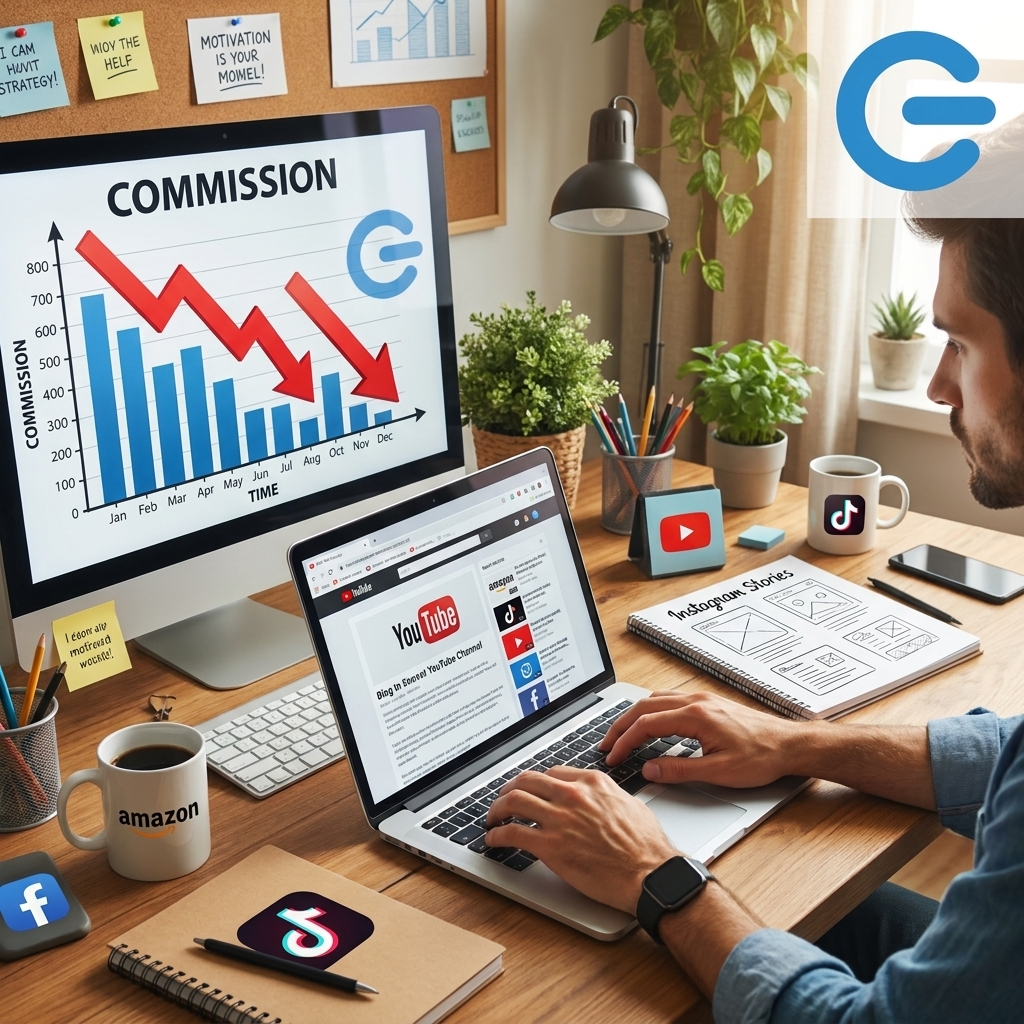
This spring, Amazon Influencer Program members woke up to a harsh new reality. Massive drops in on-site commission rates, with categories like Outdoors falling from nearly 8% to below 3%. For many creators, this wasn’t just a small adjustment, it was a direct hit to one of their most reliable income streams.
If you make a living reviewing gear, kitchenware, or health products, this shift has likely forced a rethink of how you monetize, and how stable that income really is.But Amazon isn’t alone. Target has shut down its creator program. YouTube continues rolling out new shopping and affiliate features. Even long-standing retailers are reassessing how they structure creator payouts.
In short: disruption is no longer occasional, it’s constant.

The New Rule: Off-Site Traffic Is Everything
Seasoned Logie creators have seen seismic shifts before, and their conclusion is consistent, relying only on in-platform traffic is no longer enough.
As Altovise Pelzer puts it:
“The difference is, if you talk to those who have been in the program for quite some time. We’ve already been saying, focus on off-site. Find ways to focus on off-site. What are you doing off-site? How are you bringing people to the platform?”
For years, the Amazon Influencer Program rewarded creators for simply uploading videos to product pages. But recent changes including the March 9 Reporting Reset, have made one thing clear, depending solely on on-site traffic and fixed commission structures leaves you exposed to unpredictable platform shifts.
Why Did Amazon Make These Changes?
- Shift to Incentivize Off-Site Traffic
Amazon wants creators to drive new eyeballs onto the platform, not just sell to the customers already there.
- Historical Over-Access
For years, creators benefited from easy, platform-driven “passive” on-site income with minimal need for external promotion. As a result, many neglected audience building, email list growth, and direct brand relationships. That model is now being tested as platforms tighten payouts and shift toward off-site growth expectations. - Retail Macrotrends
Across the industry, layoffs, program shutdowns, and new affiliate experiments are reshaping how creator partnerships are structured. Platforms and retailers alike are restructuring how they work with creators, shifting away from predictable commission models toward more experimental and performance-driven systems. For more context, don’t miss What Every Amazon & TikTok Creator Must Know About TOS Changes in 2025.
Community Insights: What Top Creators Are Doing Right Now
1. Aggressive Cross-Posting & Repurposing
Upload your Amazon videos to YouTube using deep links like GeniusLink and PostHat, as well as Instagram, Facebook, and TikTok. Several creators in the Logie community reported:
Uploading 500+ Amazon review videos to dedicated YouTube channels
Rapid increase in views even on channels with less than 100 subscribers, as Altovise shared:
“I started out in February, with 25 subscribers…to date, I think I have…75 followers…almost at 100,000 views.”
YouTube Shopping now requires just 500 subs for some affiliate features. See detailed playbooks in Why YouTube Affiliate Is the Next Big Creator Opportunity.
2. Pre-Promotion & Community Building
Don’t just go live on Amazon and hope for the best. Announce your livestreams days in advance across Stories (Instagram, Facebook), business pages, and your personal networks. Results show hundreds of cross-platform views versus low double digits for “silent” launches.
“I used to share my livestreams on the same day, but I noticed a big difference when I started promoting them in advance.” Altovise Pelzer
Cheryl adds
“After the show, download and upload to YouTube with timestamps. Make a shoppable list linking to the live show and each product.”
This approach turns livestreams into long-term SEO assets rather than one-time events.
3. Off-Site List Building & Web Assets
Revive Your Blog:
Blogs and owned landing pages are making a clear comeback as creators look for more stable, long-term traffic sources outside of platform dependency.
One creator in the community noted this shift directly:
“This will be the time where blogs come back into play… your landing page will be beneficial if you’re using it the proper way.”
Creators with active blogs or deal pages are now consistently outperforming those relying only on in-platform traffic. These assets continue generating search-driven traffic and conversions long after content is published.
Not sure where to start? See our guidance on content strategy in Amazon’s March 9 Reporting Reset.
At the same time, building an email list is becoming increasingly important. As social reach becomes more unpredictable, owned audience channels like email and SMS provide long-term stability and direct access to your audience.
The New Monetization Mix: Data, Deep Links, and Smart Brand Collabs
Check for dead links and out-of-stock (OOS) products in your YouTube and blog posts. Tools like GeniusLink let you re-route links to your storefront or newer, relevant products instantly, so you don’t lose attribution.
Resist oversaturated brand offers. Flooded markets lead to lower returns. Instead, analyze how many videos are already live and focus on more strategic product niches.
Pitched a brand? Advocate for your value using real performance data, like multi-channel reach and past campaign results. As Stephanie put it:
“Don’t say no, say, ‘here’s my production fee.”
Don’t sleep on LinkedIn. As brands look for business-facing influencers, this often-overlooked platform can become a strong lever when integrated into your off-site mix.
Mindset: “Don’t Freaking Quit” (DFQ)
Change often brings frustration, uncertainty, and moments of panic. The Logie community rallying cry is simple: DFQ.
“Don’t freaking quit. Because it’s still an opportunity. There are still people that are making good money. There are still people that haven’t seen such a big drop.”
The real advantage now comes from consistency and structure. Off-site traffic, owned audience lists, and repurposed content create a moat that protects your margins and helps future-proof your brand.
Not every tactic will work immediately, but the strategies outlined above are designed for iteration, not instant results. Creators who stay adaptable and consistent will continue moving forward while others wait for the old systems to return.
What’s Your Next Move?
- Audit your active revenue streams. What’s at most risk? Where is there untapped off-site upside?
- Clean your blog or landing page and post new shoppable content.
- Repurpose one Amazon video to YouTube, using a deep link. Track clicks for the next 7 days.
- Promote your next livestream or deal in Instagram and Facebook Stories two days before you go live.
- Experiment – then double down on the platform delivering your best new traffic.
Further Reading & Tactical Guides
- Amazon’s March 9 Reporting Reset: What Creators Are Losing, What Still Works, and How to Adapt
- What Every Amazon & TikTok Creator Must Know About TOS Changes in 2025
- Why YouTube Affiliate Is the Next Big Creator Opportunity
Remember: Every quarter brings a new wave of algorithm changes, policy rewrites, and tough pivots. But for those who learn, adapt, and DFQ, the creator economy remains one of the most dynamic, resilient fields today.