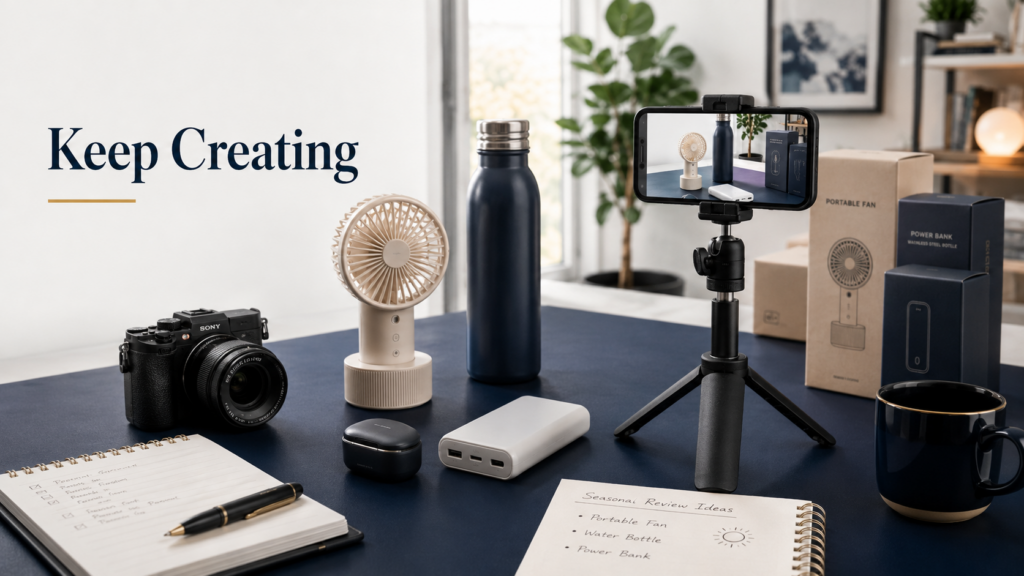


- Use your Prime Day momentum to build structured workflows now, so summer slowdowns don’t undo months of progress.
- Lean on creative prompts, a weekly research ritual, and community accountability to keep ideas flowing, even when sales numbers dip.
- Every product has an audience. If someone bought a used urn, nothing on your shelf is too niche to review.
Prime Day’s Over. Now What?
Every seasoned creator knows the pattern. The rush of Prime Day brings a flood of campaigns, packages, and spikes in both traffic and adrenaline.
Then the sales buzz fades, and even top performers find themselves dragging their feet. Productivity slips. Creative self-doubt creeps in. The question arrives on schedule, right after the last commission notification: is my work still making an impact?

The numbers say the buzz was real. This year’s event drove more than 2.5 times the amount of U.S. ecommerce sales during the full Amazon Prime Day period in 2026 than in 2020, with U.S. online retail spend growing about 9.3% year over year to $26.4 billion across the June 23 to 26 window.
Affiliates and influencers weren’t a footnote in that number either. Affiliates and influencers accounted for 21.3% of revenue, with 7% year-over-year growth, indicating that creator-driven content is now a measurable slice of one of retail’s biggest weeks.
But even record-breaking events have a shelf life. Industry trackers noted the same pattern that shows up every year: a strong Day 1 followed by lulls in purchase intent, especially by Day 3.
If your traffic and motivation dipped right along with that curve, you weren’t imagining it. You were reading the room correctly. The question is what you do next.

If you’re stuck in the post-event lull, you’re not alone, and you don’t have to stay there. The Post-Prime Day Playbook is about building a sustainable system for output, rediscovering creative spark, and leaning on your community instead of white-knuckling it alone. Altovise Pelzer, speaking to a group of Logie creators, put it bluntly:
“Remember, our workflow is important. You keep up with the workflow and let Prime Day be your momentum… If you had any reservation about any piece of content… somebody bought a used urn. You have no excuse not to create the content.” Altovise Pelzer,
Why Momentum is important
Momentum is a process. Altovise’s point cuts to the heart of something creators do to themselves constantly: tying personal worth to sales spikes and forgetting the core workflow that keeps the engine running the other 350 days of the year.
This shows up in the data. Research on the creator economy has found that burnout directly cuts into output and earnings, not just mood.
Productivity falls by 30% to 52% when creators are burned out, and mid-tier creators earning around $50,000 to $100,000 a year can lose $15,000 to $25,000 in annual income.
That’s the real cost of letting a post-Prime Day slump turn into a two-month disappearing act. A slow week doesn’t threaten your income. A pattern of stopping and restarting does.
A few things separate creators who bounce back fast from those who stay stuck:
Workflow breeds consistency, and consistency breeds results. The highest earners in the Logie community aren’t necessarily the ones with the flashiest launches.
They’re the ones with a repeatable system for reviewing, posting, and engaging week after week, whether or not there’s a sale.
Rituals create resilience. Whether it’s batching content, scheduling uploads for a set weekday, or a Friday post-Prime “reset,” these habits provide direction even on low-motivation days.
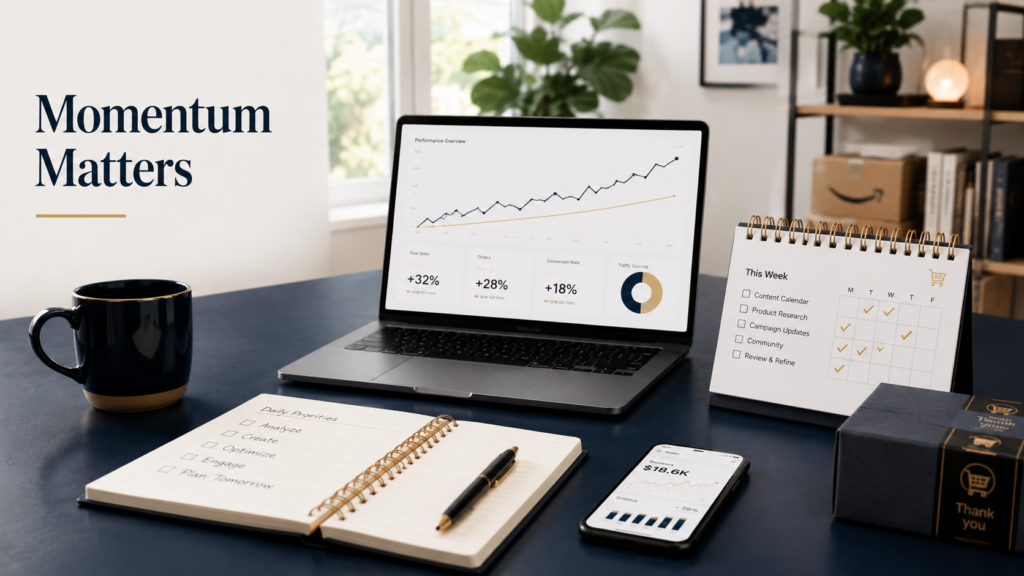
You’re not relying on inspiration to show up. You’re relying on a schedule you already built.
Peer check-ins keep you moving. As Altovise noted, the Logie Friday calls are an accountability mechanism for rebooting, laughing, and getting honest about workflow hiccups.
That kind of structure matters more than most creators admit. Recent industry data backs this up directly: creators who batch and plan report feeling 26% more confident in their planning and creative flow, and platforms that studied creator habits found that those with recurring routines reported 40% lower stress levels and 20% higher joy in creation compared to creators working ad hoc.
The Batching Habit That Prevents Burnout
Confidence in your content is one half of the equation. The other half is building a workflow that doesn’t run entirely on willpower.
This is where batching earns its reputation as the single highest-leverage habit for creators heading into a slower season.
The mechanism is simple: switching between different types of thinking, brainstorming, filming, writing captions, editing, all in the same sitting, is expensive.
Productivity research on task-switching has found that shifting between unrelated tasks can cause up to a 40% loss in efficiency, which is exactly the drain that daily, reactive posting creates.
Batching fixes this by grouping similar tasks into a single focused session, so your brain stays in one mode instead of constantly restarting.
It also builds in a buffer against the inevitable low-energy weeks. When you batch, you’re not scrambling to post something the day motivation runs out.

You already filled the pipeline when you had the energy to do it well. Marketing platforms that work directly with creators have found that even a short, planned break of one to two weeks rarely does lasting damage to an account’s reach, and that announcing a break with a return date tends to land better with audiences than disappearing without explanation.
The advice that keeps surfacing across creator-focused research: give yourself a minimum you’ll hit no matter what, and a ceiling for when you’re running hot. The minimum protects you in hard weeks. The ceiling lets you bank content when the ideas are flowing.
Practical ways to apply this right now:
- Batch and schedule. Film several product reviews in one sitting, then drip-feed the uploads over two weeks to maintain regularity, even when you’re tired.
- Run a weekly research ritual. Set a “Logie research hour” to scroll new deals and trending products. Logie’s 50% off category is a reliable place to find hidden gems worth reviewing.
- Ask the community. When you’re stuck, lean into the Logie group or DM a peer for feedback, a quick brainstorm, or even to crowdsource next week’s review topic.
- Look outside your usual niche. Scan for trending products or unbox a surprise category. Plenty of viral posts started with a creator saying they weren’t even planning to review that item.
- Celebrate small wins. Track every upload, every reply, every new comment as progress, not just commissions.
Combine these habits with heat-specific content ideas, such as fans, water balloons, pop-up tents, or rechargeable power banks, to stay relevant throughout the summer.

As Altovise put it, people are looking for those things because of what’s already going on around them, whether that’s a heat wave, back-to-school prep, or a holiday weekend.
For a deeper breakdown of building a batching system that fits your schedule, see The Batching Revolution: Why Content Creators Are All-In for Fall.
Keep the Creative Machine Turning for Fall and Beyond
Post-Prime isn’t just the “slow” season. It’s the time you invest in refining workflow, testing fresh topics, and doubling down on what makes you stand out.
That means authenticity, experimentation, and, above all, not letting opportunities pass because you talked yourself out of posting.
This is also where good tools genuinely earn their place. Power users leverage the best influencer marketing platforms to streamline research, tracking, and collaboration rather than doing everything manually.
Challenge for the week: pick one item you’ve been putting off reviewing because it felt too small, too niche, or too “un-viral.” Film it anyway. Somewhere, there’s a buyer for it. There always is.