

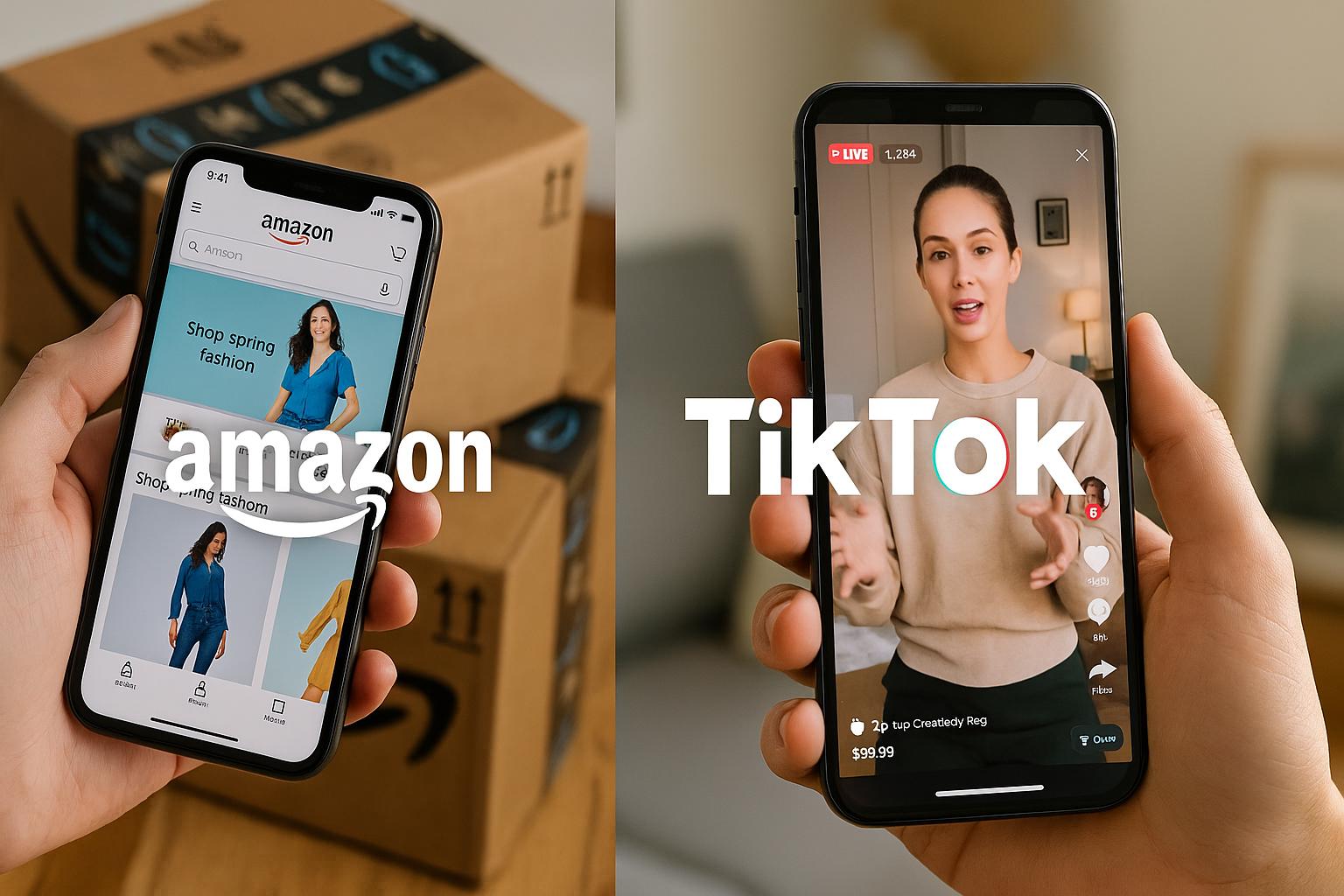
The retail landscape of 2025 is shaped by two dominant forces that serve two distinct consumer mindsets.
Amazon continues to dominate high-intent, utility-driven shopping, while TikTok Shop now leads in entertainment-driven discovery.
Understanding how and why these platforms diverge is not about choosing one over the other, but about mapping how modern consumers move between desire (TikTok) and decision (Amazon).

1. Market Reality
Amazon remains the world’s most powerful utility marketplace. Reports show it controls 40.4% of all U.S. e-commerce in 2025.
Prime households exceed 170 million, and Prime members spend an average of $1,400–$1,600 annually. Amazon’s growth remains steady because consumers use it for predictable, need-based shopping.
TikTok, meanwhile, has built the world’s fastest discovery engine. TikTok Shop global GMV grew from $4B in 2023 to a projected $60B+ in 2025, according to independent market research and additional reporting that TikTok Shop’s U.S. sales alone exceeded $500 million during Black Friday–Cyber Monday 2025
Analysts broadly agree that TikTok is not stealing Amazon’s market share; it is capturing new impulse-buy behaviors, especially among Gen Z and Millennial consumers.
2. The Psychology of Modern Buying Behavior
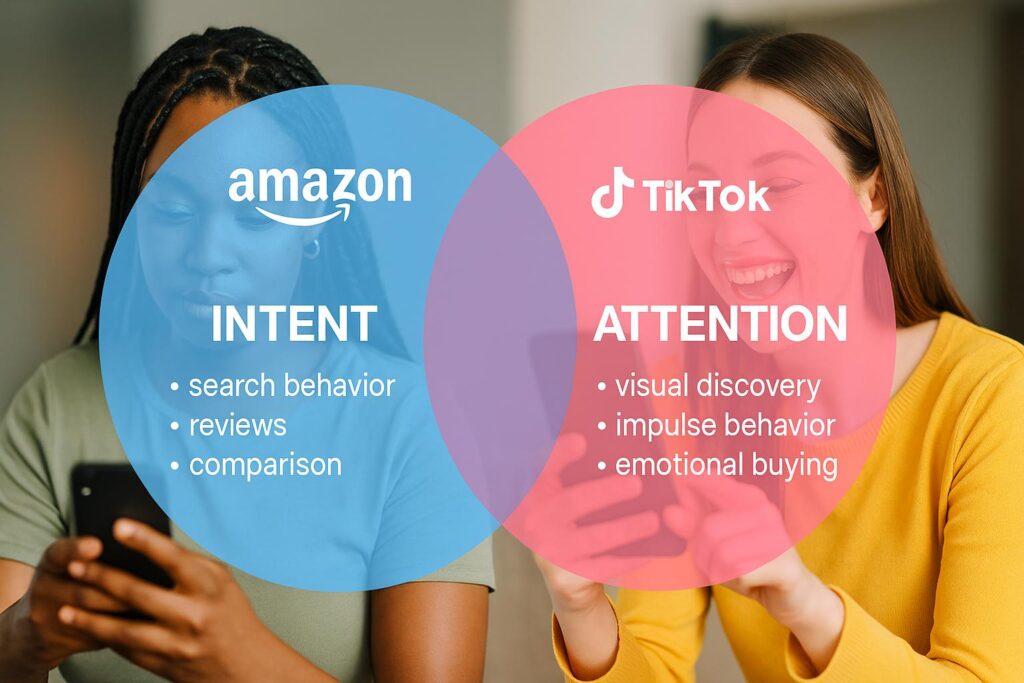
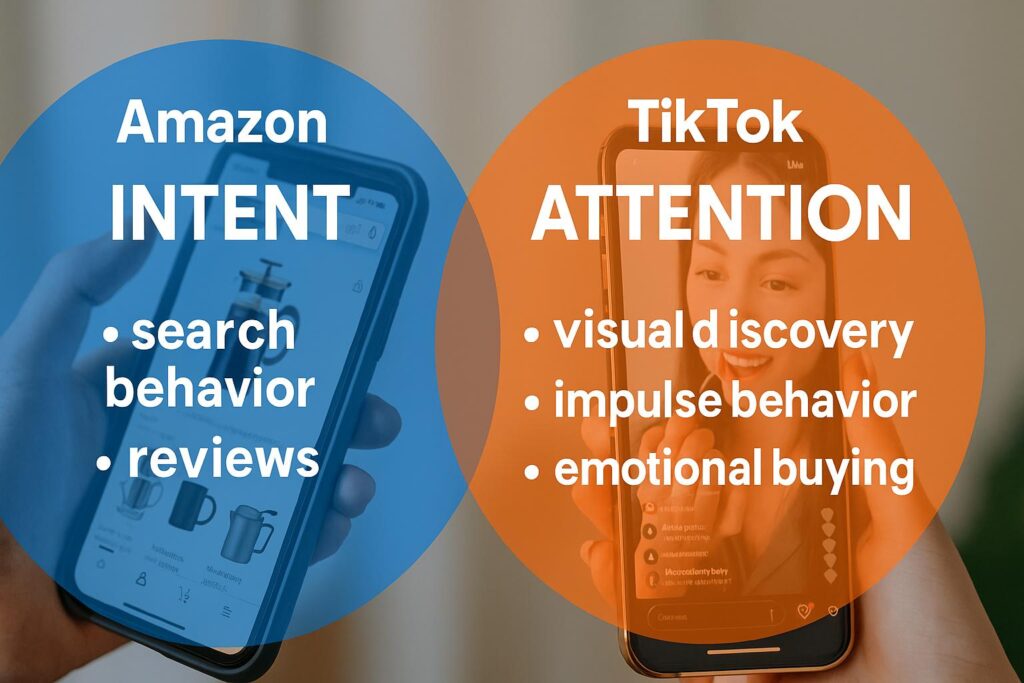
Amazon captures intent. People open Amazon because they already know they need an item and want to compare options, read reviews, verify reliability, and ensure fast delivery. This mindset leads to stable behavior patterns, predictable conversions, and longer retention cycles.
TikTok captures attention and emotion. People open TikTok for entertainment, not shopping, but the algorithm’s ability to pair creators with highly visual products makes users receptive to impulse buys.
TikTok’s strength lies in its “interest graph” and discovery-based feed, rather than in traditional search behavior.
This explains why TikTok excels in categories where visual transformation, novelty, or aesthetic appeal drive purchase decisions, such as beauty, skincare, home hacks, small gadgets, and fashion, reinforced by data from 2025 social commerce analyses.
3. ROI Breakdown
Amazon Live = High-Intent Conversion
Amazon Live’s viewers are already in a purchasing environment, often browsing similar products or checking reviews. This produces consistently strong conversion rates.
Industry benchmarks for Amazon Live range from 8–15%, far higher than those for traditional social platforms. Amazon’s 2025 enhancements, including the Amazon Creator Hub and increased placement of creator videos on PDPs, have further boosted evergreen performance.
TikTok Shop = High-Velocity, High-Volatility Discovery
TikTok Shop ROI is more explosive but more volatile. Static video conversion rates hover around 2–5%, while livestream conversions can spike to 8–30% depending on creator engagement and product fit.
Viral events can sell out thousands of units within hours. But return rates are typically higher, 15–25% compared to Amazon’s 8–12%, mainly due to impulse purchases (supported by multiple e-commerce sentiment analyses from 2024–2025).
This is why TikTok is best measured on:
- CPM
- New-to-Brand reach
- Velocity of impressions
- TikTok-to-Amazon search lift
But Amazon should be evaluated on:
- ROAS
- AOV
- LTV
- Repeat purchase rate
Each platform requires a different ROI mindset.
4. Logistics
FBA remains the most robust logistics infrastructure in Western e-commerce. It is reliable, predictable, and universally trusted.
Amazon’s fulfillment guarantees next-day or same-day delivery across most major regions and handles returns, repackaging, and customer service, which are primary reasons Amazon maintains market dominance.
Fulfilled by TikTok (FBT)
FBT is improving rapidly but remains strict. TikTok requires:
- ≥80% on-time dispatch (48 hours)
- ≤5% seller-fault cancellation rate
Accurate, real-time inventory
Failure results in algorithm suppression or temporary shop penalties, a widely documented pain point among TikTok sellers in 2025 social commerce reviews.
This is why many brands secretly use Amazon MCF to fulfill TikTok Shop orders.
5. Creator Dynamics
TikTok creators thrive on:
- fast hooks
- emotional resonance
- humor
- aesthetics
- trend participation
Amazon Live creators excel in:
- explanation
- detail
- structure
- Q&A
- product comparisons
Expecting a single creator to perform equally well on both platforms is unrealistic. This is supported by multiple influencer-economy studies showing that creator performance is platform-specific rather than universal.
6. How TikTok and Amazon Influence Each Other
When a product goes viral on TikTok, Amazon search volume typically spikes, a pattern documented across multiple brands and highlighted in 2025 e-commerce trend reports. Users verify:
- legitimacy
- reviews
- pricing
- shipping speed
TikTok creates curiosity. Amazon captures trust.
Amazon → TikTok Validation Loop
The reverse is also true: users who see a product on Amazon go to TikTok to watch real people demonstrate it or check trends associated with it. This creates a complete psychological cycle of emotional validation on TikTok and rational validation on Amazon.
7. Best-Performing Categories on Each Platform
Amazon Live Dominates:
- high-ticket electronics
- home appliances
- office equipment
- kitchen tools above $40
- smart home devices
- baby gear
TikTok Shop Dominates:
- beauty
- skincare
- fashion
- viral gadgets
- cleaning tools
- budget home hacks
- anything visually transformative
These patterns are consistent across all 2025 social commerce analyses and TikTok Shop category studies.
8. The 2025 Hybrid Strategy
The top-performing brands we track implement a four-stage hybrid sequence:
- Spark on TikTok
Generate interest through creators, storytelling, and visual demonstrations.
- Capture on Amazon
Optimize PDP, A+ content, review generation, and Amazon SEO to convert TikTok-driven traffic.
- Close on Amazon Live
Educate, compare, and answer objections for high-ticket or complex products.
- Retarget on Both Platforms
TikTok ads for discovery
Amazon DSP for intent
Creator Hub videos for evergreen placement
This creates a sustainable cycle.
9. Future Forecast (2025–2027)
Current industry trajectories suggest:
- AI shopping agents will reshape comparison and review reading.
- TikTok Shop’s logistics network will close the gap with Amazon.
- Amazon Live will further integrate with Prime Video and Alexa.
- Creators will become platform-specialists, not generalists.
- Cross-platform attribution will become standard in e-commerce analytics.
These projections align with long-term market trends outlined in various 2025 e-commerce reports.
Conclusion
The question is no longer “Amazon or TikTok?”
The real question is:
How do you use TikTok to create demand and Amazon to capture it?
TikTok drives emotional discovery.
Amazon drives rational conversion.
Creators shape perception
Logistics ensures trust
Data ties everything together
Brands that integrate both platforms strategically, supported by creator performance data from tools like Logie.ai, will outperform single-channel brands in both short-term velocity and long-term sustainability.