In the day-to-day grind of Amazon advertising, it’s easy to obsess over bids, targeting, and budget caps and almost forget the one thing every single click depends on: the product detail page (PDP).
Your ad’s job is simple: win attention and earn an expensive click.
Your PDP’s job is more complicated: turn that click into money.
If the page doesn’t convert, your ads are basically paying for window shoppers.
That’s why, if you want sustainable growth on Amazon in 2026, your media spend has to be matched by serious investment in on-site content and conversion optimization titles, images, bullets, A+ Content, video, reviews, and mobile UX.
And the frustrating part? The standard reporting tools barely give that content any credit. That’s the attribution gap. Let’s break all of this down in plain language.
1. The Hidden Requirement for Ad Success: Listing Quality and IDQ
Listing quality on Amazon is part of the algorithm that determines how your ads are delivered and how much you pay for them.
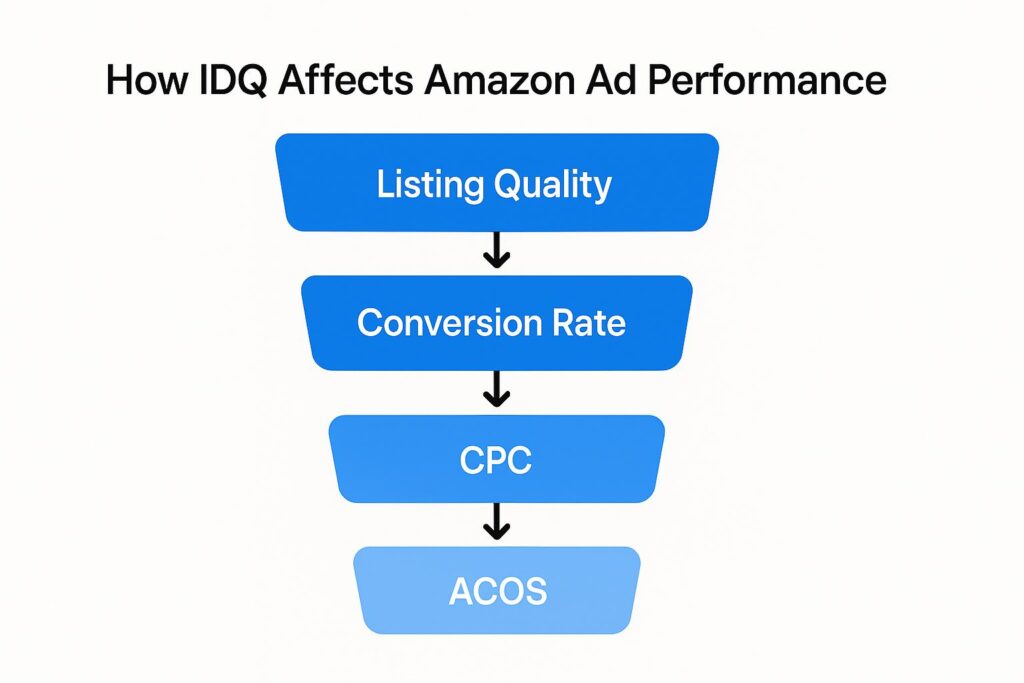
Amazon tracks listing completeness and quality with an internal Item Data Quality (IDQ) score that rates your PDP on a 0–100 scale based on how complete and “retail-ready” it is, including images, bullet points, category, attributes, reviews, and more.
A stronger IDQ makes your product easier to find and recommend. When your PDP is thin, missing images, weak titles, and vague bullets, three things happen very quickly:
Your conversion rate (CVR) drops.
Amazon’s system “decides” your listing doesn’t deserve cheap traffic.
You end up paying more per click to get the same results.
In other words: bad content = higher bids, worse ACOS.
The non-negotiable building blocks of a “worthy” PDP
If you’re running ads, at minimum, you want your listings to hit these basics (all of which Amazon itself calls out in various retail-readiness and listing guides:
Correct classification
Your product must sit in the right leaf category. Mis-categorization hurts both search and ad performance.
Enhanced / A+ Content
At least one A+ Content module Enhanced Brand Content is no longer “extra,” it’s expected. See Amazon’s own A+ overview:
Five strong bullet points
Clear, benefit-driven, and scannable. Amazon repeatedly recommends at least five bullets in its listing optimization content.
5+ high-resolution images
Multiple angles, lifestyle images, and infographics. Amazon’s listing best practices emphasize image count and quality. Sell on Amazon
A review rating of 3★+
Below that, ads will fight an uphill battle no matter how good your targeting is.
If your IDQ/retail-readiness score dips below ~90, your discoverability and ad efficiency are constrained, even with aggressive bidding.
“Most sellers still think their ads are the problem but nine times out of ten, it’s the content on the product page. You can throw money into PPC all day, but if your images, bullets, and A+ aren’t doing the heavy lifting, Amazon will charge you more and convert you less. Great on-site content isn’t ‘nice to have’ anymore. it’s the engine that makes your ads actually work.” Stas, Logie.ai
Why is the conversion rate so sensitive to the traffic source
Conversion rate on Amazon is not a single number. It’s heavily driven by where the traffic came from:
External traffic (social, search, email): often 2–6% CVR—people are still in “browsing” or “research” mode.
Generic Amazon search traffic: often 9–14% CVR for well-optimized listings.
Branded or high-intent search (“[Brand] air fryer”): can drive 30–40% CVR for strong brands.
Industry summaries and tools that track Amazon’s performance in 2025 show that:
That’s a massive volume of clicks you’re paying to attract. If your PDP doesn’t close, your ads are just buying extremely expensive window shoppers.
2. The Amazon Attribution Gap: Why Your Content Gets Zero Credit
Now we hit the heart of the problem: measurement.
You can pour time, money, and creative effort into A+ Content, video, and better images… and then open your advertising dashboard and see that all the credit for those sales goes to a single “last click.” That’s the attribution gap.
How Amazon’s default attribution really works
For off-Amazon campaigns, the primary measurement tool is Amazon Attribution:
It’s free for eligible advertisers and does something extremely useful: tells you whether your Google, Meta, TikTok, email, etc., is actually driving Amazon sales. But there’s a catch: it uses a 14-day last-touch attribution model:
It looks at all ad clicks in the 14 days before a purchase.
It assigns 100% of the credit to the last click in that chain.
Example:
Day 1: shopper clicks a Meta ad → lands on your PDP → reads your A+ Content → leaves.
Day 12: shopper sees a retargeting ad → clicks again.
Day 13: The shopper buys.
Under Amazon Attribution, the retargeting click receives 100% of the sale, and your content, which did the heavy lifting on Day 1 and warmed them up, gets no explicit credit in the report.
The same pattern applies inside Amazon, too: low-funnel campaigns like branded search and retargeting often “capture” the last click and therefore appear as heroes in the dashboard, even when awareness, mid-funnel, and content are doing most of the persuasion.
Why does this systematically undervalue content?
There are three big problems with last-touch attribution in this context:
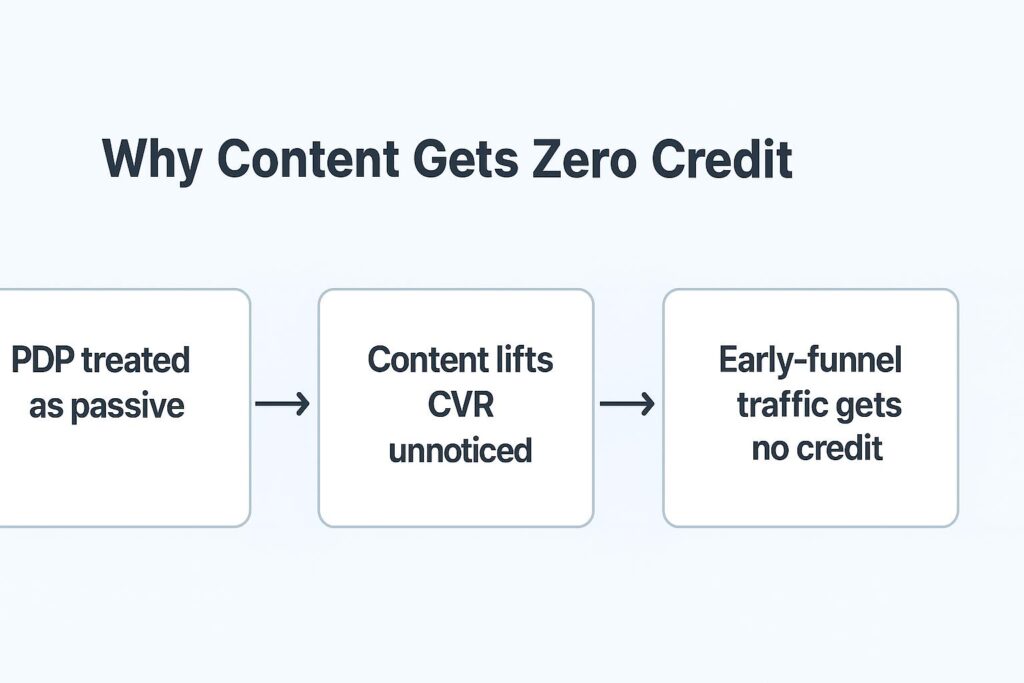
It treats the PDP as a passive endpoint
The model assumes the ad did the work and the product page just “existed.” In reality, your A+ modules, images, video, and comparison charts are what stop people from bouncing and actually push them over the line. Amazon’s own content guidance makes clear that A+ and rich media are there to improve conversion, not just aesthetics.
Content silently subsidizes media performance
If you improve your A+ Content and your CVR jumps 10%, every ad campaign suddenly looks better in ROAS/ACOS, but your ad dashboard never says, “this lift came from better content.” The media team gets the glory; the content team gets “nice job, we think?”
Upper-funnel work looks “wasteful.”
Awareness campaigns (DSP video, top-of-funnel social, creator content) are critical for building interest and trust. But because last-touch credit typically goes to a retargeting or branded search click at the end, those early-stage campaigns get almost no credit, even when they’re doing the heavy lifting.
Practically, this leads to a bad habit:
Over-invest in retargeting and branded search because the ROAS looks great.
Under-fund content, creative, and awareness because they look weak in last-touch reports.
In reality, you’re just shifting credit, not actual impact.
3. What the Data Shows About A+ Content and Conversion
Even if attribution reports don’t show it, the complex numbers on A+ Content and rich PDPs are evident.
A+ Content and Premium A+: what the numbers say
Across Amazon’s own documentation and multiple agency analyses:
Amazon has reported that A+ Content can lift conversion rate by around 5.6% on average when appropriately implemented.
Various Amazon-focused agencies and SaaS tools consistently see 3–10% or more CVR uplift from strong A+ vs. no A+.
When brands upgrade from Basic A+ to Premium A+ (with richer modules, interactive content, and embedded video), some case studies report up to a 20% increase in sales vs. non-enhanced listings.
These are average ranges; strong brands with weak old content often see bigger jumps when they finally redesign.
Content’s impact beyond “just” conversion
Optimized content also quietly improves:
Return rates
Better images, dimensions, “what’s in the box,” and clear usage explanations reduce the mismatch between expectation and reality. Fewer surprises → fewer returns → higher net margin.
Brand halo
Good A+ and Brand Store content helps shoppers understand your whole range, not just one SKU. Amazon frequently highlights that Sponsored Ads and Storefronts can drive “halo sales” for related products. Seller Central+1
One Amazon Ads case study for Jackery Japan (a portable power brand) showed that combining high-impact A+ and Store content with optimized ads drove a 141% increase in sales and a 135% lift in ROAS vs. the baseline.
Is that typical? No. Is it proof that content plus ads is a lot more potent than ads alone? Yes.
If you’re spending thousands on ads but don’t have A+ Content on your top ASINs, you’re effectively paying a “content tax” on every click.
4. How to Work Around the Attribution Gap in Practice
You can’t change how Amazon’s default attribution works, but you can change how you read the numbers and how you measure content.
Here’s a practical framework.
Step 1: Watch the mid-funnel metrics, not just orders and ROAS
Because last-touch attribution gives all credit to the final click, you need to rely more on leading indicators that sit between the click and the purchase.
Key metrics to watch:
Detail Page Views (DPV) & DPV Rate
DPV = how many people actually reached your PDP after an ad click.
If your external campaign has high CTR but low DPV, something’s wrong with your link / deep linking or the landing experience.
If DPV is high but CVR is low, it’s a content problem, not a traffic problem. Amazon Attribution exposes DPV-type metrics so you can see this path more clearly:
Add-to-Cart (ATC) & ATC Rate
How often visitors who land on the PDP decide “yes, I want this (at least in my cart).”
Strong DPV but weak ATC → your images, pricing, bullets, or first A+ modules aren’t convincing enough.
New-to-Brand (NTB)
For Sponsored Brands and some Sponsored Display formats, Amazon reports whether buyers are new to your brand in the last 365 days.
If you’re investing in Premium A+ and Brand Story, one of your goals should be to raise NTB, not just chase cheap reorders.
How to think about it:
Treat DPV and ATC as “content health checks.”
Treat NTB as a strategic north star if you’re building a brand, not a one-product hustle.
Step 2: Use “Manage Your Experiments” to prove content ROI directly
Amazon quietly gave brands a powerful weapon against the attribution gap:
Manage Your Experiments (MYE) – A/B testing for titles, images, bullets, and A+ Content.
What MYE does:
Splits traffic between two versions of your content (A vs. B).
Runs the test until there’s enough data.
Shows which version generated more sales, units, and CVR, and even estimates 1-year impact.
This is how you prove to yourself and your boss that:
Changing the main image increased CVR by 6%.
Rewriting bullets increased sales by 8%.
Adding A+ Content paid for itself in 4–8 weeks.
You’ll never see that level of clarity from last-touch attribution alone.
Practical recommendation:
Start with your top 5–10 revenue ASINs.
Test, in order:
Main image
Title
Bullets
A+ Content (full refresh)
Use the winners as templates for the rest of your catalog.
Step 3: For bigger brands, use Amazon Marketing Cloud (AMC) for multi-touch reality
If you’re an advanced advertiser (DSP + Sponsored Ads + external traffic), the best way to close the attribution gap is Amazon Marketing Cloud (AMC):
In plain terms, AMC:
It is a privacy-safe “clean room” where you can analyze anonymous event-level data.
Let’s you build your own custom attribution model (for example, giving weight to first-touch and mid-funnel campaigns, not just last-touch).
Let’s you connect ad impressions → PDP views → A+/video engagement → purchases in one chain.
This is where you can finally answer questions like:
“How many conversions were influenced by our Sponsored Brands video + A+ Content, even if a Sponsored Product ad got the last click?”
“How long is our typical conversion path for high-ticket items: 7 days, 14 days, 30 days?”
If you sell high-consideration products (electronics, furniture, B2B, etc.), you can also test longer lookback windows (21–28 days) in AMC, which is not possible with the standard 14-day Amazon Attribution model.
AMC is overkill for a lot of small brands, but for larger ones, it’s the only realistic way to stop over-funding “harvest” campaigns and under-funding content and awareness.
5. The Content Playbook: How to Optimize PDPs for Paid Traffic
Once you understand that every click is expensive and attribution won’t fully save you, it becomes obvious: your PDP must be built as a conversion engine, not a brochure.
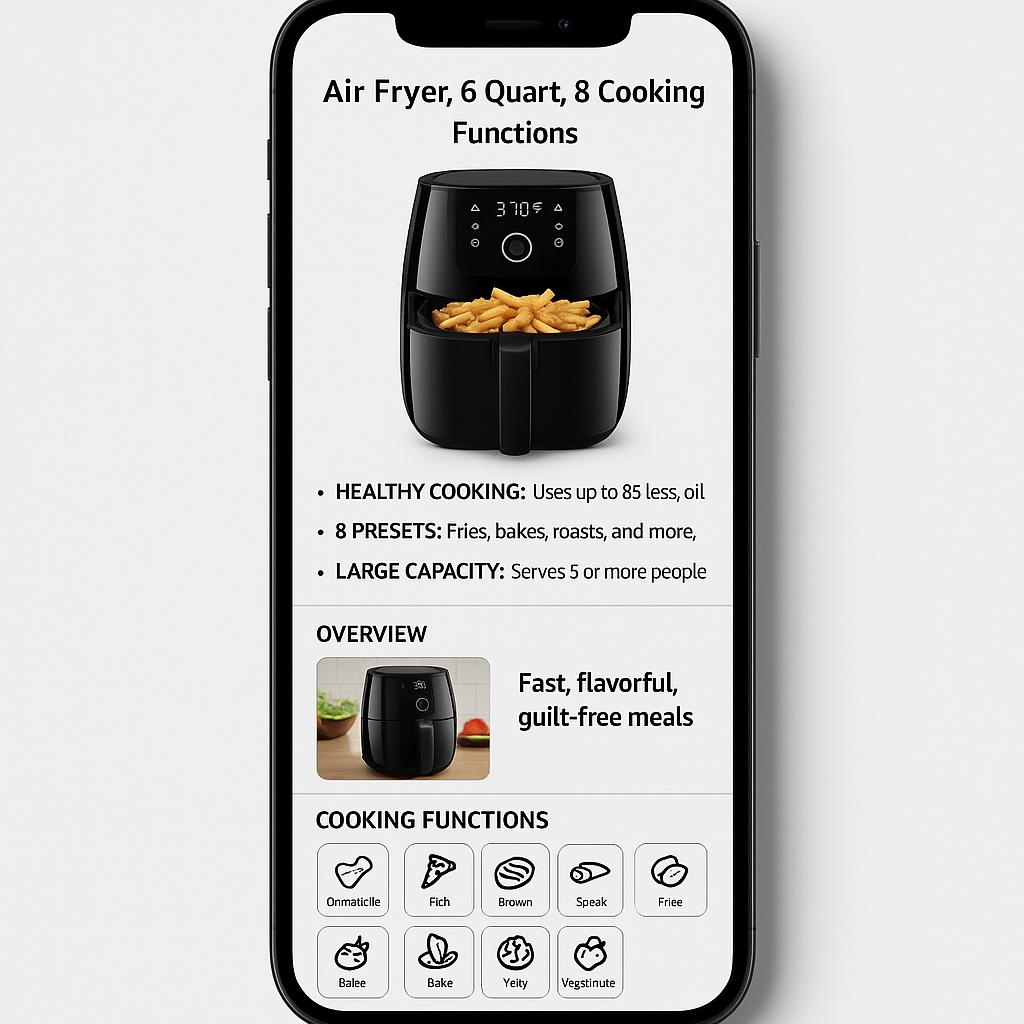
5.1. Design everything mobile-first
In 2026, more than half of Amazon’s traffic will be mobile.
And mobile shoppers scroll faster, tap quicker, and bail sooner if they don’t understand your offer at a glance.
Practical guidelines:
Use modular A+ layouts that stack cleanly and don’t feel like walls of text.
Keep text blocks short and high-impact; avoid cramming text inside images. It doesn’t scale well across screens and is hard to read.
Prioritize the first screenfuls: main image, title, price, rating, first bullets, and top A+ modules do most of the work.
Think of your PDP like a landing page you’d design for Meta or Google Ads—because that’s precisely what it is.
5.2. Use video and social proof to remove fear
If an ad brought the shopper in, your content’s job is to remove “micro-fears”:
“Will this actually work for me?”
“Is the quality good enough?”
“Is it worth this price?”
“Will it be a pain to return?”
Two tools are potent here:
Video on the PDP and inside A+
Amazon and multiple agencies note that listings with strong video often see significantly higher conversion. Some brands report up to 3.6× higher CVR vs. no-video SKUs when video clearly demonstrates use and benefits.
Use video to:
Show the product in use, real scale, and real context.
Answer the top 3–5 objections you see in reviews or pre-sale questions.
Build lifestyle aspiration when relevant (not just spinning product shots).
Social proof and UGC integration
Reviews already sit on every PDP, but you can go further:
Use A+ or Brand Story modules to pull out specific review quotes that address common fears.
Where allowed, include lifestyle images that feel like UGC real people, real settings, not just rendered assets.
Avoid cherry-picking only perfect “too polished” imagery; authenticity often converts better.
5.3. Close the loop between ads and content
Your ads generate a goldmine of data: which keywords and queries drive high CTR and reasonable ACOS.
The mistake many brands make is leaving that data in the ad console rather than feeding it back into organic content.
A better loop:
Use Sponsored Products / Sponsored Brands to discover winning terms.
Regularly update:
Title: to include the most critical, high-intent terms.
Bullets: to speak directly to the benefits people clearly care about based on search terms and reviews.
Backend keywords: to cover extra variations and long-tail phrases.
Third-party 2025 stats show that:
63% of shoppers begin their product search on Amazon, and
Use the projected one-year impact figures to justify ongoing investment in content (copy, creative, video).
Step 4 – If you’re big enough, add AMC for multi-touch clarity
If you’re running DSP + Sponsored Ads at scale, talk to your Amazon Ads partner or internal team about Amazon Marketing Cloud:
Use AMC to:
Build a custom attribution model that weights awareness and mid-funnel, not just last-click.
Analyze how often exposure to specific content types (Brand Store, A+, video) shows up in paths that lead to purchase.
This is how you make the case for content budgets at C-level, not just in the marketing team.
7. Content Is Your Cheapest Way to Make Ads Work Harder
The Amazon Attribution Gap is not a bug; it’s a side-effect of a measurement model built to answer: “Which ad got the last click?” It was never designed to show how much your product page did to earn the sale.
If you take the reports literally, you risk cutting investment in content—the very thing that’s quietly:
Lifting conversion by 5–20%.
Reducing returns.
Strengthening brand halo and New-to-Brand growth.
Making all of your ad spend look better than it deserves.
The mindset shift is simple but powerful:
Ads bring the people.
Content makes the money.
Treat your Product Detail Page as the core conversion asset of your Amazon strategy. Invest in A+ Content, mobile UX, video, reviews, and structured testing.
Use Amazon’s own tools, Attribution, Manage Your Experiments, and Amazon Marketing Cloud to prove what your gut already knows. When the page is strong, every click gets cheaper and more profitable over time.
Suppose you stop letting great content silently subsidize mediocre media, and instead build a system where ads and on-site content are optimized together.
In that case, you don’t just close the attribution gap; you make an Amazon operation that can actually scale without chaos.
Logie streamlines influencer discovery, product distribution, and content performance to drive measurable sales for eCommerce brands. We also equip content creators with the smart tools, brand partnerships, and commission opportunities they need to turn content into income.