The holiday season always brings chaos, opportunity, and a little creative caffeine, but this year, something interesting has been happening on Amazon.
And it turns out that “How-To” Idea Lists ultra-niche, problem-solving product collections are gaining unusual visibility across key shopping moments.
They’re showing up in places where shoppers are most primed to click, including post-checkout placements, personalized recommendation modules, and interest-based discovery feeds.
Why This Matters
Influencer and strategist Altovise Pelzer captured the moment perfectly during a recent creator session:
“When a platform does something new, even quietly, that’s your cue to test it. They push creators who experiment early. If we see they’re doing something with ‘how-to’ hashtags let’s hop on it and ride the wave.”
This is precisely what’s happening.
Amazon appears to be prioritizing niche, “how-to”-framed lists.
Lists built around specific problems are increasingly common.
The timing of the peak holiday traffic amplifies every single click.
Creators who move now get the priceless advantage of being early.
Creators who wait will be competing in a completely different environment.
What “How-To” Idea Lists Actually Are
There is no special tool hidden in your dashboard. There is only the standard Idea List feature, but it is set up so that Amazon’s algorithm is rewarding right now.
A “How-To” Idea List is:
A normal Idea List,
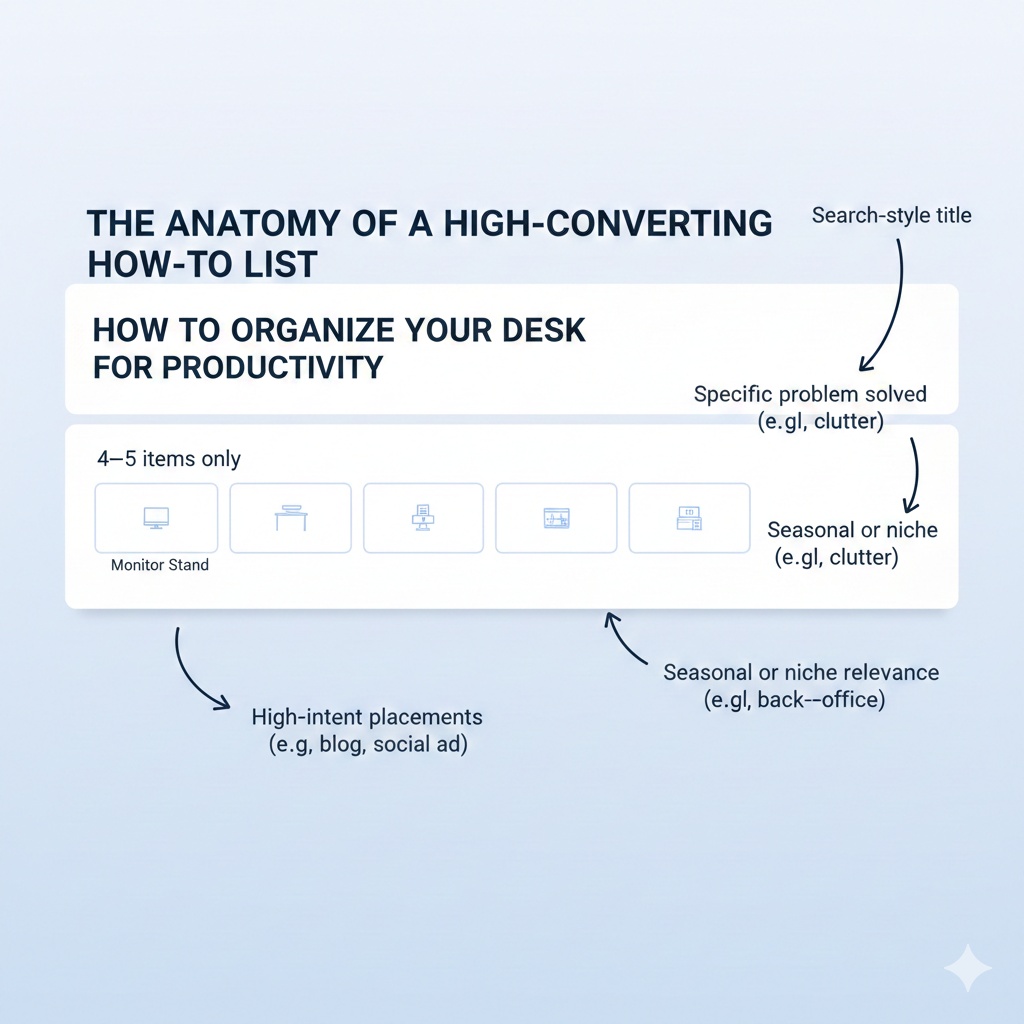
Built around a hyper-specific need,
Titled like a micro tutorial,
And limited to 4–5 carefully chosen products.
Think:
“How to prep your living room for holiday guests.”
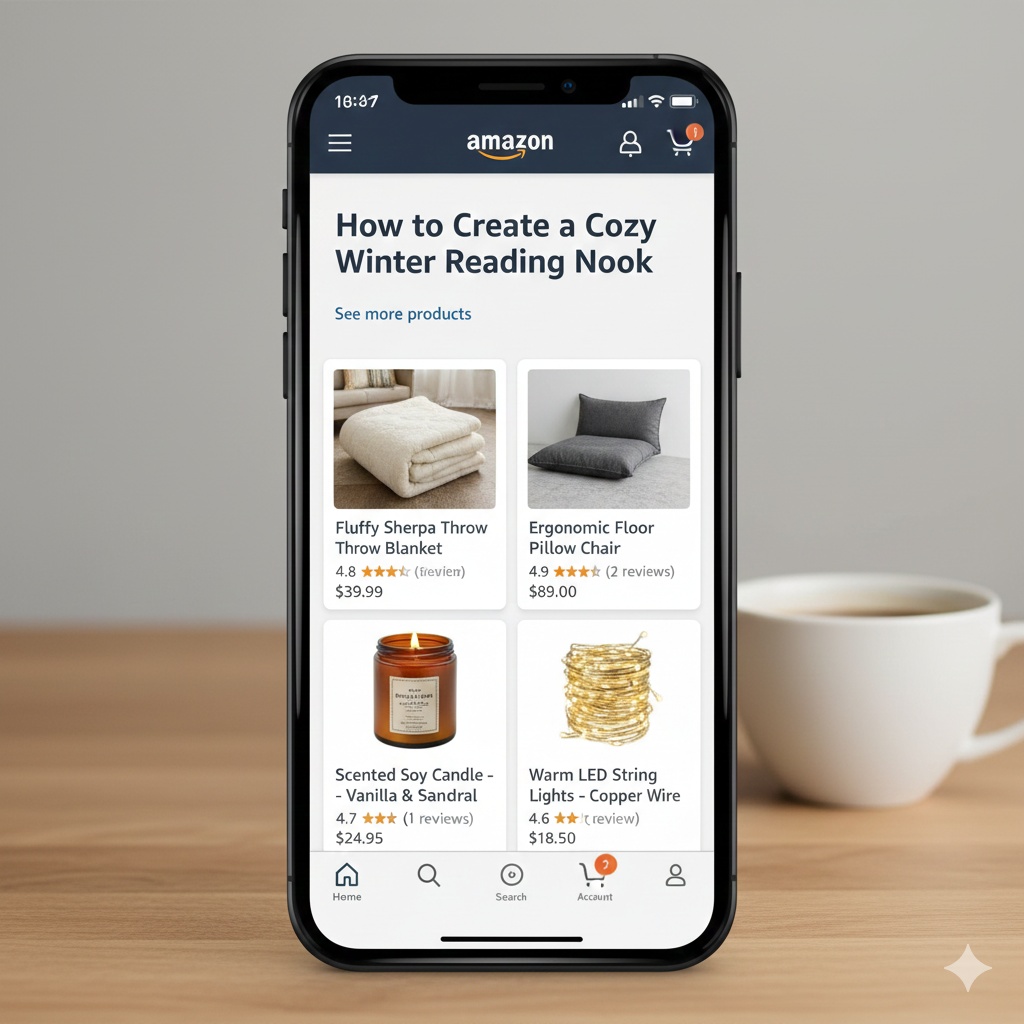
“How to create a cozy winter reading nook.”
“How to organize your car for long-distance travel.”
“How to film your Amazon videos using only your phone.”
These read like search queries. They solve a problem that fits perfectly into Amazon’s recommendation logic.
And Amazon loves content that behaves like a search answer.
Why These Lists Outperform Traditional Idea Lists
Traditional lists sit on your storefront, help with organization, and convert when buyers go looking, while How-To lists? Pull buyers in because they fit directly into the shopper’s journey.
Here’s why they perform better:
1. They appear in high-intent placements. Some creators see their lists appear right after checkout, arguably the highest-converting real estate on Amazon.
2. They tap into search psychology. People think in questions:
“How do I…?”
“What do I need for…?”
“How can I fix…?”
A list that directly answers a question is easier to click.
3. They’re short and shoppers reward simplicity
4–5 items create momentum.
20-item lists create friction.
4. They match Amazon’s shift toward personalized discovery. As Amazon focuses more on intent-based and interest-based recommendations, content that communicates a clear purpose tends to rise.
What Creators Are Doing Right Now
Across Logie sessions, community groups, Reddit threads, and industry training, the winning patterns are clear.
Ultra-specific topics
Creators are avoiding generic lists and instead targeting micro-moments:
Dorm coffee setups
Winter self-care rituals
Holiday guest prep
Pet grooming during cold months
Productivity desk resets
Road trip survival kits
If a topic solves one small, real problem, it performs.
Exactly 4–5 products
It reduces decision fatigue and makes the list feel like a curated solution, not a catalog.
Titles written like search queries
This is huge. Creators whose titles list naturally as if answering a Google search consistently see more clicks.
Cross-platform distribution
The biggest winners are NOT waiting for Amazon alone.
They’re:
Sharing their lists in Reels and TikToks
Linking lists in YouTube descriptions
Mentioning lists in Lives
Adding lists to Link-in-Bio
Embedding lists into Logie campaigns
Traffic in → visibility up → conversions up.
Monthly refresh and optimization
Creators who regularly update their lists see sustained visibility.
Creators who set-and-forget lose momentum quickly.
What Doesn’t Work Anymore
These behaviors used to fly, but not in the new environment:
✘ Huge catch-all lists
“Holiday Home Finds” won’t cut it.
“Under-$25 Stocking Stuffers for Teen Gamers” will.
✘ Trendy but vague titles
Amazon boosts clarity, not cuteness.
✘ Assuming Amazon will find your content
The algorithm amplifies creators who bring traffic, not those who quietly publish.
✘ Outdated or unrefreshed lists
Amazon rewards relevance.
Old lists fade.
What Early Results Show
Across the Logie community and broader creator ecosystem, creators consistently report:
Higher click-through rates on niche, problem-solving lists
Faster visibility in interest-driven placements
Better conversion on lists under five items
Stronger performance when lists are paired with a corresponding short video
Improved earnings when lists are cross-promoted outside Amazon
How To Create High-Converting ‘How-To’ Lists
1. Identify a micro-problem your audience has. Use comments, DMs, seasonal trends, or SEO tools to find topics that are small but urgent.
2. Curate exactly 4–5 products. ONLY choose items that directly solve the problem.
3. Title your list like a search query: “What do I need to…? “How do I…?” Turn that into your headline.
4. Pin + promote everywhere. Pin it to the top of your storefront. Then build momentum on Instagram, TikTok, and YouTube.
5. Measure → refine → expand Use Amazon reports or Logie analytics to double down on what works and remove what doesn’t.
Final Takeaways
1️⃣ This is an opportunity. And early adopters always win the biggest share.
2️⃣ Niche beats broad every time. Hyper-specific lists convert the highest.
3️⃣ Traffic is a signal. Creators who promote their lists externally get rewarded internally.
Ready to Ride the ‘How-To’ Idea List Wave?
This emerging trend is giving creators a rare moment of leverage, especially in Q4 and seasonal shopping spikes.
Logie streamlines influencer discovery, product distribution, and content performance to drive measurable sales for eCommerce brands. We also equip content creators with the smart tools, brand partnerships, and commission opportunities they need to turn content into income.