

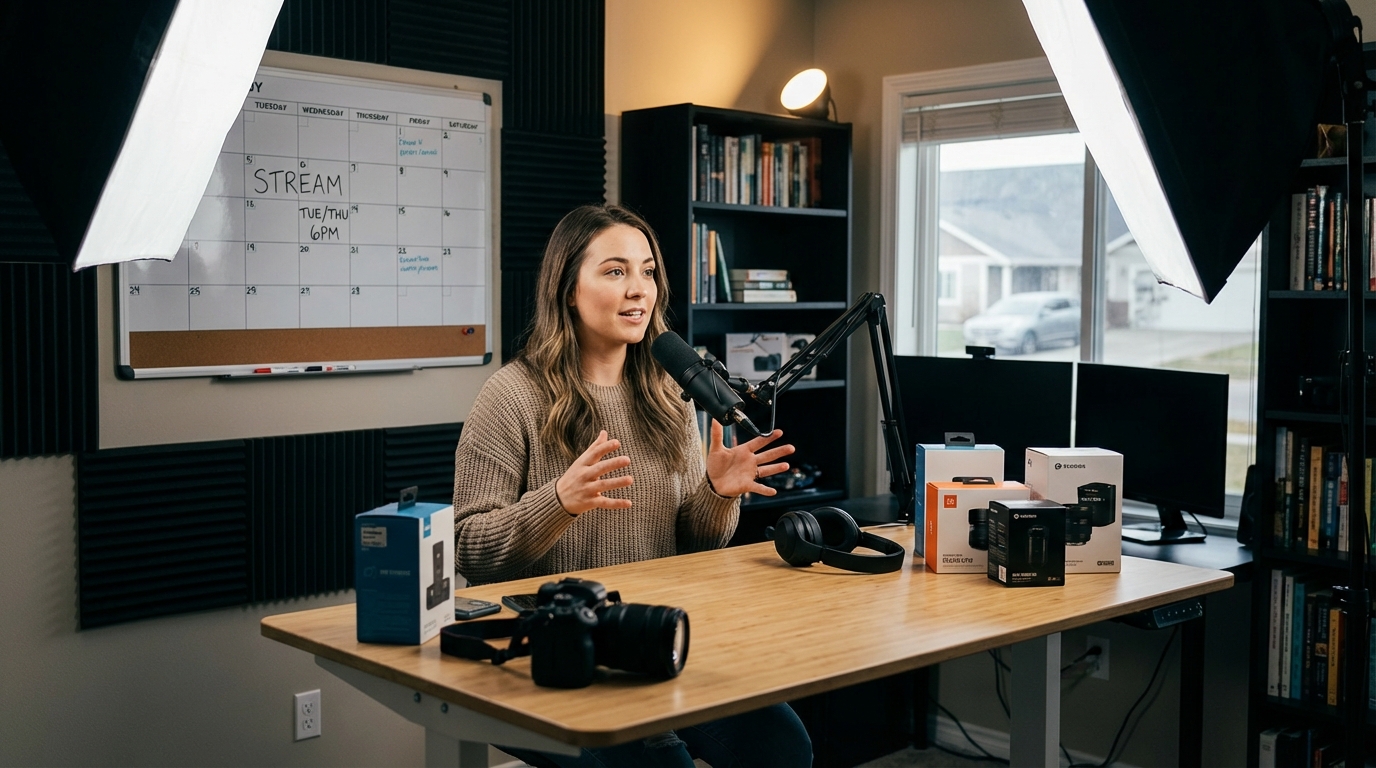
- Brands are exhausted by shallow influencer outreach and default “sample requests” – they’re seeking proven partners, not product collectors.
- Creators who pitch concrete performance stats and approach collaborations as joint ventures stand out – especially in the current Amazon landscape.
- Get noticed by communicating, showing your results, and using insight-driven tools and strategies to match your content to real brand needs.
For a long time, the Amazon influencer ecosystem operated on a simple, almost invisible loop.
Creators would publish content. Performance data would validate what worked. Brands would double down on the creators driving results.
Nothing about that loop felt complicated. It didn’t need to be explained because it worked quietly in the background.

A creator could post a video, see how it performed, understand what resonated, and approach a brand with something concrete. A brand could review that same performance and decide, with a reasonable level of confidence, whether this creator was worth investing in again.
With recent Amazon influencer reporting changes particularly the reduced visibility into conversions, sales, and order-level performance from the creator side that alignment has weakened.
According to Logie’s coverage of the March reporting reset, creators lost access to key metrics they relied on to understand performance and demonstrate ROI to brands.
And when clarity begins to fade, the effects are not immediate; they cascade.
Creators still post.
Brands still send products.
But the confidence that used to connect those actions is no longer automatic.
To understand what’s happening now, you have to look at what reporting was actually doing beneath the surface.

Reporting Was the Bridge Between Creativity and Commercial Decisions
Most creators experienced reporting as feedback.
Brands experienced it as evidence.
That distinction explains why its absence is being felt differently on both sides.
Amazon’s own guidance on creator-led commerce still emphasizes measurable outcomes clicks, conversions, and customer relationships built through content.
And in practice, Amazon’s Creator Connections reporting has historically allowed brands to track:
- campaign spend
- clicks generated by creators
- orders attributed to content
- sales linked to specific products
This is what allowed a piece of content to move from:
“this performed well”
to:
“this generated measurable business impact”
That translation is what made collaboration efficient.
Without it, both sides are left interpreting results from different angles and often arriving at different conclusions.
What Happens When That Shared Visibility Disappears
When reporting weakens, it changes behavior. Not dramatically at first but enough to alter how decisions are made.
Creator positioning begins to weaken

A creator who previously could say:
- “This product converted at 12% with my audience”
Now often says:
- “My audience really likes this category”
Without concrete performance data, even strong creators begin to sound similar to weaker ones.
Brands start filtering more aggressively
Brands are not just looking for content they are looking for outcomes.
And increasingly, they are expected to justify those outcomes internally.
Shopify’s guidance on influencer marketing makes this clear: brands are evaluating campaigns based on revenue, conversions, and cost efficiency, not just reach or engagement.
When reporting becomes less transparent, brands don’t stop investing.
They become more selective.
- fewer creators considered
- more reliance on known performers
- slower decisions on new partnerships
This is often interpreted by creators as rejection. In reality, it is a caution.
The feedback loop that sustains partnerships weakens
Long-term creator-brand relationships depend on iteration.
Sprout Social highlights that effective influencer partnerships rely on:
- clear performance tracking
- consistent communication
- ongoing relationship management
When reporting weakens, that loop becomes harder to maintain.

Instead of:
- “this worked, let’s build on it”
You get:
- “let’s try this and see”
That subtle shift is what turns partnerships into transactions.
Why Brands Feel Burned Out
From the outside, it looks like brands are overwhelmed by creator outreach.
That’s partially true.
But what they are really overwhelmed by is lack of differentiation.
Without strong performance context, most outreach looks the same:
- “I’d love to collaborate”
- “Send me a sample”
- “I create high-quality content”
Individually, these messages are reasonable.
Collectively, they are indistinguishable.
And when everything looks the same, the easiest decision is to ignore most of it.
This is not a failure of creators alone.
It is a symptom of a system where signals have become harder to see.
“All this information allows you to be able to go to a brand and say, hey… Clients really like my content for this particular category. I had this product, I did a video for it, it got this amount of clicks, it converted this percentage-wise. I would love to do a video for your particular product. It works. Because now you’re starting an actual conversation with the brand, as opposed to just saying to the brand, send me a sample.”Altovise Pelzer

What’s important here is not just the presence of data.
It’s what the data allows the creator to do.
It allows them to:
- explain patterns
- demonstrate understanding
- propose outcomes
Without that layer, the interaction remains shallow.
With it, the interaction becomes strategic.
The Gap Most Creators Don’t See: Data vs Understanding
Many creators are trying to compensate for reduced reporting by sharing whatever numbers they still have.
But numbers alone are not the differentiator.
Understanding is.
A creator who says:
- “I got 2,500 clicks”
is sharing information.
A creator who says:
- “I got 2,500 clicks because my audience responds to comparison-driven content under 60 seconds, and I’d apply that same structure to your product”
is demonstrating capability.
Brands are not just looking for performance.
They are looking for repeatable performances.
And repeatability comes from understanding not from isolated metrics.

Where Structure Begins to Replace Missing Clarity
As reporting becomes less accessible from the creator side, the creators and brands who continue to see results are the ones who introduce structure back into the process.
This shows up in subtle but important ways:
- clearer expectations before collaboration
- more intentional communication
- defined timelines and deliverables
- deliberate follow-up with results and insights
This is where platforms like Logie begin to matter more not because they replace Amazon, but because they reinforce what is missing.
Logie’s approach to creator-brand collaboration focuses on:
- organizing interactions
- clarifying expectations
- enabling better communication of performance
In a system where reporting alone no longer provides full clarity, structure becomes the mechanism that restores it.
What This Means for Brands Evaluating Creators Today
Brands are no longer operating in an environment where performance is immediately obvious.
That means evaluation has to shift.
Instead of asking:
- “Does this creator have reach?”
The more relevant questions become:
- Can this creator explain their audience?
- Can they connect content to buying behavior?
- Do they communicate clearly and consistently?
- Do they follow through after the content goes live?
The brands that adjust to this shift will identify strong creators earlier.
The ones that don’t will continue to feel like “nothing is working.”

What This Means for Creators Trying to Stand Out
For creators, the implication is direct.
Waiting for better reporting is not a strategy.
Adapting to reduced clarity is.
That means:
- documenting performance wherever possible
- understanding your category deeply
- communicating insights not just outcomes
- treating every collaboration as the start of a relationship, not the end
It also means moving away from behaviors that rely on visibility alone:
- generic outreach
- one-off content
- minimal follow-up
Because those behaviors depend on a system that no longer supports them as strongly.
The Shift That’s Actually Happening
This is not just about reporting.
It’s about how the Amazon influencer ecosystem is evolving.
From:
- access-based participation
To:
- performance-based differentiation
That shift does not remove opportunity.
It redistributes it.
Toward creators who can:
- create clarity
- communicate effectively
- reduce uncertainty for brands
And toward brands that can recognize those signals early.