
For years, Facebook felt like safe ground for affiliate marketing. Creators shared links on their personal profiles, sprinkled in a bit of commentary, and watched commissions roll in. No warnings. No issues. No reason to stop.
Then, quietly, that changed.
By late 2023 and throughout 2024, creators across affiliate communities began reporting alarming issues: sudden shadowbans, suppressed reach, blocked links, and permanent account bans often without warning, explanation, or successful appeal.

Long-standing profiles were wiped out overnight. Income streams disappeared just as quickly.
This article examines why it happened, when it began, what specifically puts creators at risk, and how influencers can protect their accounts and revenue going forward.
If your business depends on Amazon affiliate income, this is not theoretical. It is an operational risk.
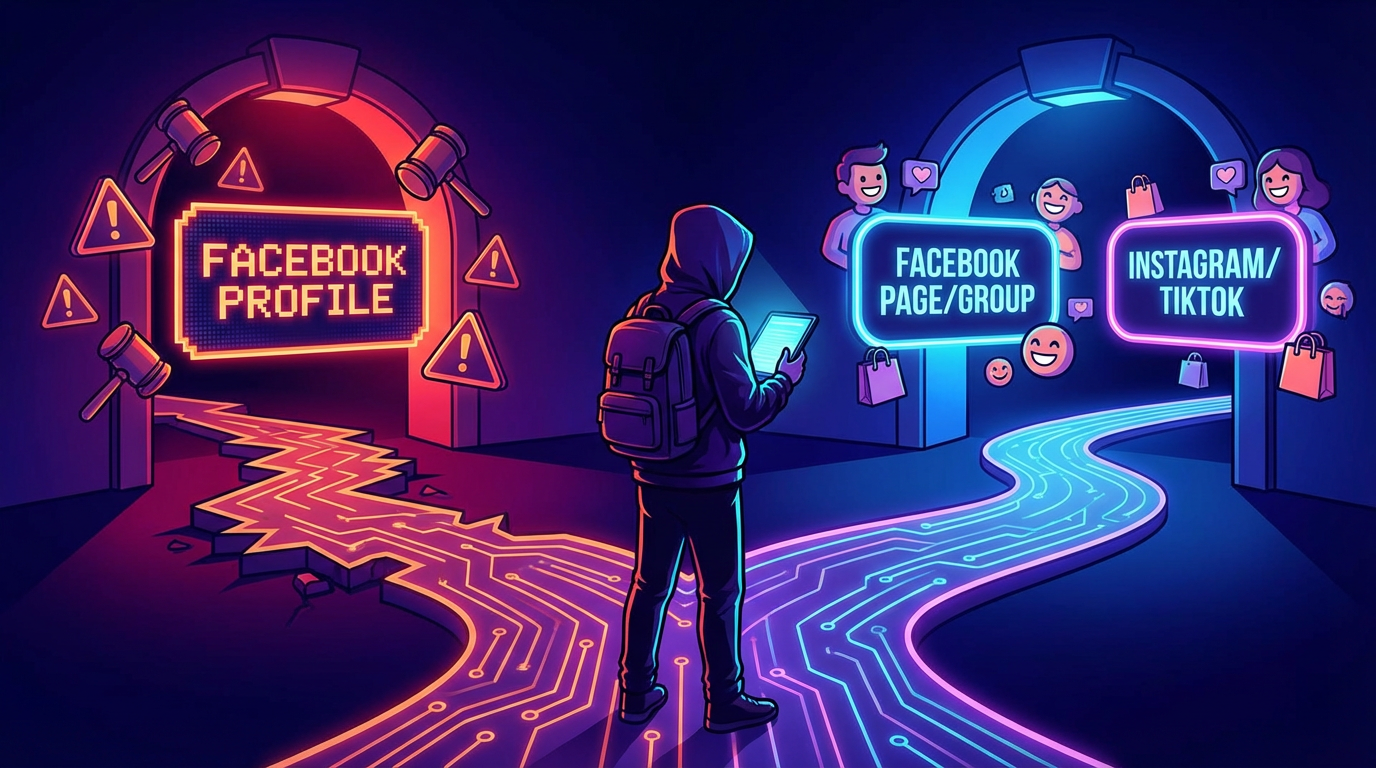
Personal Profiles Were Never Meant for Commerce
The most important thing to understand is this:
Facebook personal profiles were never designed to function as business or affiliate marketing channels.
Historically, Facebook tolerated light commercial behaviour on profiles because:
- Enforcement was inconsistent,
- Creator volume was lower,
- and affiliate links were harder to detect at scale.
That tolerance is gone.
Meta’s platform architecture draws a sharp distinction between:
- Personal identity spaces (profiles), and
- Commercial or public-facing spaces (Pages, Groups, Ads, Shops).

Affiliate marketing, even when framed as “sharing a recommendation”, falls squarely into the commercial category when done repeatedly or with clear calls to action.
What creators experienced in 2024 wasn’t a rule change. It was Facebook finally enforcing rules that already existed.
When Did the Crackdown Begin?
There was no announcement titled “Facebook Bans Affiliate Links.”
That’s why many creators were caught off guard.
The real timeline looks like this:
- Late 2023: Meta significantly improved automated detection of spam, monetization patterns, and outbound link behaviour.
- Early 2024: Enforcement became visible. Creators began reporting shadowbans, URL suppression, and sudden profile restrictions.
- Mid to late 2024: Permanent bans and locked profiles increased, especially for accounts repeatedly posting affiliate links.
- 2025 onward: The pattern stabilized, meaning the risk is now structural, not temporary.
Creators describe it as a “crackdown” because the consequences became immediate and irreversible, not because a new rule was introduced.
Why Influencers Don’t Trust Facebook Profiles Anymore
During a Logie community discussion, veteran creator Ileane Smith summed up the sentiment many now share:
“I don’t trust Facebook. I don’t trust using my profile.”
That distrust is earned.
Facebook’s enforcement today is:
- automated,
- opaque,
- fast,
- and immune primarily to appeals.
Once a profile is flagged for repeated commercial behaviour, there is often no meaningful path to recovery. Even six- or ten-year-old accounts are not exempt.
A personal Facebook profile is no longer a safe asset for monetization. It is a high-risk dependency.

What Triggers Enforcement on Profiles
Based on community reports, creator case studies, and Meta’s stated policies, enforcement is rarely about a single post. It is pattern-based.
High-risk behaviours include:
- Posting Amazon affiliate links repeatedly on a personal profile
- Using shortened or redirected URLs (Bitly, generic link hubs)
- Call-to-action language such as “buy now,” “link below,” or “don’t miss this deal”
- Minimal personal context around the link
- Consistent outbound traffic to the same commercial destination
Low-risk behaviour (but still not zero-risk):
- Occasional mention of a product without a direct link
- Personal experience posts without calls to action
- Non-commercial storytelling
Turning on Facebook’s Professional Mode does not change this risk profile.
Professional Mode
Professional Mode gives creators analytics and monetization tools.
It does not convert a personal profile into a business entity.
Many creators assumed:
- “If Facebook lets me monetize, affiliate links must be allowed.”
That assumption has proven costly.
“Just because Facebook says ‘Professional Mode’ doesn’t mean they’re cool with you sharing Amazon links there. I lost my main account after 6 years because I didn’t read the fine print – and I know other creators who’ve had it worse.” Ileane Smith
Professional Mode still operates under personal profile rules, not Page rules. External affiliate links, especially Amazon links, remain risky.
Professional Mode is a creator analytics feature, not a compliance shield.
The Amazon Complication
Amazon’s affiliate policies place responsibility squarely on the creator. Amazon does not override platform rules.
This creates a dangerous overlap:
- Facebook may penalize you for posting affiliate links on a profile.
- Amazon may still hold you responsible for improper placement or disclosure
In other words:
One post can put two accounts at risk.
Amazon generally considers Pages, public Groups, and approved social channels compliant. Personal profiles fall into a grey area, and that grey area is where accounts are terminated.
What Influencers Are Afraid Of
Influencers don’t worry about “violations” in the abstract.
They worry about losing assets.
What actually affects them:
- Losing a Facebook account means losing years of relationships.
- Losing reach means losing momentum.
- Losing an Amazon affiliate account means losing income entirely.
This is why the reaction to 2024 enforcement felt severe. It wasn’t about rules. It was about a sudden loss with no warning.
Safer Places to Share Amazon Affiliate Links
Creators who continue to earn consistently have shifted to lower-risk surfaces.
Safer options include:
- Facebook Pages are explicitly designed for business activity
- Public Facebook Groups, when rules are followed, and value is provided
- Short-form video (Reels) with traffic routed via bio links
- Instagram Stories and Reels native link tools reduce friction
- TikTok, where product discovery and linking are platform-native
A common strategy is:
Content first → context → bio link → storefront or landing page
This removes direct affiliate links from high-risk zones.
Practical Recommendations for Influencers
If you rely on affiliate income, here is what matters operationally:
- Treat your personal Facebook profile as a relationship space, not a sales channel.
- Remove or stop posting direct Amazon affiliate links on your profile.
- Centralise links through compliant landing pages or storefronts.
- Diversify traffic sources so no single platform can shut you down.
- Review Facebook and Amazon terms; quarterly enforcement evolves.
Compliance is not a constraint on growth. It is a prerequisite for sustainable development.
Platforms Are Reasserting Control
Facebook’s actions are part of a broader trend across social platforms:
- Clear separation between personal identity and commerce
- Monetization is restricted to approved surfaces.
- Algorithms replacing human judgment
- Less tolerance for grey-zone behaviour
Creators who adapt early protect their businesses.
Creators who wait often learn through loss.
Conclusion
The “Facebook crackdown” was a signal. A signal that platforms are done tolerating behaviour that blurs personal use and commerce. A signal that affiliate marketing now requires structure, intent, and compliance.
If you are an Amazon influencer or Logie creator, the takeaway is clear:
- Personal profiles are no longer safe monetization assets.
- Systems, not sympathy, enforce platform rules
- Diversification and compliance protect your income.
- The creators who last are the ones who adapt first.
Build on solid ground.
Your audience, your accounts, and your revenue depend on it.