

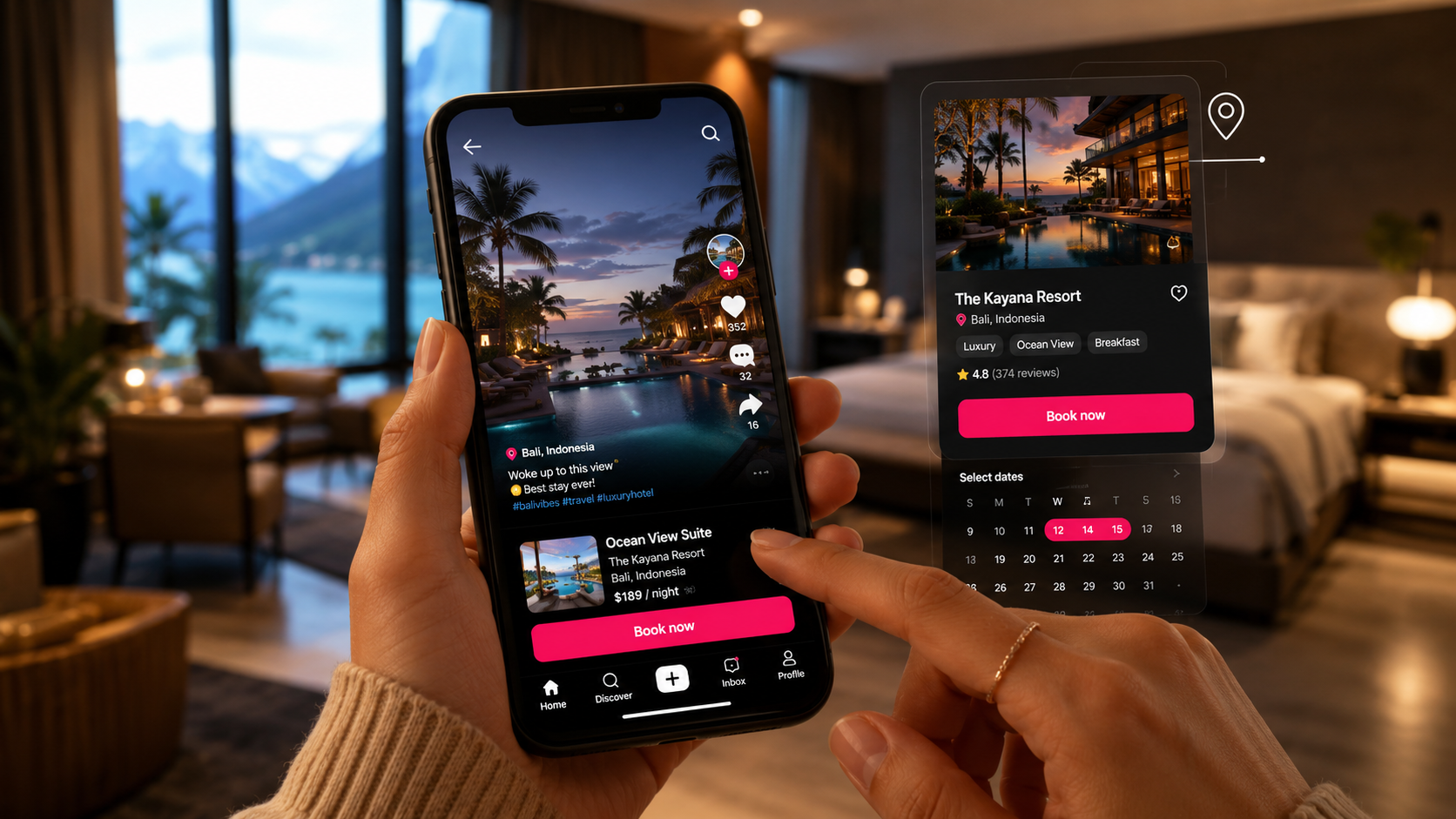
TikTok launched a travel booking feature on May 12, 2026. Here is everything worth knowing, including the details that are being glossed over.
TikTok has been building toward this for two years.
In July 2024, Southwest Airlines ran a 14-week “shoppable flights” campaign where ten TikTok creators featured a “book now” button directly in their videos. Viewers could buy plane tickets without leaving the app. It was a test, and it worked well enough to signal something bigger was coming.

In 2025, an early version of TikTok GO appeared invite-only, structured more like an affiliate program than a finished product. Creators could earn rewards for filming content at specific hotels and locations.
Booking.com was already involved. It was rough around the edges, but it showed TikTok exactly the direction it wanted to go.
On May 12, 2026, TikTok GO officially launched in the United States as a full product. And there is quite a lot worth understanding about it.
What TikTok GO is and What It Is Not
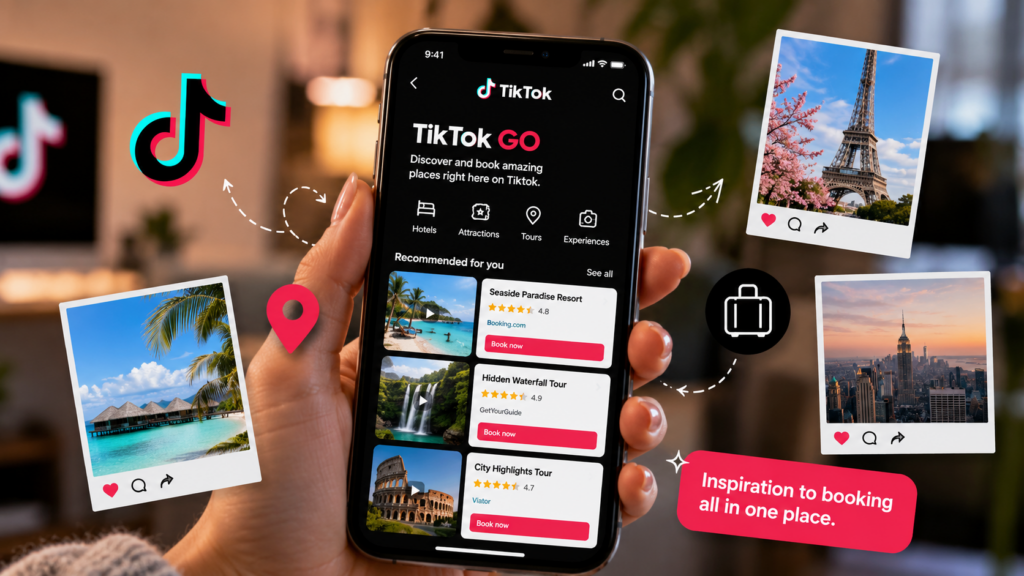
TikTok GO is a discovery-to-booking feature built into TikTok’s existing interface. It is not a separate app.
It is not a dedicated travel tab. It sits on top of what already exists: videos, search results, and location pages, and adds a booking layer on top.
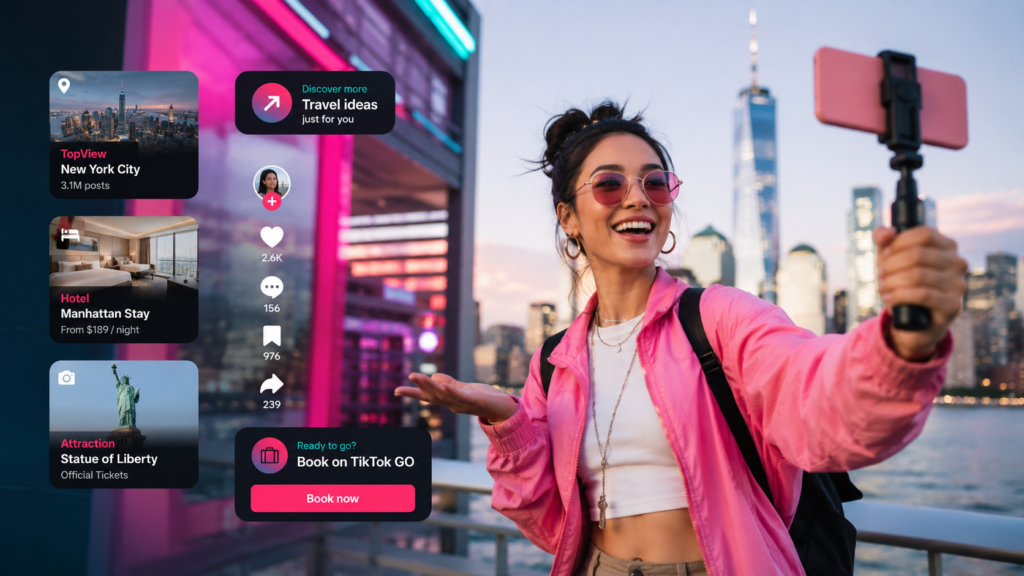
When a user comes across a hotel, attraction, tour, or local experience through a video or a search, they can tap through to view details, check availability, and complete a booking without opening a browser or switching to another app.
TikTok does not process payments itself. Unlike TikTok Shop, where transactions happen within TikTok’s own commerce system, TikTok GO redirects users to partner platforms to complete the transaction.
The booking happens on Booking.com, Expedia, Viator, GetYourGuide, Tiqets, or Trip.com, not inside TikTok’s own checkout. TikTok provides the discovery and connection layer. The partners handle inventory, pricing, and payment.
What TikTok does provide during promotions is exclusive rates and additional support, meaning there can be pricing advantages for users who book through TikTok GO rather than going directly to those partner platforms separately.
Who Can Use It Right Now
TikTok GO is currently available only in the United States. TikTok has 200 million US users and chose to launch there first, which makes sense given the market scale and the complexity of travel commerce regulation in other regions.
Users must be at least 18 years old to complete a booking. This is a real restriction, not a checkbox formality.
Because TikTok GO involves financial transactions, travel commitments, and real money, the platform has drawn a clear line.
Younger users will still see travel content on TikTok as normal; the age requirement applies specifically to completing bookings through TikTok GO.
There is no confirmed timeline yet for when TikTok GO will expand beyond the US, though given TikTok’s global footprint, expansion is a reasonable expectation if the launch performs well.
What You Can Book
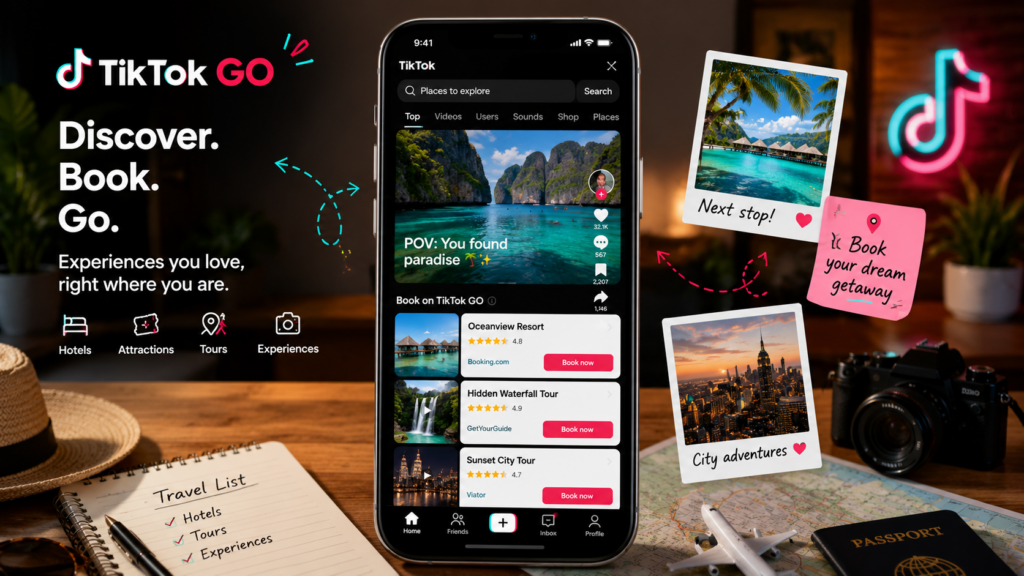
The current TikTok GO inventory covers four main categories, each tied to a specific partner:
- Hotels and accommodation via Booking.com and Expedia
- Tours and guided experiences via Viator and GetYourGuide
- Attractions and ticketed activities via Tiqets
- Broader travel planning via Trip.com
Notably absent from the current launch: restaurants and food experiences. TikTok is already one of the most powerful forces in where people choose to eat, and the omission is conspicuous.
It would be surprising if TikTok GO does not expand into food booking eventually, but for now, the focus is on accommodation, experiences, and activities.
Where Bookable Content Surfaces Inside the App
This is the detail that makes TikTok GO meaningfully different from simply “adding a booking link.” Bookable listings appear in three distinct places:
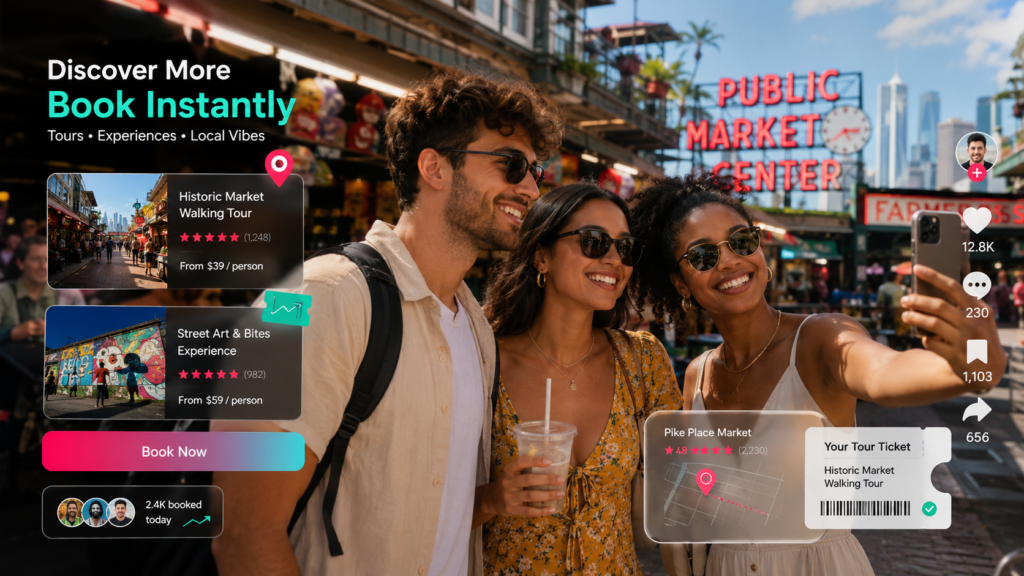
In videos on the For You Page. When a video features a hotel, attraction, or experience that is part of TikTok GO’s inventory, the booking option can surface directly in or alongside that content. You do not need to search for it; it finds you while you are already watching.
In TikTok search results. TikTok has been functioning as a de facto search engine for millions of users, particularly Gen Z, for several years.
When someone searches “best things to do in Miami” or “hotels in Kyoto,” TikTok GO results can appear alongside video content. This is precisely where TikTok starts to compete directly with Google Hotels and Google Things to Do.
On location pages. TikTok already has location-tagged content throughout the platform. A hotel or attraction can have a dedicated presence on its location page, combining videos, property details, and a booking option in a single place.
The combination of these three touchpoints means TikTok GO is not a destination users have to seek out. It is embedded in the content experience they already have.
Why This Is More Threatening to Google Than It Looks
TikTok GO puts TikTok in direct competition with Google in two of Google’s most commercially valuable areas: travel search and local discovery.
Google has spent years building Google Hotels, Google Flights, and Google Things to Do products that intercept users at the moment of travel intent and route bookings through Google before sending them to OTA partners.
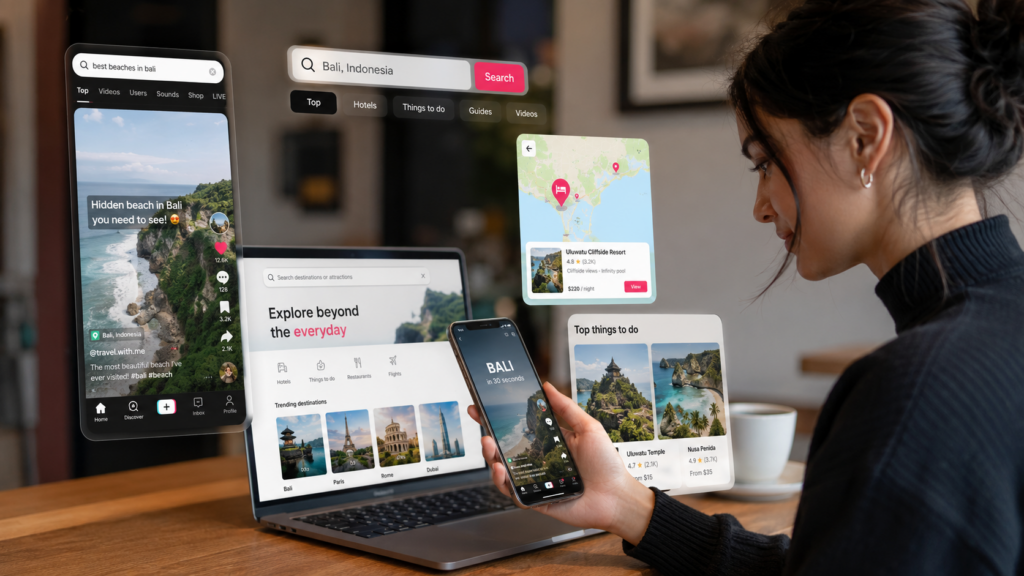
TikTok GO is doing structurally the same thing, but with one enormous advantage: it captures desire before it becomes a search query.
A Google search result shows you options. A TikTok video makes you want to go somewhere. Those are completely different emotional positions, and the second one is far closer to a booking. TikTok is now capturing the inspiration and the transaction.
It is also worth noting that Booking.com and Expedia, two of TikTok GO’s launch partners, are themselves major competitors to Google in travel search.
The fact that they are partnering with TikTok rather than relying solely on Google reflects where the industry sees attention moving.
What This Means for Creators
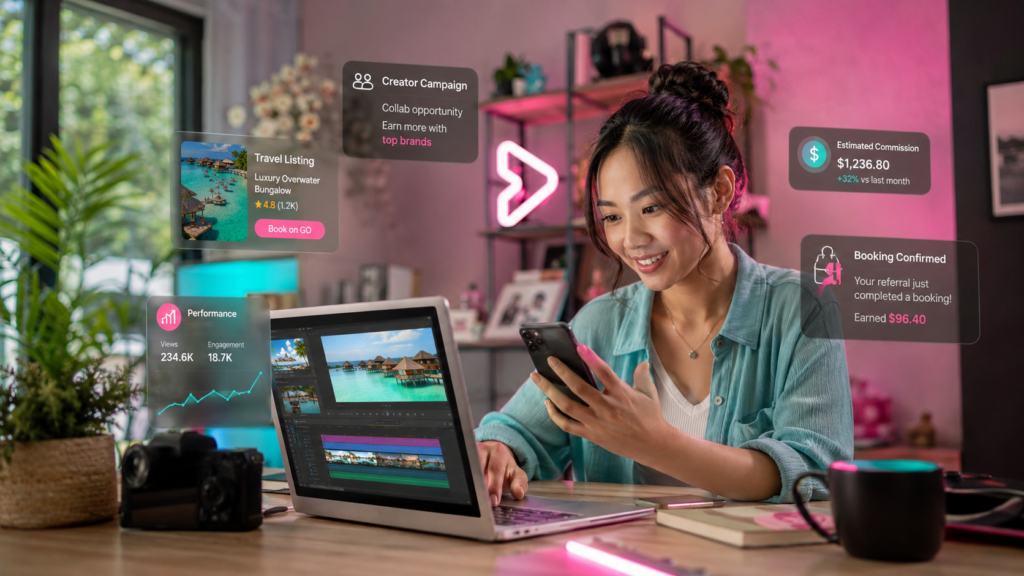
TikTok has confirmed that creators who feature hotels, attractions, and local experiences through TikTok GO can earn through commissions and creator campaigns.
What is confirmed: Creators can link their content directly to bookable listings. When a booking is attributed to a creator’s content, they earn a commission.
TikTok also runs paid creator campaigns where businesses pay for creators to feature specific properties, similar to sponsored content but with direct booking integration built in.
What is not yet fully public: Commission rates for TikTok GO travel bookings have not been formally disclosed.
For context, affiliate commission rates in travel typically range from 3% to 8% of the booking value, depending on the partner and property type.
A 5% commission on a $200 hotel night is $10. A 5% commission on a $1,200 multi-day trip package is $60. Travel has significantly higher transaction values than most TikTok Shop products, which means commission potential per conversion can be meaningfully higher even at lower percentage rates, a dynamic that works in creators’ favor.
Access is likely not fully open yet: Based on how the 2025 testing phase worked and how TikTok typically rolls out creator monetization features, it is likely that the commission program is not immediately available to all creators.
The earlier version required a minimum of 1,000 followers, a clean account history with no policy violations, and operated on an invite or application basis.
Whether the May 2026 launch has formally changed these thresholds has not been publicly confirmed.
The practical move right now is to apply through the TikTok creator tools section, ensure your account is in good standing, and start building content that is clearly relevant to travel, local experiences, or hospitality, even before you have access.
Attribution works on a last-click basis: TikTok’s commerce products use a last-click attribution model.
In TikTok GO terms, the creator whose content directly drove the final booking tap receives the commission, not every creator who previously featured the same hotel or destination.
If you are making content about popular properties that many other creators also cover, being the last and most decisive touchpoint in someone’s decision process is what matters for earnings.
The Content That Is Positioned to Convert
Not all travel content is equal under TikTok GO. Here is a practical breakdown of what is most likely to drive bookings rather than just views.
Specific property reviews. A video that covers a named hotel, what the room looks like, what breakfast is like, whether the pool is worth it, and who the property is best suited for gives viewers enough information to make a real decision. Vague “vibes” content is inspiring but rarely decisive.
Honest comparisons. “Is Hotel X worth the price compared to Hotel Y two streets away?” The content gives viewers the judgment call they were already privately trying to make. Creators who answer that question clearly are doing the hardest part of the buyer’s journey on the viewer’s behalf.
Experience walkthroughs. Tours and activities benefit enormously from video because you can show the actual experience in a way a website description simply cannot. A 45-second walkthrough of a cooking class, a boat tour, or a guided hike does more conversion work than a paragraph of text ever could.
Local knowledge content. “Three things I did in Lisbon that aren’t in any guidebook” or “The neighborhood in Bangkok you should be staying in” content that feels like insider knowledge rather than a brochure is what drives saves, replays, and eventually booking intent. It also searches extremely well within TikTok itself.
Decision-support content. “What I wish I knew before booking X” or “Is X actually worth it for families?” content reaches people at a specific moment of hesitation. If your video resolves that hesitation clearly and specifically, the booking often follows.
The Impulse-Purchase Problem TikTok GO Has to Solve
One tension in TikTok GO that deserves honest attention: TikTok was built on fast, impulsive engagement. Buying a $15 product after seeing it in a video is one kind of decision.
Booking a hotel, a four-day tour, or a family experience worth several hundred dollars is a completely different one it involves specific dates, other people’s schedules, cancellation terms, and real financial commitment.
This is not a reason TikTok GO will fail, but it is a reason the content has to do more work than a typical TikTok Shop post. Creators who build a reputation for trustworthy, specific, balanced recommendations the kind that help people make confident decisions, will be far better positioned in this ecosystem than creators chasing viral reach with beautiful but shallow travel content.
A creator with 20,000 highly engaged followers who consistently reviews hotels and experiences honestly will likely drive more TikTok GO conversions than a creator with 500,000 followers posting aesthetically polished but informationally thin travel videos.
That is a meaningful shift in what creator value looks like on this platform, and it opens real opportunities for smaller creators who have genuine local knowledge and audience trust.
What TikTok Is Actually Building
TikTok GO is not an isolated feature. It is the latest step in a clear, consistent strategy.
TikTok added a Shopping tab in 2021. TikTok Shop launched in the US in 2023 and has been growing aggressively. Some analysts project it could reach 10% of US retail sales by 2028.
The Southwest Airlines shoppable flights campaign in 2024 tested travel commerce at scale. TikTok GO in 2026 formalizes that direction across the entire travel and experiences category.
TikTok identifies a category where it is already influencing decisions, builds the infrastructure to capture the transaction, and recruits the OTA or retail partners that already own the inventory.
It does not need to build its own hotel booking engine or its own logistics network. It builds the discovery layer and the monetization layer, and lets established partners handle the rest.
For creators, understanding this pattern is more useful than any single tactical tip. TikTok is deliberately building a platform where content is expected to drive measurable, real-world action, not just reach or engagement.
The creators who will do well in this environment are the ones who treat what they make as genuinely useful decision-support media: specific, honest, and built for someone who is about to spend real money on a real experience.
Quick Summary
For users: You can now discover and book hotels, tours, attractions, and experiences without leaving TikTok. Payments are processed through Booking.com, Expedia, Viator, GetYourGuide, Tiqets, or Trip.com, not TikTok directly. US only for now. Must be 18 or older.
For creators: Commission opportunities exist for content that drives bookings. Exact rates are not publicly confirmed.
Access may be invite-only or application-based initially. Focus on specific, honest, decision-support content. Minimum 1,000 followers and a clean account with no policy violations are likely baseline requirements.
Start building relevant content now, even before formal access.
For businesses: TikTok GO gives local operators, boutique hotels, and experience providers access to an audience that is actively in discovery mode through creator content, TikTok search, and location pages.
The partnership infrastructure is already in place through GetYourGuide, Viator, Booking.com, and others.
For the wider industry: TikTok GO is a direct challenge to Google’s dominance in travel discovery.
It captures intent earlier in the journey at the inspiration stage and now captures the transaction, too. That is a meaningful shift in where travel booking decisions are being made.