
Game-Changer TOS-Legal AI and Canva Pinterest Pins for Amazon and DTC Creators
The content “arms race” for creators is hotter than ever.
Pinterest trends and changing shopping behaviors mean faster, more visually engaging content wins. Yet traditional product photography is time-consuming, and now, with Amazon commissions tighter than ever, every click and every hour matters more.
That’s why creators are rapidly shifting toward AI-powered Pinterest workflows.

Instead of waiting for products to arrive, setting up shoots, editing images, and designing pins manually, creators are now using ChatGPT, Canva, AI-generated imagery, and automated design workflows to create Pinterest-ready assets in minutes.
And surprisingly, the platforms themselves are helping enable it.
Pinterest now openly supports AI-generated imagery.
Canva now integrates with Amazon product workflows.
AI tools can generate realistic lifestyle scenes without expensive photoshoots.
The result is a new era of affiliate content creation built around:
- speed
- scalability
- visual consistency
- lower production costs
- platform optimization
The creators adapting fastest are already seeing the advantage.
Why Pinterest Still Matters in 2026
Many creators underestimate Pinterest.
They focus entirely on TikTok, Instagram Reels, or YouTube Shorts while ignoring one of the highest-intent traffic platforms online.
Pinterest is fundamentally different from most social platforms because users actively search for inspiration, products, and solutions.
People go to Pinterest looking for:
- outfit ideas
- home decor inspiration
- skincare routines
- office setups
- “Amazon Finds”
- seasonal trends
- gift ideas
- organization hacks
- beauty products
That means Pinterest traffic often converts better than passive scrolling traffic.
A strong Pinterest pin can continue generating clicks for months, sometimes even years.
Unlike short-form video platforms where content disappears quickly, Pinterest behaves more like searchable visual SEO.
That’s why creators are investing heavily into scalable pin creation systems.
And AI tools are making those systems dramatically faster.
AI Pinterest Pins Went From Risky to Mainstream
A few years ago, creators were nervous about AI-generated imagery.
Questions around copyright, disclosure, and Amazon compliance created massive uncertainty.
Creators worried that:
- AI visuals might hurt reach
- Amazon might reject content
- Pinterest might suppress AI imagery
- brands would reject AI workflows
- affiliate accounts could get flagged
But between 2024 and 2026, the entire conversation changed.
Pinterest now openly supports AI-generated images , as long as creators disclose the content as “AI modified.”
That single policy shift changed everything.
At the same time, Amazon and Canva expanded API-connected workflows that allow creators to legally transform product imagery into compliant designs.
This includes:
- removing backgrounds
- creating collages
- layering typography
- generating Pinterest-friendly layouts
- building AI-assisted lifestyle scenes
- combining screenshots with creative transformations
The key distinction is transformation.
Platforms are increasingly supportive of transformed content workflows.
What they do not support is reposting raw, unedited product imagery.
That distinction matters enormously.
The Real Reason Creators Are Switching to AI Workflows
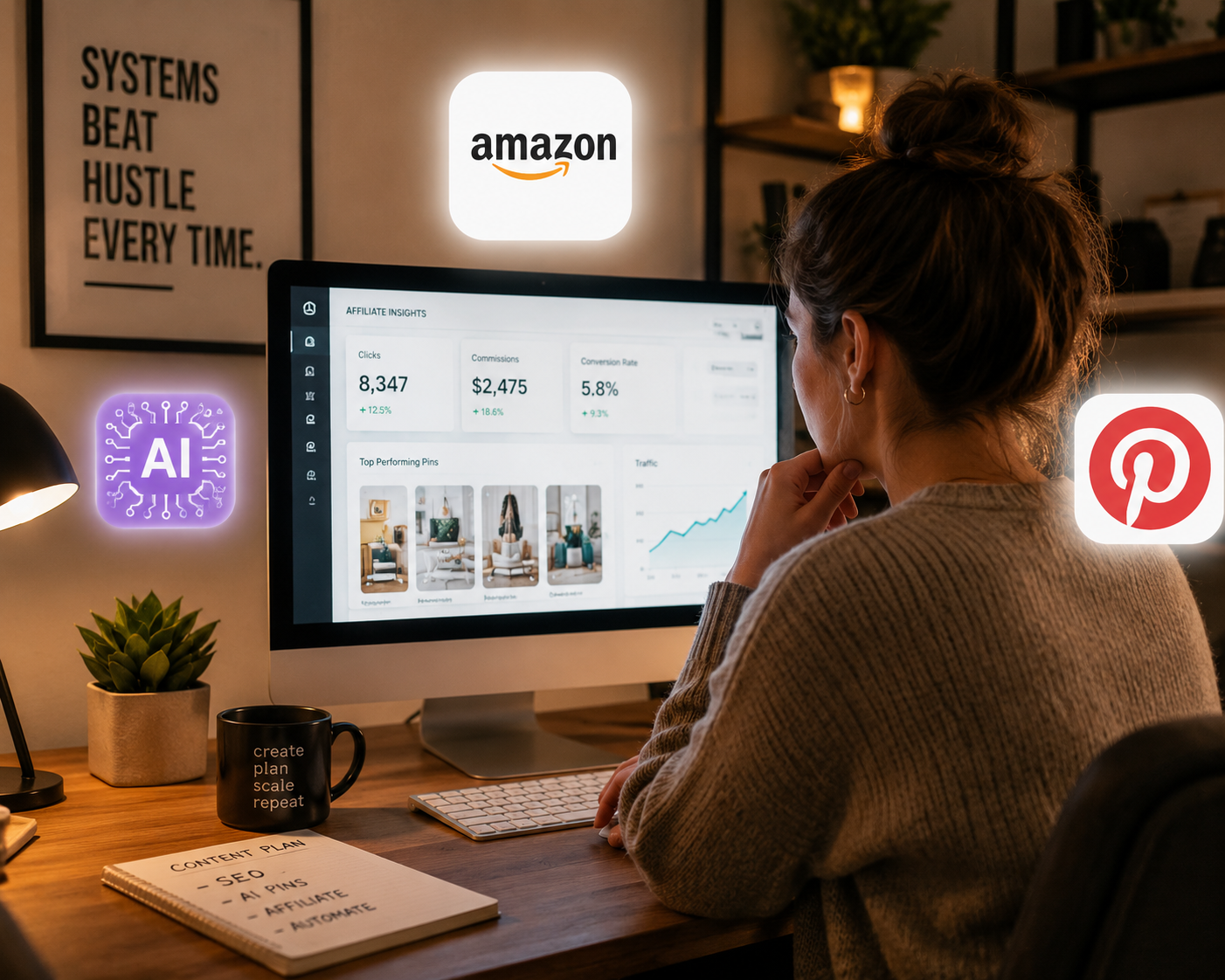
Most creators are not switching to AI because they dislike photography.
They’re switching because the economics changed.
Lower commissions mean creators need:
- more content output
- more testing
- more variations
- faster publishing cycles
- lower production costs
AI dramatically reduces friction.
Instead of spending days creating one Pinterest asset, creators can now test:
- multiple backgrounds
- alternate layouts
- different text hooks
- seasonal variations
- various product combinations
- trend-specific aesthetics
…in a fraction of the time.
This allows creators to behave more like media companies.
They can publish faster, test faster, and optimize faster.
And over time, that speed compounds.
How Top Creators Are Actually Using AI Pins
Top creators are already experimenting heavily with AI-assisted Pinterest workflows. One of the most discussed examples came from Amazon and Logie influencer Andreea (@Kindly.Connected), who openly discussed testing AI-generated imagery during a Logie live session.
“I’VE TAKEN A RISK AND POSTED SOME AI PHOTOS ON MY AMAZON STOREFRONT, WHICH I DON’T RECOMMEND DOING, BECAUSE I DON’T THINK YOU SHOULD BE USING AI ON YOUR AMAZON STOREFRONT. BUT I WAS SENDING TRAFFIC TO… PINTEREST TRAFFIC TO A PHOTO THAT WAS AN AI PHOTO, AND AMAZON PUT MONEY BEHIND THAT PHOTO… SO I’M NOT SAYING EVERYBODY GO AND USE AI ON YOUR AMAZON, I DON’T RECOMMEND THAT. IT WAS A RISK THAT I WAS WILLING TO TEST.”
That quote became a major talking point because it revealed what many creators were already quietly testing.
Instead of relying entirely on traditional photography, creators were using AI-generated visuals to increase content output and drive Pinterest traffic.
Andreea’s workflow combines:
- Canva workflows
- AI-generated imagery
- screenshots
- Pinterest optimization
- affiliate disclosures
- AI-modified labels
She creates pins in ChatGPT and Canva, sometimes using screenshots or API-fetched Amazon images to build transformed Pinterest-friendly collages and lifestyle visuals.
The result? Higher reach, compliant income, and workflow speed that other creators envy.
And for creators competing in affiliate marketing, speed matters.
Pinterest Pin Styles Performing Best Right Now
Not all AI-generated pins perform equally.
Some visual styles are consistently outperforming others.
The creators seeing the strongest engagement are focusing on Pinterest-native aesthetics rather than overly polished advertisements.
High-Performing Pinterest Styles in 2026
Minimal Lifestyle Collages
Products combined with clean backgrounds, subtle typography, and neutral color palettes.
Cozy Home Office Scenes
Pinterest users love productivity setups, warm lighting, and minimalist spaces.
Fashion Lifestyle Imagery
AI-generated fashion imagery is exploding because creators no longer need expensive photoshoots.
“Amazon Finds” Layouts
Pinterest users respond strongly to curated discovery-style content.
Neutral Flat-Lays
Especially popular in beauty, skincare, and home decor niches.
Pinterest Mood Boards
Collage-style visuals with soft branding often outperform aggressive sales graphics.
For fashion specifically, many creators report that simpler pins perform better.
“For fashion specifically, not adding text does a lot better for my account than adding text.”
That insight aligns with broader Pinterest trends.
The platform increasingly rewards visuals that feel inspirational rather than overly promotional.
The Compliance Rules Most Creators Still Don’t Understand
This is where most confusion still exists. Creators hear that AI content is allowed and assume everything is automatically safe.That’s not true.
There’s an important difference between transformed content and raw product reposting.
The Most Important Rule
Do not simply download and repost raw Amazon product images.
That’s where creators run into problems.
Instead, creators should transform the content using:
- Canva collages
- background removal
- overlays
- lifestyle scenes
- AI-generated compositions
- API-connected workflows
Transformation changes the asset into new creative content.
That distinction is critical.
One creator explained it this way:
“As long as you don’t use the original Amazon photo by itself, you’re fine to do whatever you want and, you know, use it however you want.”
Again, transformation is the key.
Quick Compliance Rules for AI Pinterest Pins
Generally Allowed
- AI-generated lifestyle imagery
- Canva collages
- background removal
- API-connected product workflows
- Pinterest AI labels
- affiliate disclosures
- transformed product imagery
Risky or Not Recommended
- uploading raw Amazon product photos
- misrepresenting products
- editing products inaccurately
- skipping disclosures
- making fake claims
- posting misleading AI imagery
Creators should also understand that platform policies evolve constantly.
Staying updated matters.
Canva vs Amazon’s Built-In Collage Tool
Amazon’s built-in collage tool works well for beginners.
But most advanced creators quickly outgrow it.
The reason is simple:
Pinterest rewards creative flexibility.
And Canva offers far more control.
Amazon Collage Tool
Pros
- beginner friendly
- fast setup
- built into Amazon
- easy product importing
Cons
- limited customization
- weak Pinterest optimization
- limited typography control
- less trendy layouts
- minimal branding flexibility
Canva Workflow
Pros
- Pinterest-perfect sizing
- background removal
- advanced typography
- AI-powered design tools
- better visual customization
- multi-platform workflows
- easy brand consistency
- API-connected product integration
Cons
- requires stronger design instincts
- Some premium features cost extra
For serious Pinterest creators, Canva is becoming the standard workflow.
Walkthrough: Building TOS-Legal Viral Pinterest Pins FAST
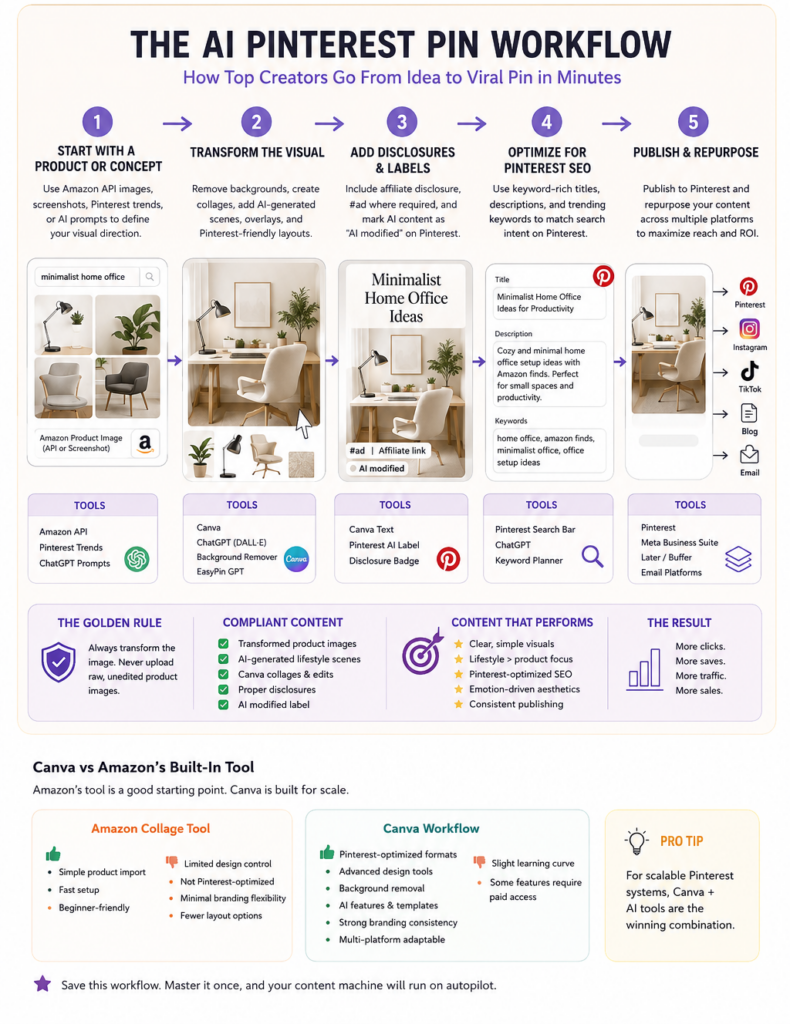
Step 1: Start with a Product or Prompt
Creators begin with:
- Amazon API image pulls
- screenshots
- AI prompts
- inspiration images
- Pinterest trends
Example prompt:
‘’Create a cozy Pinterest-style home office scene with warm lighting, neutral decor, and minimalist Scandinavian aesthetic.”
Step 2: Transform the Visual
Inside Canva or ChatGPT, creators:
- remove backgrounds
- create collages
- generate AI models
- add overlays
- build Pinterest-friendly layouts
This is where raw assets become transformed creative content.
Step 3: Add Disclosures
Creators should always include:
- affiliate disclosures
- #ad labels when appropriate
- Pinterest “AI modified” labels
Pinterest AI labels are now a toggle, not a barrier to reach.
Step 4: Optimize for Pinterest SEO
Pinterest is heavily search-driven.
Creators should optimize:
- titles
- descriptions
- keywords
- categories
- trend phrases
Example:
“Minimalist Amazon Home Office Finds for Cozy Productivity”
Step 5: Publish and Repurpose
Top creators reuse winning assets across:
- TikTok
- blogs
- Amazon storefronts
- email campaigns
One strong asset can fuel multiple platforms.
Fashion & Furniture Examples
Fashion
OOTD (Outfit of the Day) pins often perform best with AI-generated models, sometimes even better without text overlays.
“For fashion specifically, not adding text does a lot better for my account than adding text.”
Minimal visuals frequently outperform cluttered graphics.
Home & Furniture
Creators combine:
- product screenshots
- AI-generated room backgrounds
- Pinterest-style layouts
to create viral visuals like:
- cozy office setups
- aesthetic bedroom scenes
- luxury-inspired living rooms
The real bottleneck is creative transformation, not platform visibility.
Do AI Pins Hurt Pinterest Reach?
Many creators still worry that AI labels reduce visibility.
Right now, there’s little evidence supporting that fear.
In fact, many viral Pinterest pins are already AI-assisted.
Pinterest appears to care far more about:
- engagement
- saves
- click-through rates
- visual quality
- freshness
…than whether AI was used.
Bad content performs badly regardless of whether AI was involved.
The quality of the idea, design, and execution still matters far more than the tool used to create it.
Example ChatGPT Prompts for Pinterest Pins
Fashion Prompt
“Create a Pinterest-style lifestyle image of a woman wearing a neutral summer outfit outdoors with soft editorial lighting and luxury aesthetic.”
Home Decor Prompt
“Generate a cozy modern home office scene with warm lighting, minimalist furniture, and clean Pinterest-style composition.”
Beauty Prompt
“Create a luxury skincare flat-lay with neutral tones, soft shadows, and premium Pinterest aesthetic.”
Furniture Prompt
“Generate a Scandinavian-inspired living room featuring a modern accent chair and soft natural lighting.”
The goal isn’t creating random AI art.
The goal is to generate platform-native visuals.
Common AI Pinterest Mistakes That Kill Reach
AI tools help creators move faster, but they do not automatically create good content.
Biggest Mistakes
- unrealistic AI imagery
- overloading pins with text
- Weak Pinterest SEO
- inconsistent branding
- reposting raw product images
- ignoring seasonal trends
- weak prompts
- overly promotional designs
The creators succeeding with AI combine:
- visual taste
- platform understanding
- SEO knowledge
- consistency
- fast experimentation
AI alone is not enough.
Smart Internal Linking: Extend Your Asset Workflow
AI-powered Pinterest pins are just the beginning of a larger content ecosystem.
Top creators now:
- Use Pinterest for discovery
- send traffic to Amazon storefronts
- repurpose assets across platforms
- build searchable content libraries
- create reusable workflow systems
The smartest creators are building scalable asset machines, not isolated posts.
Pro Tips & Common Questions
How many AI images can you generate in ChatGPT for free?
Most free plans allow a limited number of daily generations. Paid plans dramatically increase output and workflow speed.
What if you don’t own the product?
Creators often use:
- screenshots
- API-fetched imagery
- AI-generated collages,
- lifestyle mockups,
while properly disclosing affiliate relationships and AI use.
AI-powered Pinterest workflows are not just a trend.
They represent a larger shift in creator economics.
Content production is becoming:
- faster
- cheaper
- more scalable
- more systemized
The creators adapting fastest gain the advantage.
And increasingly, success is less about expensive production and more about:
- consistency
- testing
- workflow efficiency
- visual quality
- speed
AI compresses production time.
That changes everything.
AI Won’t Save Bad Content
This is important.
AI tools are powerful, but they are not magic.
Weak hooks still fail.
Ugly layouts still fail.
Poor SEO still fails.
Inconsistent posting still fails.
The creators dominating Pinterest in 2026 are combining:
- AI speed
- creative instincts
- audience understanding
- platform strategy
- visual consistency
- rapid experimentation
That combination is what scales.
Now’s the Moment: Modernize Your Pin Creation & Sell More with Less
The creators winning on Pinterest today aren’t necessarily the ones with the best cameras.
They’re the ones adapting fastest.
AI-powered Pinterest workflows dramatically reduce production time, increase publishing speed, and make affiliate content creation more scalable than ever before.
And as Pinterest, Canva, and AI tools continue evolving together, creators who learn these systems early will have a massive advantage.
AI isn’t replacing creativity.
It’s compressing production time.
And right now, speed is becoming one of the biggest competitive advantages in affiliate content.
Do brands approve AI imagery?
Many brands do, as long as products are not misrepresented.
As Andreea explained:
“Four out of five brands surveyed said yes, as long as you don’t change our product or make it look different.”
Can you use Amazon images on other platforms?
Only if the images are transformed through compliant workflows like:
- collages
- background removal
- Canva API integrations
Never repost raw Amazon product photos directly.
The Bigger Shift Happening Right Now
AI-powered Pinterest with the best cameras.
They’re the ones adapting fastest.
AI-powered Pinterest workflows dramatically reduce production time, increase publishing speed, and make affiliate content creation more scalable than ever before.
And as Pinterest, Canva, and AI tools continue evolving together, creators who learn these systems early will have a massive advantage.
AI isn’t replacing creativity.
It’s compressing production time.
And right now, speed is becoming one of the biggest competitive advantages in affiliate content.