
Last updated: May 2026 | Reading time: ~15 minutes
—
YouTube has become the most powerful marketing channel that most brands still underestimate.

It is no longer just a place to host product videos. In 2026, YouTube functions as a search engine, a purchase-decision platform, a connected TV destination, a creator economy engine, and a serious performance marketing channel all at once.
And the numbers behind it are staggering: YouTube’s 2025 annual revenue hit $62.3 billion
, eclipsing Disney for the first time and making it the largest media company in the world by revenue.
For brands, this changes everything about how creator partnerships should be approached.
A YouTube creator integration is no longer a one-off influencer mention. Done well, it becomes searchable content, social proof, product education, brand storytelling, and paid media creative all rolled into a single asset that can keep performing for months.
That is exactly why the most forward-thinking brands are treating YouTube creators as long-term growth partners rather than disposable media placements.
This guide covers everything you need to know to build a YouTube creator marketing strategy that actually compounds.
—
Why YouTube Creator Marketing Matters More in 2026 Than Ever Before
The fundamental advantage YouTube holds over almost every other social platform is intent.
People arrive on YouTube with a purpose to learn something, solve a problem, compare products, watch a review, or go deeper on a topic they care about.
That makes it uniquely powerful for any product category where trust and explanation matter, which is most categories.

A short social post can create fleeting awareness. A YouTube video can build genuine confidence.
That distinction matters because buying decisions are rarely instant. A viewer might first encounter your brand through a YouTube Short, then watch a long-form review, then search for comparisons and then return two weeks later, ready to buy.
YouTube supports that entire journey better than any other single platform because it combines short-form discovery, long-form depth, search intent, subscriptions, creator trust, and paid amplification in one ecosystem.
The scale is now impossible to ignore
- 2.70 billion people use YouTube monthly, roughly 25% of the world’s total population
- YouTube Shorts now generates 200 billion daily views, nearly tripling from 70 billion just a year earlier
- Users spent an average of 48.7 minutes per day on YouTube in 2026
- YouTube’s ad revenue of $40.4 billion in 2025 exceeded the combined totals of Disney, NBCUniversal, Paramount, and Warner Bros. Discovery
- YouTube delivers 23% higher ROI than other social channels and 109% higher ROI than linear television (Nielsen, 2026)
Our take: Any brand still treating YouTube as a secondary channel or as a place to repost TikTok content is leaving serious money on the table. The brands that will win in 2026 are the ones treating YouTube as a compounding content asset, not an afterthought.
—
The Longevity Advantage: Why YouTube Content Outlasts Everything Else
One of the most costly mistakes brands make with YouTube creator campaigns is judging performance too early.
On fast-moving social feeds, TikTok, Instagram Reels and LinkedIn, performance spikes within the first 24–48 hours and then effectively disappear.
YouTube behaves completely differently. Videos continue getting discovered through search, recommendations, playlists, Shorts, external embeds, and creator channel libraries, sometimes for years.
According to Think with Google, citing an Agentio study of 10,000 YouTube integrations, 40% of a video’s total views happen more than 30 days after it goes live, and 30% of clicks come after that same 30-day mark.
A standard one-week or two-week reporting window, which is how most brands currently measure influencer campaigns, can dramatically undervalue YouTube creator performance.
The key mindset shift: YouTube creator marketing should not be measured like a disposable ad placement. It should be measured like a compounding content asset with a long tail of value.
This also changes what “success” looks like on day seven. Early view counts matter less than watch time, comment quality, and search ranking.
A video that ranks for a high-intent search term your buyers already use is worth more in the long run than a video that went briefly viral and then vanished.
—
Shorts + Long-Form: Why the Combination Is the Real Opportunity
YouTube’s competitive strength in 2026 is not just long-form video. It is the interplay between Short-form and long-form content that no other platform can currently match at scale.
A YouTube/Ipsos study from February 2026 found that 76% of weekly YouTube users say access to both short-form and long-form content is a top reason YouTube is their go-to platform.
That’s a structural advantage. And the audience reach is additive: 45% of YouTube Shorts users are not on TikTok, and 65% of Shorts users are not on Instagram Reels.
In practical terms, here is how the format combination works for brands:
Shorts introduce the idea quickly. They show the problem, tease the solution, spark curiosity, or capture a compelling moment. They are discovery and awareness tools.
Long-form videos do the heavy lifting, explaining the product in depth, comparing alternatives, showing real use cases, answering objections, and building the trust that converts browsers into buyers.
Together, they create a more complete purchase funnel than either format alone.
Stop briefing YouTube creators on a single-post format. Brief them on a content system that combines a Short (discovery) with a longer video (education and conversion). The two assets reinforce each other, amplifying compounding.
For reference, YouTube’s internal data from March 2026 shows that repurposing ads from other platforms onto YouTube Shorts can increase long-term brand growth by 21%.
—
The Bring, Build, Boost Framework
YouTube’s own 2026 Creator Marketing Playbook organizes a practical strategy around three steps: Bring, Build, and Boost. It is a solid framework and one we recommend brands adopt directly.
1. Bring: Repurpose What Already Works
Most brands are sitting on video assets they have not fully exploited, such as TikToks, Instagram Reels, paid social creatives, product demos, webinars, founder interviews and customer testimonials. The first step is bringing the strongest of those assets into YouTube’s ecosystem, particularly Shorts.
This does not mean a blind cross-post. Effective YouTube Shorts open quickly, clearly convey value within the first two seconds, use captions, and connect naturally to a broader product story.
The shortcut is to start with what already shows signs of demand: high watch time, saves, shares, comments, or strong click-through behavior on other platforms. If an asset is already resonating elsewhere, it is worth adapting for YouTube rather than building from scratch.
2. Build: Partner With the Right Creators
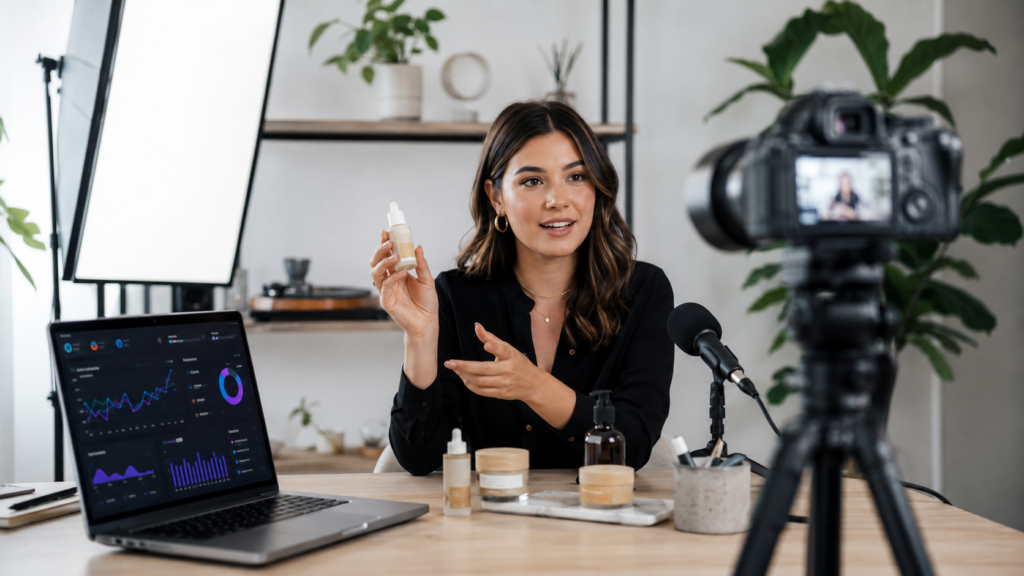
The best YouTube creator partnerships are built around relevance and fit, not follower count. A creator with 80,000 highly engaged subscribers in your exact product niche will almost always outperform a creator with 2 million followers whose audience does not care about your category.
When evaluating potential YouTube creator partners, the questions worth asking are:
- Does their audience match your ideal customer profile?
- Would your product feel natural and credible in their content?
- Are commenters asking real questions, sharing personal experiences, or showing purchase intent?
- Does the creator rank for search terms your buyers already use?
- Can they explain, demonstrate, or tell a story without sounding like they are reading a script?
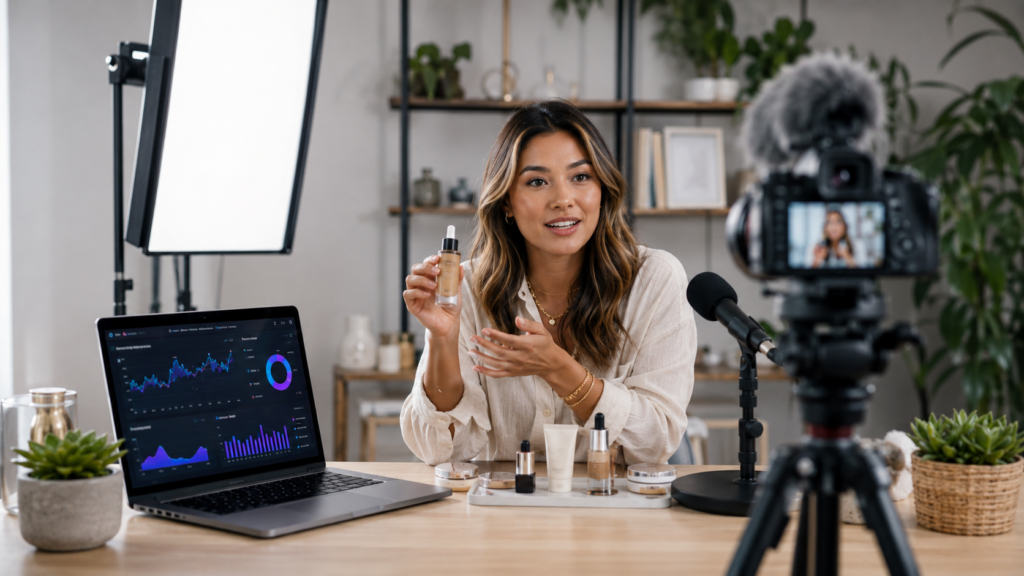
On creative freedom: The data here is clear. Google’s case study on Bombas highlights that giving creator Caroline Winkler high-level talking points and guardrails, while letting her deliver the message in her own voice, produced placements that felt genuinely native and reduced the creative fatigue typical of standard digital ads.
Over-scripted creator content is one of the most common reasons YouTube campaigns underperform.
The new YouTube Creator Partnerships platform (formerly BrandConnect, relaunched at the 2026 NewFronts) gives brands access to more than 3 million creators within the YouTube Partner Program, searchable directly inside Google Ads using Gemini-powered AI.
Creators who share channel insights with advertisers are surfaced 60% more frequently in search results.
78% of viewers say YouTube has the most trusted creators for product recommendations, which should be the foundation for your creator selection.
3. Boost: Turn Strong Creator Content Into Paid Media
Organic reach is valuable, but the strongest YouTube creator campaigns do not stop there.
Google Ads’ Creator Partnerships Boost allows brands to link creator videos directly to ad campaigns and run them as paid media.
The feature is available across Demand Gen, Video Reach, Video View, App, Video Action, and Performance Max campaigns. Critically, the ads run from the creator’s channel, which preserves the authenticity and social proof that makes creator content perform differently from traditional brand creative.
The performance data supporting this investment is compelling:
- YouTube drives 86% higher incremental long-term ROAS than paid social(Circana/Google MMM meta-analysis, 2025)
- Creator Partnerships Boost on Demand Gen campaigns delivered an average 20% increase in conversion lift (Google internal data, Jan 2025–Jan 2026)
- Brands using Creator Partnerships Boost saw 5% higher lift in long-term brand equity, outperforming other platforms by 3.1 times (Kantar/Google US Context Lab, 2026)

Our recommended workflow:
- Launch creator content organically and let it breathe for 7–14 days
- Monitor early engagement, watch time, comment quality and click behavior
- Identify the top-performing videos
- Secure usage rights before boosting (your creator agreement must explicitly cover paid amplification)
- Boost the strongest videos through Google Ads using Creator Partnerships Boost
- Run a head-to-head experiment: creator video vs. standard brand creative, keeping budgets and targeting identical
- Measure against both brand and performance outcomes over at least 60 days
One thing many brands miss: the YouTube Creator Partnerships hub also lets you build custom audience segments from people who have watched creator videos and use those segments as seeds for lookalike audiences in Demand Gen campaigns. This is a significant capability that most brands are not yet using.
—
What YouTube Creator Marketing Actually Costs
Pricing is one of the most opaque areas in creator marketing, and it varies enormously. But here is a realistic framework:
Micro-creators (10K–100K subscribers): Typically $500–$5,000 per integration, depending on niche, engagement rate, and video format. Often, the highest ROI tier is for niche product categories.
Mid-tier creators (100K–1M subscribers): Typically $5,000–$50,000 per integration. High value for product education in established categories.
Large creators (1M+ subscribers): Typically $50,000–$500,000+. Justified primarily for broad awareness goals or when combined with a paid boosting strategy.
Important caveat: Follower count is the worst proxy for value. Always negotiate based on average views per video, audience demographics, and category engagement, not subscriber counts.
A creator with 200K subscribers and 8% engagement in your specific niche is worth more than one with 2 million subscribers and 0.5% engagement in a broad lifestyle category.
For brands getting started, allocating 70% of the creator budget to micro and mid-tier creators and reserving 30% for testing larger creator relationships tends to produce better learnings and more efficient spend.

—
How to Measure YouTube Creator Campaigns Properly
YouTube creator marketing needs a wider measurement window and a broader set of metrics than most social campaigns.
Do not only ask: “How many clicks did we get in the first seven days?”
Instead, build your measurement framework around these questions:
Awareness and trust signals:
- Did branded search volume increase during and after the campaign?
- Are comments showing purchase intent, product questions, or personal experience sharing?
- Did the video rank for relevant search terms your buyers use?
Performance signals:
- Did traffic to the landing page continue growing after 30 days?
- Did boosted creator content outperform standard brand creative in head-to-head tests?
- What were the assisted conversion rates where YouTube played a role in paths that converted elsewhere?
Long-term signals:
- Did repeated creator integrations improve brand recall and trust over time?
- Did the creator audience become a high-value retargeting segment?
[All standard Google Ads reporting and Lift measurement capabilities](https://support.google.com/google-ads/answer/15223349?hl=en) are available for campaigns using Creator Partnerships Boost, including Brand Lift, Search Lift, and Conversion Lift studies. Use them. And commit to a minimum 30–60 day measurement window before drawing conclusions.
On engagement rate: A 2026 study analyzing over 7 million YouTube videos found that while views grew 76% year-over-year, the overall engagement rate dropped 37%, from 3.73 to 2.34. This is because view counts are growing faster than interactions.
For brands, this means a lower engagement rate does not necessarily indicate underperformance. If absolute likes and comments are increasing, the channel and campaign are healthy. Context matters more than benchmark comparisons.
—
A Practical YouTube Creator Marketing Plan for 2026
For brands just getting started:
- Audit your existing short-form video assets from other platforms
- Identify your top 5–10 by engagement and adapt them for YouTube Shorts
- Use the YouTube Creator Partnerships hub in Google Ads to find creators already discussing your product category
- Start with 3–5 creators whose audiences closely match your target customer, and prioritize relevance over reach
- Write flexible briefs: share the key message, product benefits, and brand guardrails, but do not script the delivery
- Secure usage rights explicitly in your creator agreements before launch
- Track results for at least 30–60 days before evaluating performance
For brands already investing in YouTube creators:
- Shift from one-off sponsorships to ongoing creator relationships, recurring integrations and build trust signals that single placements cannot
- Use Shorts for discovery and long-form videos for product education and conversion
- Build a systematic paid boosting process for top-performing creator videos
- Set up head-to-head experiments: creator video vs. standard brand creative
- Build audience segments from creator video viewers and use them as lookalike seeds
- Measure search lift, assisted conversions, 60-day view trends, and paid performance side by side
- Consider the new Open Call feature in Creator Partnerships, which lets brands publish a brief and receive creator applications, useful for discovering non-obvious creator matches at scale
—
The New Tools Reshaping YouTube Creator Marketing in 2026
Several platform updates have materially changed what is possible this year.
YouTube Creator Partnerships (formerly BrandConnect): The biggest structural change. Announced at the YouTube NewFronts 2026, this Gemini-powered platform gives brands access to 3+ million vetted creators, AI-driven discovery, zero-commission deals, and unified organic and paid performance reporting, all inside Google Ads.
This is not an incremental update; it fundamentally consolidates creator marketing with performance advertising.
Affiliate Partnerships Boost: Announced at Brandcast 2026, this feature lets brands amplify organic creator content that already has their products tagged via YouTube Shopping affiliate links.
It is a win for both parties: creators earn on conversions, and brands get amplification of authentic content they did not have to commission.
Buy with Google Pay on CTV: YouTube viewers can now complete purchases with two clicks on their connected TV. For any brand with a direct-to-consumer component, this is worth paying close attention to.
Multimodal Video Creation: Google’s Brandcast 2026 announcement included AI-powered production tools using Gemini, Veo, and Nano Banana to move from a creative brief to a finished video with minimal manual production work.
This lowers the cost floor for creator-style content for brands that cannot always find or afford ideal creator partners.
—
Where YouTube Creator Marketing Is Heading
Three shifts will define the next phase of YouTube creator marketing.
First, creator content and paid media will merge. The line between influencer marketing and performance advertising is already blurred by Creator Partnerships Boost.
Brands that maintain separate influencer and media buying teams with separate budgets will be structurally disadvantaged compared to those that have integrated the two.
Second, AI will dramatically speed up creator workflows and make them more competitive.YouTube has already rolled out tools, including Ask Studio, title A/B testing, auto-dubbing upgrades, AI-powered inspiration tools, and Veo-supported video creation. As production costs fall, content volume in every niche will increase. The brands with established creator relationships and owned audience segments today will have a material head start.
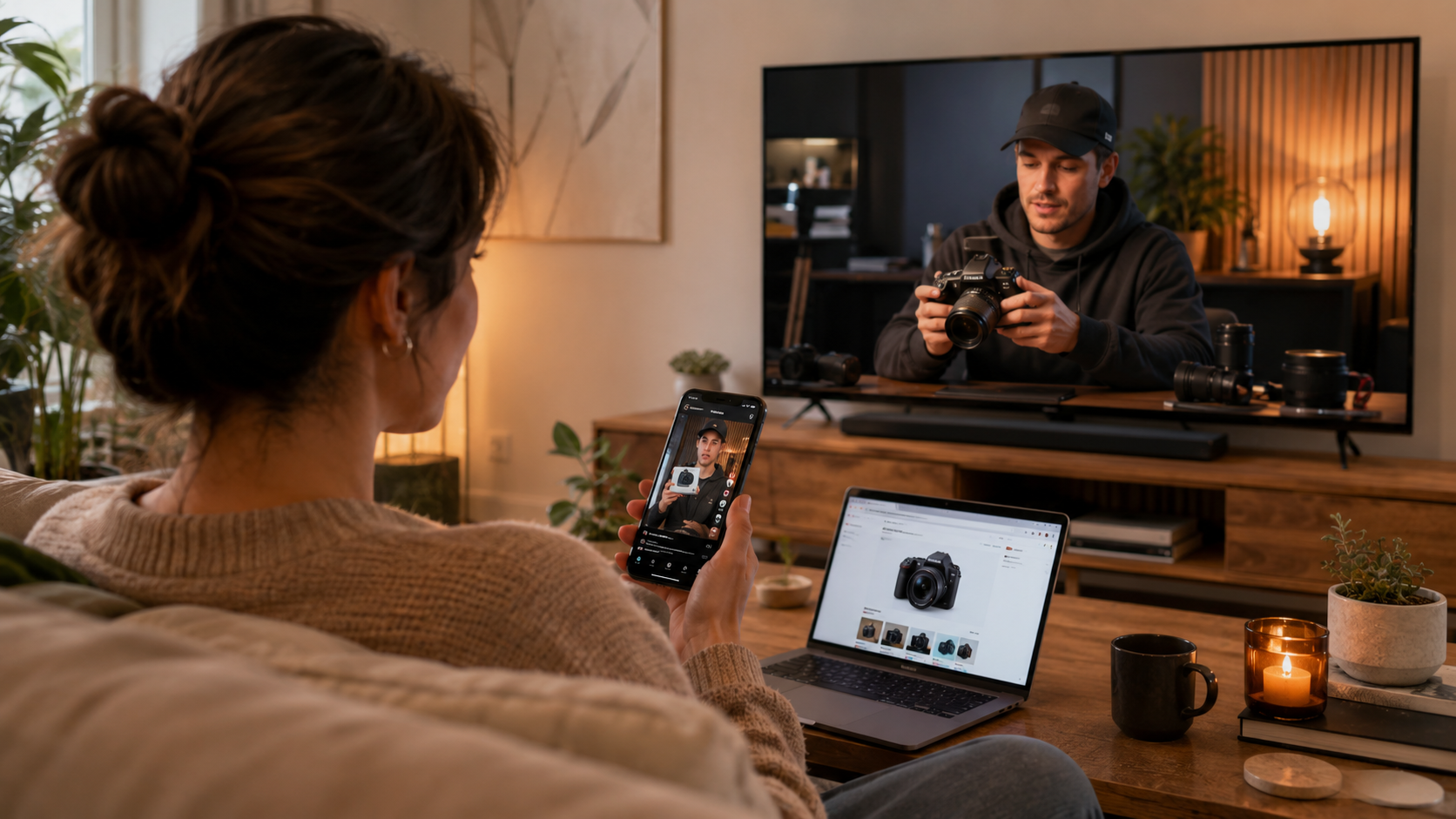
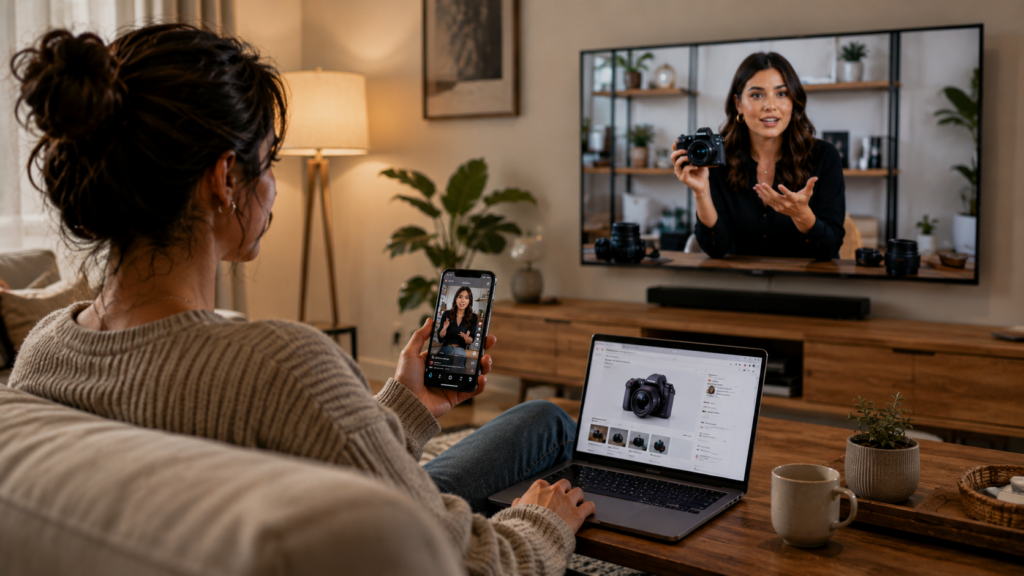
Third, the living room is becoming YouTube’s dominant screen. [More than 1 billion hours of YouTube content are watched on TV screens every day. That is not mobile background viewing it is lean-back, high-attention, TV-scale reach.
For brands that have historically written off YouTube as a “mobile platform,” this changes the audience context entirely. Creator content that plays well on TV is a different brief than content optimized for phone scrolling.
MoffettNathanson projects YouTube’s combined revenue will exceed $75 billion by 2027. The compounding advantage goes to brands that build on this platform now, before AI-native creators flood every niche and audience attention becomes even more competitive to earn.
—
Final Takeaway
YouTube creator marketing in 2026 is not about buying a few days of attention from a creator with a big following.
It is about building a content engine that earns genuine trust, stays discoverable through search for months or years, compounds in value over time, and can be amplified through paid media the moment it proves itself.
The brands that win will not be the ones with the biggest influencer budgets or the flashiest creator names.
They will be the ones who choose creators based on audience fit rather than follower counts, give those creators the room to speak in their own voice, measure performance with patience and the right metrics, and treat top-performing creator videos as long-term growth assets rather than one-time expenses.
The infrastructure is now fully in place between YouTube Creator Partnerships, Creator Partnerships Boost in Google Ads, and YouTube’s expanding AI production tools.
What separates the brands that benefit from it from those that don’t is simply whether they treat YouTube creator marketing as a serious, measured channel or as an experiment they haven’t fully committed to yet.