
- Luxury and high-ticket Amazon campaigns are a mixed bag: some creators see impressive returns, others experience disappointing engagement or outright flops.
- For beauty and creator ads, strategic use of idea lists and carousels converts – while generic luxury posts often underperform without audience-aligned curation.
- Constant testing, audience fit, and leveraging community insights are essential to unlocking real ROI in the crowded luxury vertical.
When we first asked the community whether luxury campaigns were worth the effort, the answer was a shrug split down the middle.
Some creators were seeing real traction, others were watching engagement quietly die. Two years and one very rough commission season later, that split hasn’t closed; it’s just gotten more expensive to ignore.
Because here’s what changed since that first conversation: Amazon didn’t just tweak the rules around luxury content. It restructured the underlying economics that made chasing high-ticket items worth it in the first place.

The Commission Picture Has Gotten Messier, Not Clearer
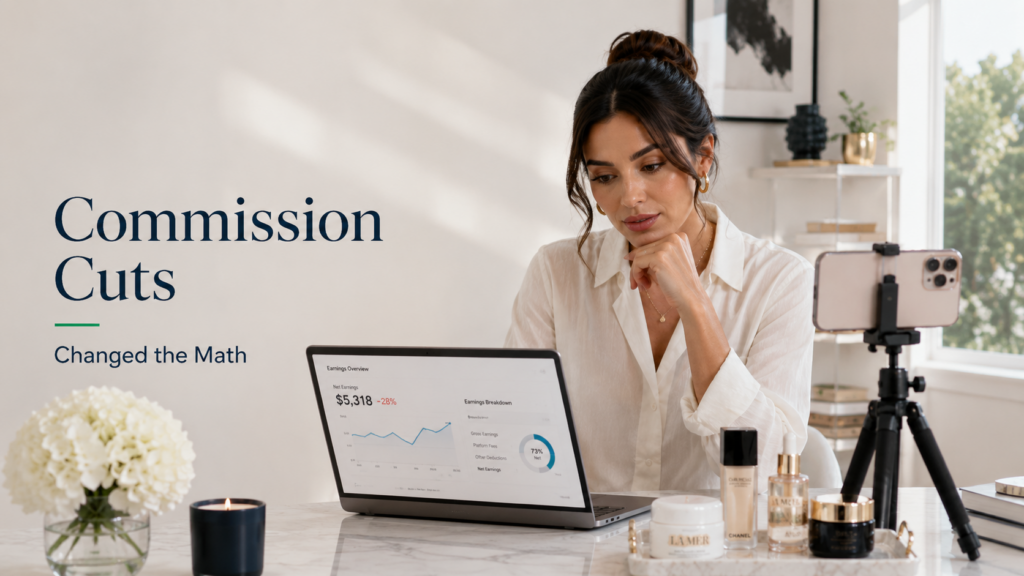
Earlier this year, Amazon repriced large parts of the Associates program. Reports describe cuts of up to 50% in some categories, with premium rates that once sat near 10% falling to 4 to 5% in several verticals.
Milestone bonuses were eliminated, and product-level reporting got noticeably thinner, so many creators found out about their new numbers by checking their own dashboards rather than through any announcement.
Luxury beauty is the category everyone watches closest, and even here the data doesn’t fully agree with itself.
Some 2026 rate breakdowns still list luxury beauty at a flat 10%, calling it one of the few categories that’s held steady for years.
Others point to a leaked internal rate card showing luxury beauty dropped from 10% to 9%, alongside a new tiered bonus that pays creators an extra 2% once they clear $50,000 in quarterly luxury beauty sales.
Whichever figure is exactly right, the direction of travel is the same. Amazon is narrowing the gap between luxury and everything else, while dangling scale-based bonuses to keep its highest earners producing content.
That’s a system built for creators who already have volume, not for someone testing luxury content for the first time.
This matters directly for the debate in our original thread. If the commission premium on luxury is shrinking while general categories get cut even harder, luxury’s relative appeal actually holds up better than it looks at first glance. The problem was never really the rate. It’s what we cover next.
The Community Split
The original disagreement is worth sitting with again, because none of it has aged out.
As Altovise Pelzer put it:
“I have not seen any traction, and I think it was you, Stephanie, that said you had some luxury product videos that you did, and like you saw a decrease in the engagement that you were getting for some of those things… but Andrew said they do great.”

Andrew’s experience leaned the other way, with shared luxury beauty and apparel idea lists driving solid carousel traffic. Michelle landed somewhere in between: luxury beauty performed well, “including internationally,” but luxury handbags were a different story, “zero traction.” Stephanie’s take cuts to the heart of it: “Luxury is an extra hour of sleep. We buy groceries, not bags.”
Stephanie’s framing turns out to be more statistically accurate than any of us probably realized at the time. Numerator’s real-time Prime Day 2026 tracker found that [69% of items purchased sold for under $20, just 3% were priced above $100, and average spend per item actually fell year over year to $23.23.
The typical Prime Day shopper skewed toward a high-income, suburban woman aged 45 to 64, which sounds like a plausible luxury buyer on paper, but the basket data says otherwise. People are stocking up on protein shakes and cat treats, not designer bags.
And yet beauty specifically bucked the trend. Baby, electronics, and beauty were named the top-performing verticals of Prime Day 2026, which lines up with what Andrew and Michelle both reported.
Luxury fashion had its own moment too, with Amazon’s Luxury Stores and Shopbop running real markdowns on Hermès, Chanel, and Cartier resale pieces during the event.
So luxury isn’t dead weight across the board; it’s just badly suited to impulse categories and much better suited to categories where people already save up and plan the purchase, like beauty and considered fashion.
The audience-fit test the community landed on originally still holds, and now there’s real event-level data backing it up. Luxury handbags on a grocery-and-gadgets audience were always going to underperform. Luxury beauty on the same audience works because beauty purchases don’t require the same financial commitment or occasion.
Idea Lists, Carousels, and Why the Rules Keep Shifting
The mechanics of getting luxury content seen have also moved since our first look at this. Amazon’s carousel algorithm now weighs watch time more heavily than conversion rate, which is a real reversal of years of standard advice to keep videos short and punchy.
Longer, substantive luxury content that actually explains materials, fit, or heritage now has more staying power in the carousel than a quick unboxing, which plays directly into Stephanie’s “real talk” point about why generic luxury posts underperform.
There’s also a tagging discipline worth adopting. Videos with too many product tags tend to lose upper-carousel placement, so trimming down to one to three highly relevant tags per video, and treating idea lists and collages as a separate experiment from tagged video, tends to protect placement rather than dilute it.
Idea lists themselves remain one of the stronger levers for luxury specifically, especially when they’re built as a flywheel rather than a one-off post.
One approach the community has seen work well: build a tightly themed idea list, pin it to your storefront, then create standalone video content elsewhere that links straight back to that list.
The external content arrives with warmed-up intent, the list gets the dwell time and click signals that push it up in Shop by Interest feeds, and the two channels feed each other.
The Off-Site Shift Changes the Luxury Calculation Too
None of this happens in a vacuum. Amazon has been pushing creators toward off-site traffic generation all year, partly because the March reporting changes made pure on-platform dependency look riskier, and partly because Amazon simply wants new shoppers arriving from outside rather than recycling the same on-platform audience.

For luxury content specifically, that’s an opportunity rather than a burden. If your on-platform audience skews toward the $23-average-basket Prime Day shopper, your best luxury traffic was never going to come from there anyway.
Pinterest, Benable, and niche blogs draw a shopper who’s already further along in intent, which is exactly the audience luxury content needs.
It also means the “just post it and hope the algorithm finds it” approach to luxury is now actively penalized twice over, once by an algorithm that rewards off-site-sourced engagement, and once by an audience mismatch that no amount of on-platform reach fixes.
Where This Leaves Luxury Campaigns Going Into the Rest of 2026
Nothing here overturns the original verdict; it sharpens it. Luxury can still work, but the margin for error has narrowed. Commission cuts elsewhere make luxury’s relative payout more attractive even where luxury’s own rate has softened.
Prime Day data confirms the audience-fit problem is real and measurable, not just a vibe creators picked up on. And the platforms rewarding longer, more considered content happen to be exactly the format luxury needs to earn trust.
The creators still getting traction in luxury tend to share three habits: they stick to categories where their audience already spends without a second thought, mostly beauty and considered fashion rather than aspirational big-ticket items, they build content designed for dwell time rather than a quick sell, and they treat off-site traffic as the primary channel rather than an afterthought.
Everyone else is likely to keep seeing the flat engagement Stephanie described, just with a smaller commission cushion to make it worthwhile.