

- AI tools have made it shockingly easy to steal not just your videos, but your face, voice, and persona – creators must be proactive in 2026.
- Platforms like YouTube now offer some protection, but Amazon and others lag behind, leaving sellers at risk of having their likeness abused.
- Clear steps – auditing, watermarking, community vigilance, and understanding platform-specific IP tools – can help secure your content and reputation.
Deepfakes are stealing creator identities faster than platforms can catch them. Here’s what’s driving AI likeness theft in 2026, which platforms are fighting back, and how to protect yourself.
—

AI Content & Likeness Theft:
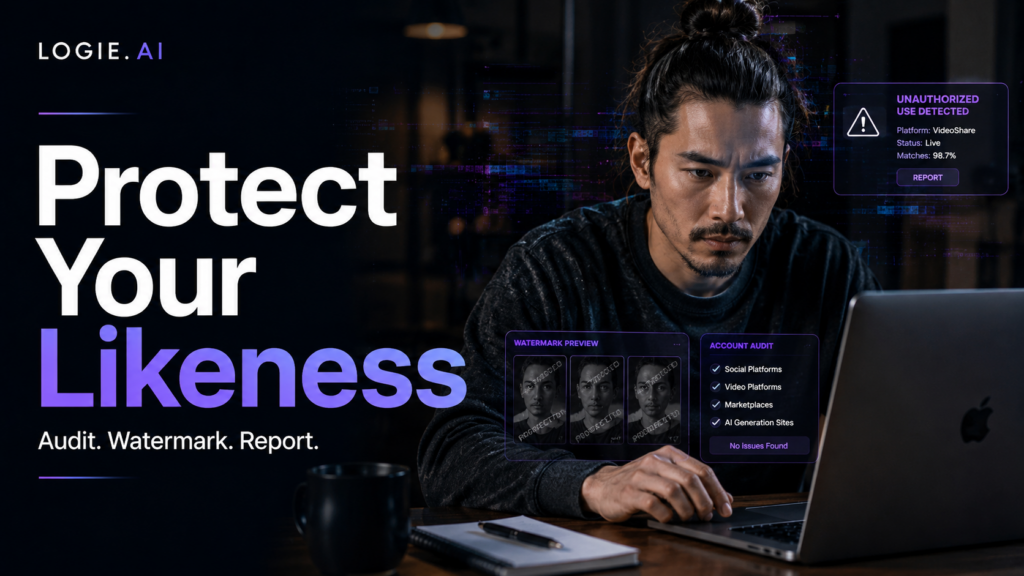
If 2023’s biggest creator fear was unauthorized reposts, 2026 is the era of stolen identities. Anyone with a few AI tools can now copy your videos, or worse, your face and voice, and recast you in content you never approved.
As Altovise Pelzer shared on Logie’s July call, “So now, instead of just stealing your video, they’re stealing your likeness. And creating content with your likeness.”
This is no longer a niche problem affecting a handful of celebrities. It is a structural shift in how creator identity gets exploited, and the numbers back that up.
Just How Big Is the Problem?
The scale is genuinely alarming once you look past the headlines. An MIT analysis of the AI Incident Database found that reported cases of malicious actors using AI to produce disinformation and scam victims jumped from 20 records in 2022 to 211 in 2025, according to Rolling Stone’s reporting on creators fighting AI deepfakes.
The article follows podcaster Yanina Oyarzo, who built a 90,000-person Instagram following, only to discover an AI avatar of herself promoting a personal-injury law firm she had never worked with. She wasn’t the only one.
Fashion creator Brookins found her likeness altered to promote a Bible study app, and later discovered a cybersecurity company had lifted footage from her TikTok to advertise its product.
What’s notable is that this isn’t only a big-account problem. Hany Farid, cofounder and chief science officer at GetReal Security, frames it less as a “deepfake problem” and more as an “identity problem,” pointing out that anyone with even a single public photo or short clip can have their likeness cloned regardless of follower count, as noted in the same Rolling Stone piece.
For creators managing their own channel without a legal or PR team behind them, that’s a sobering reality.
The financial fraud angle makes the urgency even clearer. According to CybelAngel’s 2026 breakdown of deepfake-driven fraud, a convincing voice clone can now be built from as little as three seconds of audio, and a deepfake video can be produced in under an hour using tools that cost only a few dollars per campaign.
The FBI logged more than 22,000 AI-related fraud complaints in 2025 alone, with losses exceeding $893 million.
Separately, Resemble AI’s Deepfake Watchlist has documented a growing, repeatable industry of scam ads that clone creator and celebrity faces and voices to push fake investments and giveaways, warning that mid-tier creators are increasingly viewed as easy, high-yield targets, both as impersonation material and through direct account takeovers.
Who’s Protecting Creators?
Some platforms are stepping up faster than others, and the gap between them matters for anyone building a business around social commerce.
YouTube has moved the furthest. In October 2025, YouTube officially rolled out its Likeness Detection tool to all creators in the YouTube Partner Program, following a pilot built in partnership with Creative Artists Agency, according to TechCrunch’s launch coverage.
The tool works similarly to Content ID, but instead of scanning for copyrighted audio or video, it scans newly uploaded content for a creator’s enrolled facial likeness and flags potential matches for review.
Enrollment requires a government-issued ID and a short selfie video, and it can take up to 5 days to activate, according to YouTube’s own support documentation.
By March 2026, YouTube reported roughly 4 million Partner Program creators had enrolled, and the company has since expanded eligibility to talent agencies and celebrities without a YouTube channel, government officials, journalists, and political candidates, per YouTube’s official announcement. Voice detection is expected to follow in 2026.
Amazon and other commerce platforms remain behind, and the Logie creator community felt this gap sharply during the July call. As one community member summarized during the webinar:
“YouTube’s AI flagged a stolen video using my face for a Play-Doh promo. Amazon, why haven’t you done this yet?”
That frustration aligns with what legal analysts are now publicly flagging. A May 2026 legal risk breakdown for Amazon sellers points out that Amazon’s UGC-style AI video content creates a genuine legal exposure problem: when an AI-generated person resembling a real, identifiable individual appears to endorse a product, the seller can be on the hook for right-of-publicity violations, false endorsement claims, and even defamation if the depiction is damaging, regardless of intent.
The piece is blunt about one point worth repeating to any seller cutting corners with AI UGC: owning the video file does not give you the right to use someone’s face, voice, or identity within it.
Amazon has been active on AI policy this year, but the focus has mostly landed on fake reviews and automated seller agents rather than likeness protection specifically.
Amazon’s March 2026 policy update formalized rules governing AI seller agents and automated repricing, and the platform has ramped up AI-powered fake-review detection, as covered in SalesDuo’s fake review crackdown analysis.
What’s still missing is a creator-facing likeness-detection and takedown system comparable to YouTube’s.
Until that changes, Amazon sellers and affiliates remain more exposed than their YouTube counterparts.
Responsible AI vs. Infringing Use:
There’s a major difference between responsibly leveraging generative AI, such as background swaps or creative batch editing, and outright likeness theft.
Infringers use AI to impersonate, deceive, or exploit, which is both unethical and, in most jurisdictions, a violation of privacy and publicity laws.
That distinction is becoming a bigger legal one, not just an ethical one. According to a breakdown of AI litigation trends, deepfake claims now typically rest on right-of-publicity law, which is recognized in about half of US states and gives individuals control over commercial use of their name, image, and likeness.
More than a dozen states, including California, Texas, Georgia, and Virginia, have passed deepfake-specific statutes covering non-consensual intimate content, political deepfakes, and commercial deepfakes used for advertising without consent.
There’s also fast-moving momentum at the federal level. On June 18, 2026, the Senate Judiciary Committee unanimously advanced the NO FAKES Act, which would create a federal intellectual property right over a person’s voice and visual likeness, according to Resemble AI’s policy tracking.
The bill would hold platforms liable for up to $750,000 per work for knowingly hosting unauthorized digital replicas and would establish a notice-and-takedown process modeled on copyright law, with carve-outs for news, commentary, and parody.
YouTube has publicly backed the bill.
On the disclosure side, rules are tightening too. New York’s synthetic performer disclosure law took effect June 9, 2026, requiring any advertisement featuring an AI-generated human likeness to carry a clear disclosure, according to Dynamis LLP’s 2026 AI disclosure guide.
The EU AI Act’s labeling requirements for AI-generated content, including deepfakes, become enforceable on August 2, 2026. California, Illinois, Texas, and Washington are considering similar disclosure bills.
For anyone working across borders on brand deals, that patchwork matters: what’s compliant in one market may not be in another.
It’s worth noting there’s genuine debate among legal and creator-economy voices about whether this is the right approach.
Some argue that federal legislation like NO FAKES is overdue and finally provides creators with clear legal footing rather than relying on a fragmented mix of state laws.
Others, including some digital rights advocates, worry that platform liability provisions could push companies toward overly aggressive content removal, sweeping up legitimate parody, commentary, or fair use.
Both concerns are worth understanding if you plan to lean on takedown processes yourself, since the same tools that protect you could, in theory, be misused against others.
Simple, Pro-Level Steps to Protect Your Content and Likeness
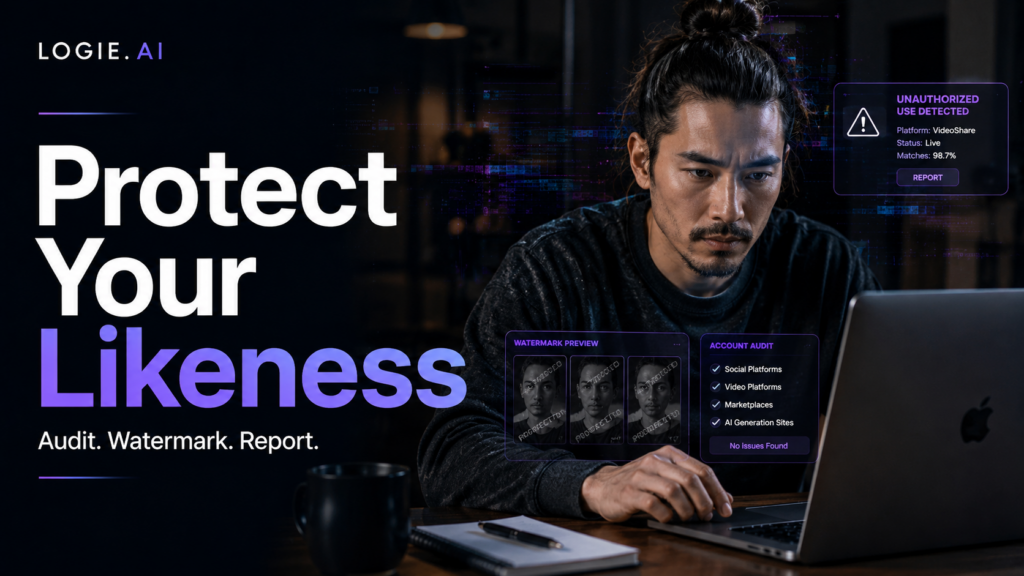
- Audit your materials regularly. Search for your face, name, and branded video titles across YouTube, Google, and TikTok on a recurring schedule, not just when someone flags a problem. Set up alerts for your name, brand, and image so you hear about misuse early.
- Enroll in YouTube’s Likeness Detection if you’re eligible. If you’re in the YouTube Partner Program, this is the single most concrete protection currently available to creators at scale.
Enrollment happens through YouTube Studio under the Content Detection tab: you’ll scan a QR code, upload a government-issued ID, and record a brief selfie video. It takes up to five days to activate, and you can opt out at any time.
- Watermark everything. This is obvious but still widely neglected. Persistent watermarks or dynamic overlays make it harder for would-be thieves to repurpose your content. Use both subtle embedded text, which is harder to crop out, and overt branding.
- Join and monitor creator communities. As Altovise noted in a call, “The person that posted it…saw her likeness in totally bogus content.” Community vigilance, whether through private groups, Logie Discords, or Facebook communities, is often how creators learn about misuse before any detection tool does.
- Understand your take-down options by platform. On YouTube, both the privacy complaint process and DMCA requests can move quickly once a match is confirmed. On Amazon, options remain limited: report through official seller and brand-protection channels, and push for better IP safeguards via creator feedback forms. Don’t hesitate to advocate publicly for better technology; platform pressure has visibly worked on YouTube, and it can work elsewhere too.
- Know your legal footing. Even without a federal likeness law yet, the right of publicity already protects you in roughly half of US states, and DMCA takedown mechanisms apply when your original footage was used to build the manipulated content.
If a deepfake is damaging your reputation or income, it’s worth understanding whether your state has a specific deepfake statute before assuming you have no recourse.
- Don’t stay silent. Educate your brand partners and your audience. An informed following is your best defense. Post reminders about your official channels and how to verify your real accounts. Brands working with creators should also audit for fake likenesses tied to their campaigns and reconfirm that campaign content originated with the creator it claims to feature.
The Future: AI, Ethics, and Brand Safety
Until platforms like Amazon and Meta match YouTube’s sophistication in detecting stolen content and likeness, the burden largely sits with creators to defend their digital selves.
Logie’s community discussions during the July call reinforced a universal truth: your brand is only as safe as your vigilance and your network.
Logie is actively championing stronger creator-first protection tools and education to help sellers respond quickly and decisively to new forms of digital infringement.
The law and platform tooling are both racing to catch up, and 2026 is shaping up to be the year that race actually starts producing results, from YouTube’s expanding detection system to the NO FAKES Act’s advance through committee.
Until commerce platforms catch up to that standard, practical self-defense and community vigilance remain your strongest insurance against the next AI-generated threat.