

TL;DR Quick Strategy
What You Need to Know in 60 Seconds
- Amazon now requires a checkbox disclosure for any storefront content featuring AI-generated people. This is a legal compliance move, not a platform detection tool.
- Amazon cannot reliably detect AI-generated people in your content. The burden of disclosure is entirely on you.
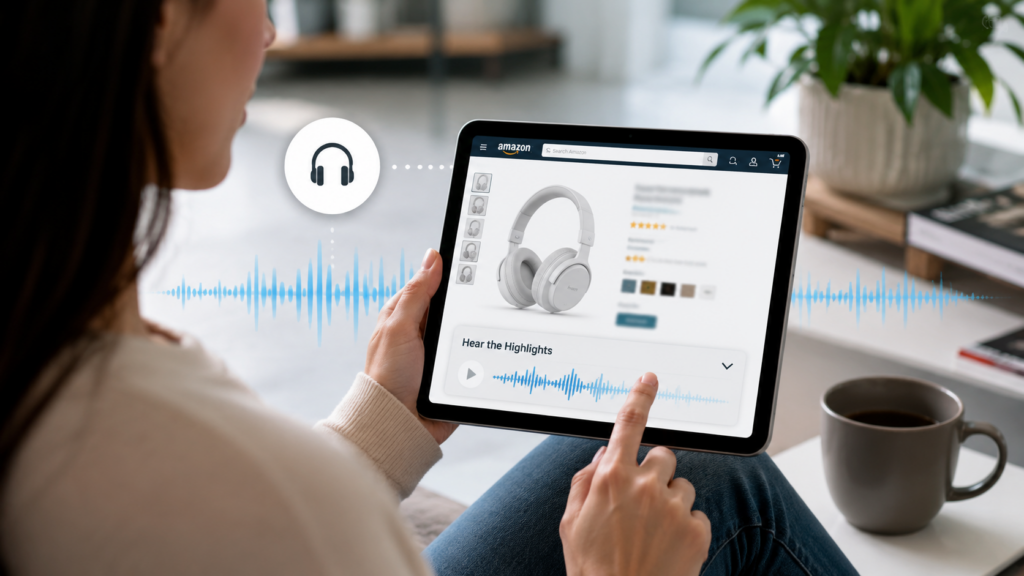
- Amazon’s new “Hear the Highlights” AI Shopping Shows are now live on millions of product pages, where they summarize reviews and specs via AI audio.
- For influencers, these AI shows are not your competition; they’re your setup. Your job is to deliver the human context AI cannot replicate.
- For sellers, your product listing copy now directly feeds what these AI audio shows say about your product. Clean, specific listings win.
If you’ve been inside the Amazon creator and seller ecosystem lately, two things have probably caught your attention: a new checkbox that appeared quietly in your storefront upload flow, and reports of AI-generated audio voices summarizing products right on the listing page.

Both changes happened within weeks of each other in 2026, and together, they represent the most significant shift in how Amazon handles content, compliance, and commerce in years.
This article breaks down in full what they are, why Amazon made these moves, what the creator community is saying, and what you should actually do about it as either an influencer or a seller.
Part One: The AI Content Disclosure Checkbox
What Is It, Exactly?
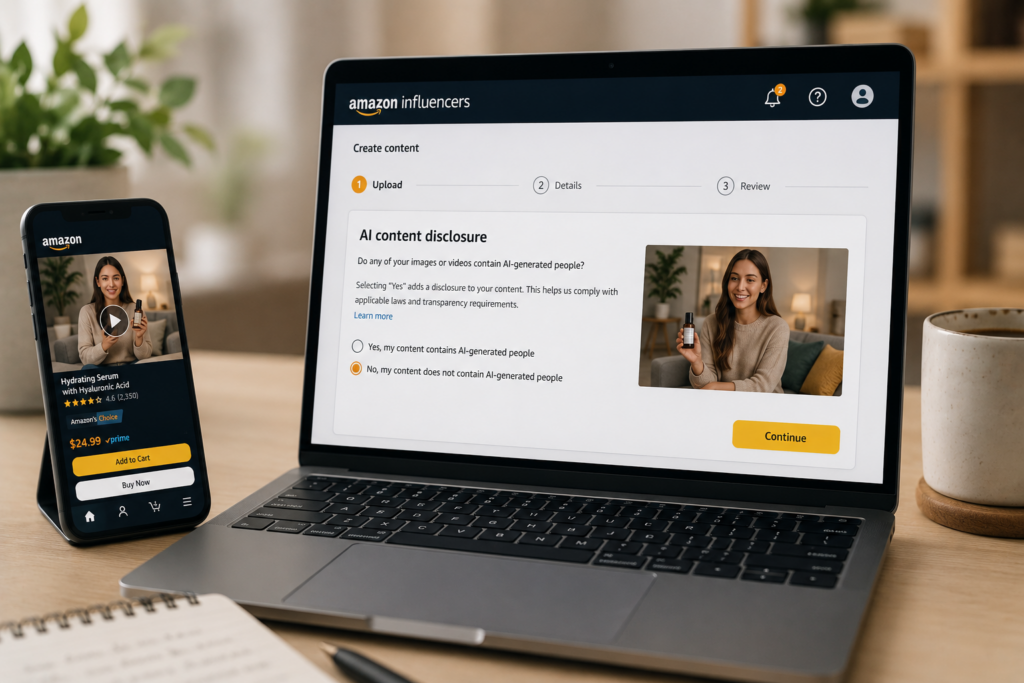
As of June 2026, Amazon added a mandatory checkbox to the storefront content upload process.
When you upload images or videos to your Amazon Influencer storefront, you are now required to flag whether the content contains AI-generated people, meaning synthetic, digitally created humans, whether they appear as photos, video characters, or even AI avatars.
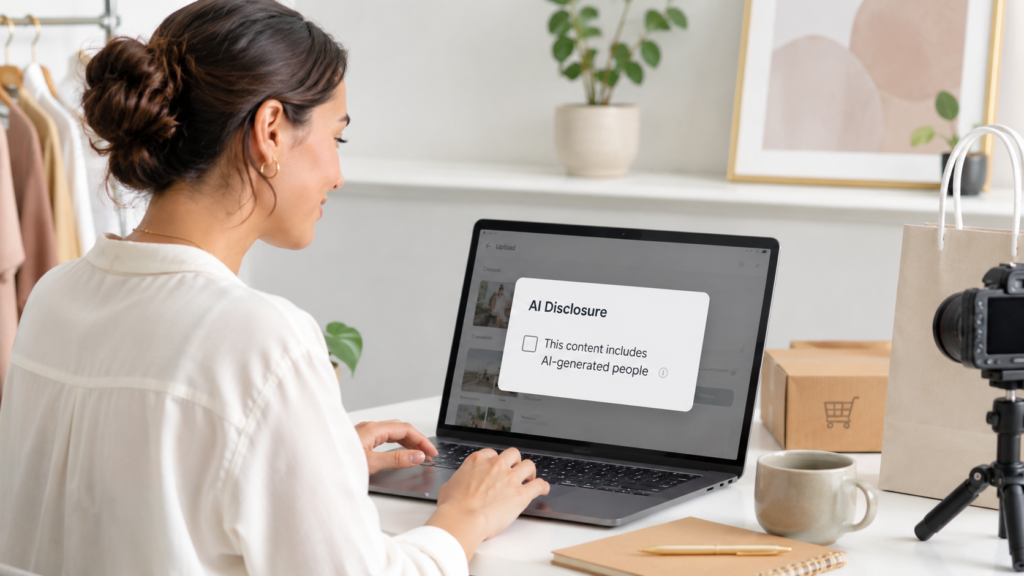
According to Amazon’s updated guidance, the checkbox specifically targets content where the person depicted is AI-generated.
AI-generated backgrounds, product mockups, or AI-enhanced lighting do not currently trigger this requirement; only synthetic or digitally created humans do.
This isn’t just Amazon being cautious. It’s a direct response to fast-moving global regulations around synthetic media and advertising transparency.
Why Did Amazon Add This?
Amazon’s is less about platform policy and more about legal self-protection and shifting compliance responsibility to creators.
Several jurisdictions now require disclosures when advertisements feature AI-generated people, and the regulatory landscape is accelerating quickly.
In the United States, the FTC’s updated Endorsement Guides extended disclosure requirements to virtual and AI-generated influencers, tightening the “clear and conspicuous” standard so that disclosures must be genuinely unavoidable to viewers.
New York’s A8887-B legislation took effect in June 2026, specifically targeting the use of synthetic performers in advertising.
California’s AB 2602, effective as of January 2025, added contract-enforceability rules governing digital replicas of living performers. Across the EU, Article 50 of the AI Act requires full compliance for AI-generated and AI-manipulated content by August 2, 2026.
Amazon read the room. Rather than risk being the platform that distributed undisclosed synthetic-human advertising at scale, they built the checkbox and made it your responsibility.
- Aug 2: 2026 EU AI Act compliance deadline for AI-generated content
- $53K: FTC penalty per non-compliant post, per violation
- 63% of consumers believe brands have a duty to disclose AI use
Amazon cannot detect AI People
Here is the single most important thing to understand about this update, and it comes directly from a Logie creator community Q&A featuring Ileane Smith:
“They cannot detect if it’s AI content. That’s why they want us to check the box!” Ileane Smith, Logie Creator Q&A
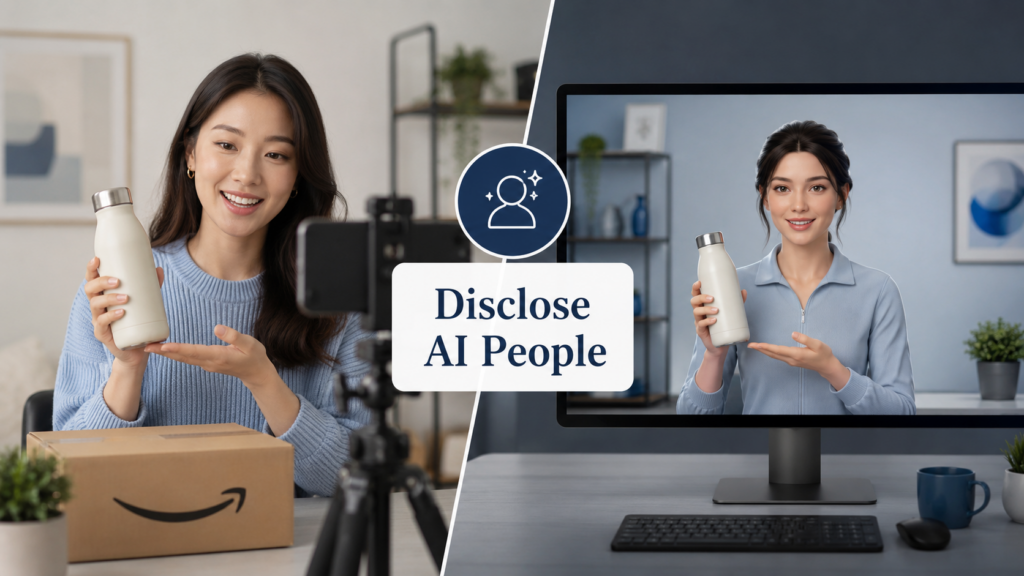
This is not a system that Amazon’s backend scans and flags. They don’t yet have a reliable automated way to detect AI-generated humans in your videos and images.
Which means right now, the entire compliance system runs on creator self-disclosure. If you don’t check the box, Amazon won’t necessarily catch you on its platform.
But if a government or regulatory body ever inquires, that undisclosed AI content becomes your legal exposure, not Amazon’s.
Think of it like tax filings. The government doesn’t audit every return, but liability for accurate disclosure rests with the individual. Amazon has essentially built a similar structure here.
What Counts as AI-Generated People?
This is where many creators get confused, so let’s be clear. If you have used any of the following in content that shows a person or human likeness, you likely need to check the box:
- AI tools like Logie’s talent image features to generate or composite your likeness into product imagery
- Canva’s AI image generation or any Midjourney/DALL-E prompt that produced a human figure used in your content
- AI avatars or digital doubles used in video content uploaded to your storefront
- AI voice cloning or deepfake-adjacent tools that recreate a real person’s appearance
What does not currently require disclosure: AI-enhanced lighting or color correction; AI-generated backgrounds behind a real person; AI-written captions or descriptions; and AI tools used purely for brainstorming or drafting (not appearing in the final content itself).
When in Doubt
Community consensus is clear: if you’re unsure whether your content features AI-generated people, check the box. As Ileane Smith put it in the community session, “Just to be in the good books.”
Checking when you don’t need to carry has no downside. Not checking when you should have can carry significant legal and accounting risk.
How Is the Creator Community Responding?
Reactions within the Logie community have been a mix of relief, skepticism, and practical acceptance.
Some creators are simply relieved. The checkbox clarifies a grey area that previously had no formal guidance.
Creators who wanted to use AI tools responsibly now have a defined mechanism to do so. As one community member confirmed, “I’ve seen it, have no concerns, I’m glad it’s there.”
Others remain skeptical about enforcement. Creator Stephanie Faith raised the fair point that Amazon can build a checkbox for AI disclosure, but struggles to reliably detect when an influencer has uploaded someone else’s original content without permission, a problem that predates AI.
If the underlying detection capability isn’t in place, what enforcement will actually look like over time remains an open question.
Most experienced creators are treating this in practical terms: it’s a legal and brand-protection measure, not a technical safeguard. Use AI tools, disclose appropriately, and document your choices. That’s the safe path forward.
Will Disclosing AI Content Hurt Your Sales?
This is the question creators are most anxious about. The honest answer is that it’s genuinely uncertain, and the community knows it.
As discussed in the Q&A session, “AI” is a trigger word for some shoppers, a subset of consumers who are less inclined to purchase when they see an AI label attached to content.
But there’s no clear data yet showing broad conversion drops from disclosure labels on Amazon storefronts specifically.
Our recommendation: monitor your content performance after disclosures go live. If you see a meaningful shift in specific content, test alternatives, whether that’s using real footage instead of AI-generated imagery or adjusting how prominent the content is on your storefront.
The disclosure requirement is non-negotiable, but how you structure your content strategy around it is absolutely within your control.
Practical Checklist: What to Do Right Now
- Audit your existing storefront content. Go through your uploaded images and videos and identify any where AI tools were used to generate or heavily composite human figures. Make a documented list.
- Check the box going forward. Any new uploads that contain AI-generated people must have the checkbox checked. Build this into your upload workflow so it’s automatic, not an afterthought.
- Don’t panic about past uploads. Amazon has not issued a retroactive labeling requirement. But proactively reviewing high-visibility content, particularly if you’re in a strictly regulated US state or country, is wise protection.
- Document your decisions. Keep notes on what content used AI tools and what choices you made about disclosure. In the event of a platform review or regulatory inquiry, documentation is your defense.
- Educate your collaborators. If you work with other creators, brands, or a content team, make sure everyone understands the new requirement. One undisclosed piece of content in a collab is your shared liability.
Part Two: Amazon’s AI Shopping Shows “Hear the Highlights”
What Are They and How Do They Work?
Separate from the disclosure checkbox and arguably the bigger commercial story is the rapid expansion of Amazon’s “Hear the Highlights” feature.
As of April 2026, Amazon launched a significant update that turned these audio summaries into fully interactive AI conversations.
Here’s how it works for shoppers: In the Amazon Shopping app (iOS and Android, US only for now), a shopper opens a product detail page and sees a “Hear the Highlights” button below the product image.
Tapping it plays a short conversational audio summary of the product. Think of it as a synthetic podcast episode about that specific item.
The AI voices draw from product descriptions, customer reviews, Q&As, and publicly available information to generate the summary.
The April 2026 update added “Join the Chat,” an interactive layer where shoppers can ask questions mid-summary via text or voice and receive tailored responses without pausing the audio.
Questions like “Is this product dishwasher safe?” or “Do people find this sweater itchy?” get woven directly into the conversation.
“Customers can ask questions and actually steer where the conversation goes. Every question they ask influences what comes next, making the experience a conversation customers can join and customize.” Amazon Blog Post, April 2026
For Sellers
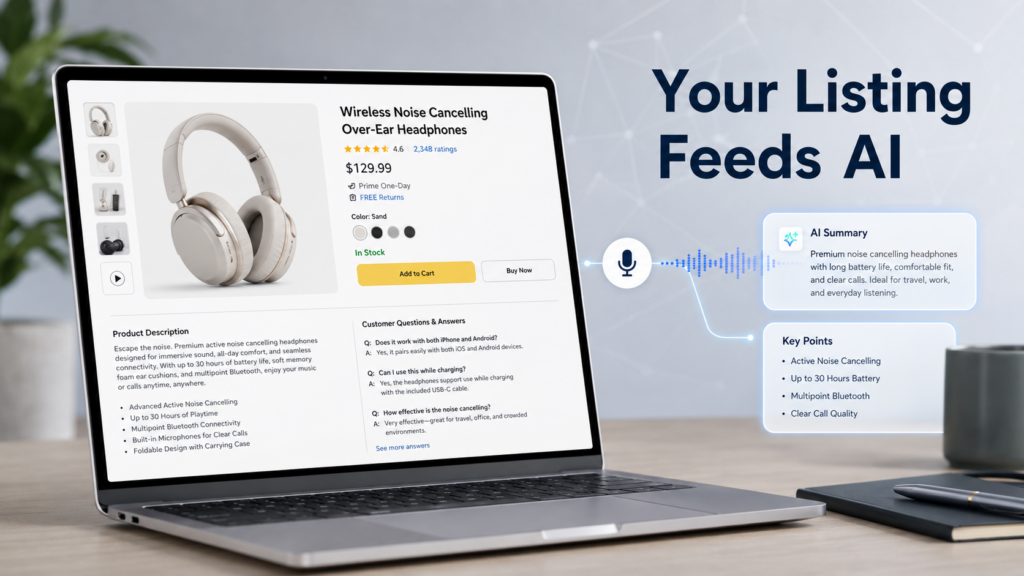
What your AI audio summary says is directly determined by the quality of your product listing copy, your customer reviews, and your Q&A responses.
If your listing is keyword-stuffed, inconsistent, or jargon-heavy, it will come through in the audio and cost you conversions.
What Does This Mean for Influencers and Creators?
The creator community has had strong and divided opinions on this. Let’s look at both sides clearly.
The concern is obvious: Amazon is now placing AI-generated audio content directly on product pages, at the same moment in the browsing experience that previously belonged to influencer videos and user reviews.
If a shopper gets their product questions answered by an AI voice summary before they ever scroll to the video carousel, does that cut into influencer conversion power?
The more optimistic reading and the one that holds up when you look at the data is that AI Shopping Shows actually position human creator content higher in the purchase journey, not lower. Logie community member Magan M. Hunt put it well:
“That actually places our videos in a better place on the product journey… Our videos will actually show the use. That means our videos are gonna convert at a higher rate. Eventually. So that could actually work in our favor.” Magan M. Hunt, Logie Creator Q&A
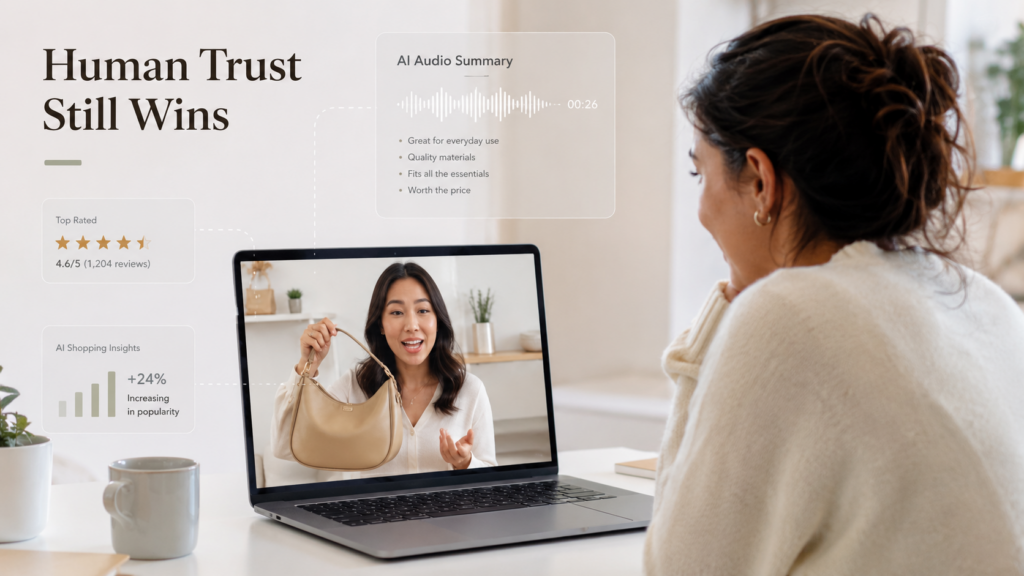
Here’s the logic: AI can instantly summarize reviews and specs. But it cannot sit in a chair for eight hours, walk around in those shoes, or react authentically when a product disappoints or overdelivers. Shoppers use AI summaries to pre-qualify a product.
They turn to creator videos when they’re close to a decision and need to trust someone who actually used the thing.
- 2.4× conversion lift from shoppable influencer video vs standard listing pages (Profitero, 2026)
- 3.1× conversion lift in the wellness category, specifically from influencer video
- 4–7× more monthly commission revenue for storefronts with 300+ product video clips
AI vs. Human Creator: What Each Does Best
| Amazon AI Shopping Shows | Human Creator / Influencer Video |
| Rapid product specs and feature summaries | real-world demonstration, and lived experience |
| Aggregates hundreds of customer reviews instantly. | Cuts through review noise with one trusted voice |
| Available 24/7 with no production effort. | Builds parasocial trust that compounds over time |
| Can answer factual questions (“Is it machine washable?”) | Can answer contextual questions (“Is it worth it for someone like me?”) |
| No personality, no relationship with the viewer, | Community, humor, vulnerability, human connection |
| Pulls from what’s already public can’t challenge hype | Can call out overselling, share unexpected failures, myth-bust |
Veteran creator Antoine Speller (Computer Pal) framed the line perfectly in the Logie community session:
“To watch a show that is totally AI-generated is absolutely a no-no… I want someone human to show me what they’re doing. If I’m gonna use AI to showcase a product’s features, that’s fine. But if I want some real-world things going on… no.” Antoine Speller, Computer Pal, Logie Creator Q&A
The takeaway is that they shift what your content needs to do. Generic unboxings and spec recaps?
AI does that now. Authentic use-case demonstrations with real reactions, honest assessments, and personality? That’s yours, and it converts at a rate AI can’t match.
What Sellers Need to Know About “Hear the Highlights”
If you’re a seller (not just an influencer), this is where your attention should be. The AI audio summaries are being generated directly from your product listing content.
That means the quality of what the AI says about your product is entirely downstream of how well you’ve written and maintained your listing.
- Clean up your listing copy immediately. Keyword stuffing, unusual formatting, and excessive jargon will produce robotic-sounding AI summaries that lose shoppers. Write for humans first, and the AI will follow.
- Prioritize your Q&A section. The “Join the Chat” feature pulls from Q&A data when shoppers ask specific questions. Ensure the most common shopper questions are answered clearly and early in your Q&A.
- Respond actively to customer reviews. AI summaries aggregate review sentiment if your reviews skew toward a specific complaint or praise, which surfaces in the audio. Actively engage with reviews to shape the narrative over time.
- Test your listing on mobile with audio active. Tap “Hear the Highlights” on your own products and actually listen. If the AI summary sounds robotic or misrepresents your product, that’s your signal that your listing copy needs work.
- Avoid unusual characters or formatting in product descriptions these confuse the AI’s language model and produce lower-quality audio output.
Opportunity Framing
Some observers noted that “Hear the Highlights” could eventually replace user reviews as the primary source of product information for shoppers. If that’s where Amazon is heading, sellers who have strong, consistent, human-readable listings will have a significant advantage as AI increasingly interprets and presents their content.
Prime Day Is Right Around the Corner
Both of these AI updates arrive as Prime Day 2026 approaches, Amazon’s highest-traffic shopping event of the year, and the biggest commission opportunity on the calendar for influencers.
During Prime Day, shoppers are overwhelmed with options and moving fast. AI Shopping Shows will see heavy use from impatient browsers who want quick product answers before clicking through.
That means your storefront videos need to do more work than ever to earn the click-through that converts.
- Short-form video (20–40 seconds) is still the highest-converting format. Don’t try to be comprehensive; be decisive. Show the most important thing about the product fast.
- Use-case-specific titles. “Will it last a summer road trip?” outperforms “Unboxing” every time during high-traffic events. Speak to shoppers’ search intent, not product descriptions.
- Urgency language in voiceover. Phrases like “this might sell out tonight” or “only available at this price during Prime” genuinely move conversion needles during limited-time events.
- Old videos still convert. Amazon storefronts don’t penalize content age the way social feeds do. Your video from eight months ago showing a product in real use is still working for you every day. Refresh titles and descriptions if needed, but don’t underestimate your existing library.
- Cross-promote your best storefront content in the weeks leading up to Prime Day. Drive traffic from TikTok, Instagram, and YouTube Shorts to your storefront in advance, so Amazon’s algorithm learns your content converts before the biggest traffic surge of the year hits.
Data Point
YouTube Shorts emerged as the fastest-growing driver of Amazon storefront traffic in early 2026, with an average engagement rate of 11.3% for product-focused content under 60 seconds. If you’re not cross-posting to YouTube Shorts yet, Prime Day is your reason to start.
What Amazon Is Actually Doing Here
Zoom out from both updates, and a clear pattern emerges. Amazon is systematically using AI to handle the generic, commoditized parts of product discovery: spec summaries, review aggregations, and the “is it dishwasher-safe” questions.
In parallel, it’s building a compliance infrastructure that places greater legal responsibility on content creators while limiting Amazon’s liability.
Neither of these moves is hostile to creators or sellers who are already doing things well. If your content is authentic, use-case-driven, and grounded in real experience, AI Shopping Shows make your videos more valuable, not less.
If your listing copy is clean and your reviews are genuine, AI audio summaries can serve as a free promotional tool on millions of product pages.
The creators and sellers who will struggle are those still operating on generic, spec-focused content that AI can now replicate for free. That was always going to be a race to the bottom. The AI just accelerated the timeline.
The Core Principle
Let AI win on speed and information density. You win on trust, lived experience, and the specific moments of human relatability that no language model can manufacture. That’s where conversions live, and that’s where they’ll keep living.
Summary: Your Action Plan
- Audit your storefront for AI-generated human imagery. Document what you find and prepare to check the disclosure box on any affected uploads going forward.
- Build the checkbox into your upload workflow so it’s never an afterthought. When in doubt, disclose.
- Listen to your own “Hear the Highlights” summaries as a seller. If they’re off, fix your listing copy first.
- Reposition your creator content strategy away from spec recaps and toward authentic use-case demonstrations that answer the human questions AI cannot answer.
- Prepare your best Prime Day content now. Short-form, use-case-specific, urgency-driven videos will out-convert AI summaries in the final decision moment, so make sure you have them ready and driving traffic before Prime Day hits.