

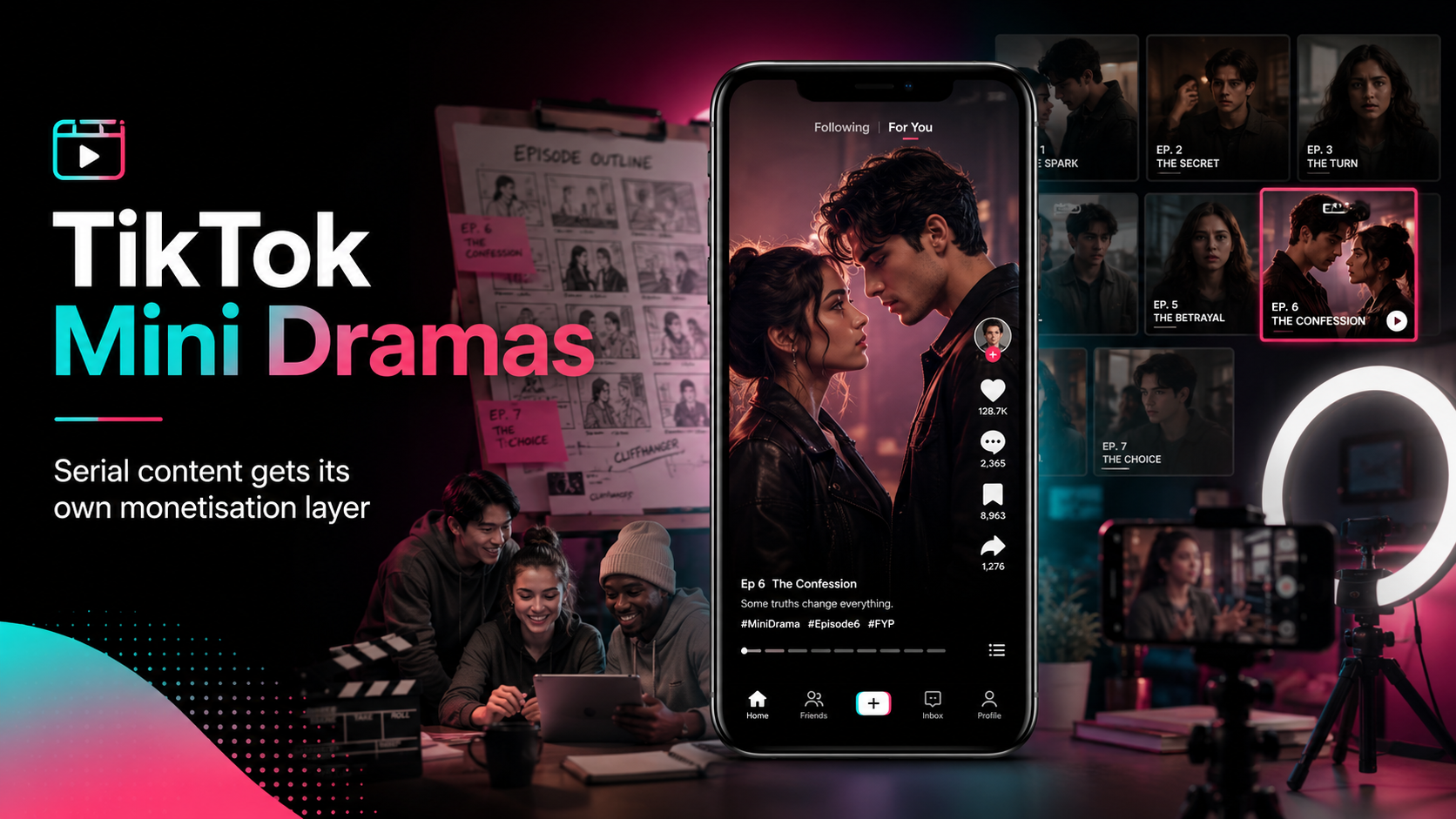
On June 29, 2026, TikTok officially launched its Mini Dramas commercial ecosystem, a program that lets brands and content operators publish episodic microdrama series within TikTok and monetise through its new Growth Max ad tool.
If you’ve spent any time on TikTok over the past year watching two-minute cliffhangers about secret heirs, fake marriages, or workplace revenge plots, you’ve already met the format. What’s new is the business layer TikTok just built underneath it.
For creators and brands already building an audience through short-form video, Mini Dramas is TikTok’s clear signal that serialised content now has its own dedicated ad infrastructure, monetisation paths, and performance data.

Here’s what’s in the announcement, what the numbers mean, and where the real opportunity sits.
What Is TikTok Mini Dramas
TikTok Mini Dramas (originally previewed as TikTok Mini Series) is an in-app feature that lets brands and marketers build and publish episodic drama content directly on TikTok.
Instead of a single video living and dying in the feed, creators can structure content into a series audiences follow episode by episode, the same “snackable, serialised” format that’s driven the explosive growth of standalone microdrama apps like ReelShort over the past two years.
There are two ways to publish:

- Through the TikTok Minis Centre, a dedicated in-app viewing hub where audiences discover new series through Search and the For You feed. This option is currently available in the United States, Canada, Australia, New Zealand, Indonesia, Thailand, South Korea, Japan, Brazil, and Mexico. Revenue here comes two ways: viewers can pay to unlock additional episodes, or brands can embed ads that viewers watch in exchange for unlocking the next part of the story.
- Through a TikTok Business Account, publishing organic episodic posts directly into the main feed. This route is available globally, and it’s the more accessible option for most creators and brands, since it doesn’t require a separate app-like presence. Revenue works the same way here: viewers watch ads embedded in the drama to unlock more of the series.
Both formats are now designed to work with TikTok Growth Max, the ad solution that sits beneath the whole system.
What Does TikTok Growth Max Do
Growth Max is the automation and targeting layer that turns a Mini Drama from a piece of content into a performance channel.
According to TikTok, the tool uses advertising automation and on-site behavioural signals to identify high-intent viewers, the people most likely to keep watching, unlock episodes, or convert, and pushes the content toward them specifically, rather than relying on organic discovery alone.
Campaigns run through Growth Max for Mini Dramas drove a 3x higher Day-0 return on ad spend using the IAA (in-app advertising) tROAS solution, and a 1.5x higher Day-0 ROAS using the IAP (in-app purchase) tROAS solution, compared to standard TikTok app and web campaigns.

On top of that, Growth Max campaigns produced a 52% increase in incremental audience reach beyond off-platform acquisition campaigns, with minimal audience overlap, and pairing on-platform Mini Dramas with off-platform app promotion drove a 10x increase in advertiser scale.
This means brands aren’t just reaching new people with this format; they’re reaching people their existing acquisition campaigns weren’t touching at all, and monetising them faster on day one.
That’s a genuinely different value proposition than a standard TikTok ad campaign, where ROAS typically builds over days or weeks rather than showing up same-day.
Why Is TikTok Betting Big on Microdrama Right Now
TikTok is backing a format that’s already proving itself financially. Microdramas generated roughly $1.3 billion in the United States last year, most of it from viewers paying directly for premium episode access.
The audience is scaling fast too: eMarketer projects U.S. microdrama viewers will grow from 2.2 million in 2025 to 5 million in 2026, a 130% jump, reaching 10.8 million by 2028.

Globally, the momentum is even sharper. Short-drama app downloads grew 140% year-on-year in Q1 2026, with Southeast Asia recording 220% growth.
TikTok is entering vertical drama as distribution and monetisation infrastructure, not as a content platform in its own right.
That’s an important distinction, and honestly the smarter move. Rather than competing directly with dedicated apps like ReelShort or DramaBox for original IP, TikTok is positioning itself as the rails on which everyone else builds, taking a cut of a market it didn’t have to create from scratch.
It’s the same playbook TikTok has already run with TikTok Shop: don’t build the store, own the checkout.
TikTok has also been laying groundwork for this for a while. It launched a dedicated Minis section in the app, rolled out a standalone microdrama app called PineDrama in the U.S. and Brazil, and partnered with the Sundance Institute on a scriptwriting program to train creators to write serialised, story-driven content.
Growth Max for Mini Dramas is the point at which all of that infrastructure gets a monetisation engine attached.
What This Means for Creators and Brands
This is one of the more meaningful shifts in short-form content strategy this year, and creators who treat it as “just another TikTok feature” will miss the real opportunity.
A few reasons this matters beyond the entertainment niche:

- Episodic content solves the algorithm’s biggest ask: return visits. Every platform’s recommendation system rewards content that brings viewers back. A single viral video gets one moment of attention. A series builds in reasons for someone to come back tomorrow and the next day, which is exactly the kind of retention signal that gets rewarded with more distribution.
- It opens a monetisation path that doesn’t depend on brand deals. Most creators monetise through sponsorships, affiliate commissions, or platform creator funds. Mini Dramas adds a direct-to-viewer revenue stream, either through pay-to-unlock or embedded ad views, that’s independent of landing a partnership. For creators already producing narrative or character-driven content, that’s a meaningfully different income lever.
- Brands get a new storytelling format that isn’t a straight ad. A branded Mini Drama can carry a product, a message, or a partnership across multiple episodes instead of cramming it into 30 seconds. For product-based creators and affiliate-driven content, especially in categories like beauty, fashion, or home goods, that gives far more room to build a narrative around why a product matters instead of just showing it once and hoping it lands.
That said, it’s worth going in with realistic expectations. Episodic content is a bigger production lift than a single video.
Writing, pacing, and cliffhangers that make someone want the next episode is a skill in itself, which is exactly why TikTok brought in Sundance to help train creators on it.
This format rewards planning and serialised thinking, not spontaneous posting. Creators who batch and plan content in advance, rather than working reactively, will have a real head start here.
The Bigger Picture
TikTok Growth Max for Mini Dramas signals where the platform expects growth to come next. Short-form video got creators and brands used to grabbing attention in seconds.
Microdrama is TikTok’s answer to holding that attention across days, and now, monetising it while it holds.
For brands and creators already building a presence on TikTok, the format is worth testing even in a small way: a three- to five-episode series tied to a product launch, a seasonal push, or an ongoing brand story.
The data TikTok is reporting suggests the audience is there and the monetisation tools are real. Whether it becomes a core part of your content strategy or a periodic experiment, it’s no longer a feature you can afford to overlook entirely.