
- FTC action is coming to TikTok Shop – widespread non-disclosure practices could mean a wave of bans or fines for creators.
- Amazon’s influencer program is stricter on disclosure. If you want stability, follow their lead: disclose everything, update your process, and go compliant NOW.
- Use this moment to differentiate – build trust, stand out from the crowd, and future-proof your income before enforcement hits.
The rules changed. The stakes got higher. And the “Wild West” era of TikTok Shop is officially over.
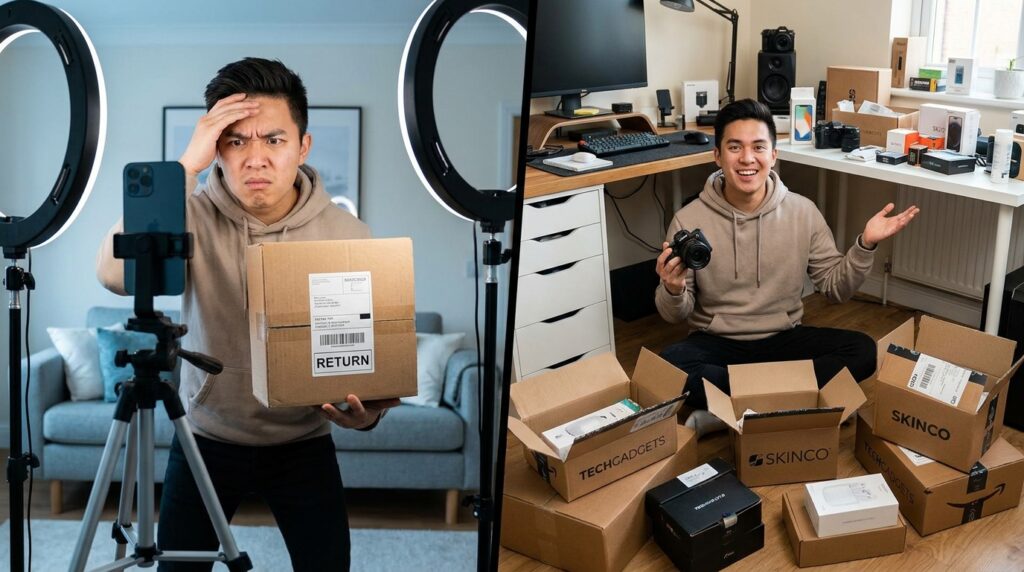
If you’ve spent any time on TikTok Shop recently, you’ve seen the videos. A creator stares into the camera with the urgency of someone reporting breaking news: “I’m literally about to return this, but first, let me show you…“*
The product looks great. The hook is magnetic. And somewhere in the 47-second clip, a purchase button appears. But one thing’s missing: any disclosure that the creator is being paid, gifted, or earning a commission.

That’s not an accident. For a long time, it was a strategy.
Now, in 2026, that strategy is a liability.
The Era of “Just Don’t Disclose” Is Over
TikTok Shop built its affiliate ecosystem at breakneck speed, and it did so in a culture of rampant non-disclosure.

Creators figured out quickly that the “I’m returning this” hook drove massive engagement, and that adding #ad somewhere in the caption killed the “authentic” vibe they were going for. So many of them just… didn’t.
For a while, it worked. The algorithm rewarded raw, unpolished content. Disclosures felt corporate. Even the briefly-trendy hashtag #giftedbyTikTokShop disappeared once creators noticed there wasn’t much enforcement. The platform was growing too fast for anyone to pump the brakes.
But that era is done. And the shift happened in waves.
What’s Changed
September 2025: TikTok Flips the Switch
The turning point came on September 1, 2025, when TikTok began enforcing branded content disclosure at scale in the US.
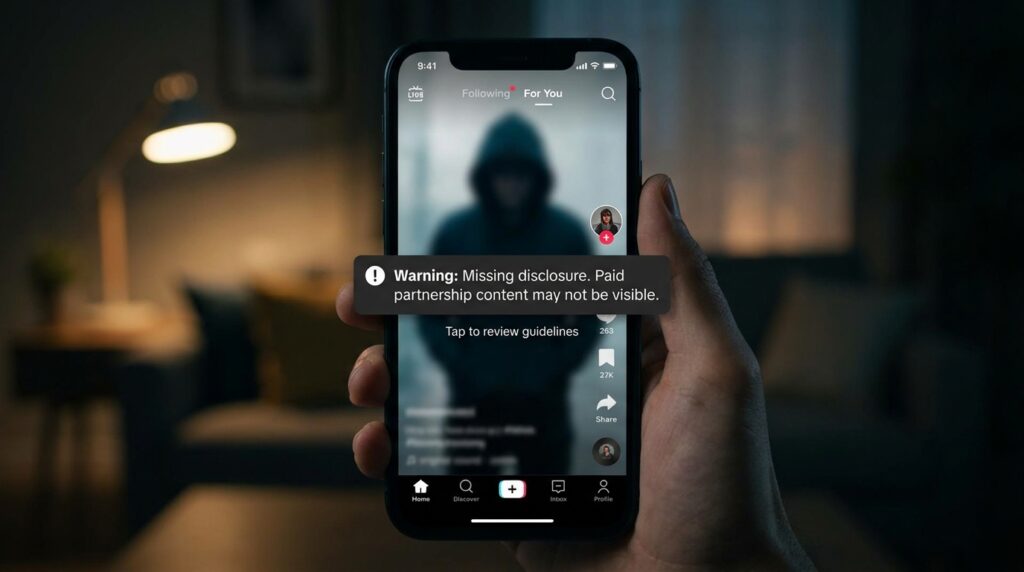
Accounts that post videos detected to contain commercial content without proper disclosure now receive an in-app notification within 2–3 hours of posting. If the content isn’t properly disclosed or appealed within 24 hours, the content becomes ineligible for the For You feed and experiences significantly limited reach.
This was algorithmic enforcement. For creators who built their entire income model on organic reach through undisclosed affiliate content, this was a direct hit to the wallet.
TikTok’s new policies rolled out across four main areas: live streaming eligibility, commercial content disclosure, AI-generated content, and off-platform promotion.
Commercial content disclosure became mandatory for all promotional posts, with content lacking proper disclosure facing removal from the For You feed or limited reach.
The message was unmistakable: Label your content or lose your distribution.

What Counts as “Commercial Content”?
A lot more than most creators assumed. TikTok flags videos as branded content based on three factors: financial incentives (money, benefits, promo codes, URLs, QR codes), brand mentions (when a brand name appears as a hashtag, tag, or logo), and product recommendations (demos, tutorials, or calls to action like “buy now” or “shop today”).
That covers a huge swath of TikTok Shop content, essentially anything where a creator is earning commission on a sale, received a free product, or was paid in any form.
The “I bought this myself” framing? If you earned commission when viewers clicked and bought, that’s still a material connection that requires disclosure.
The FTC’s Parallel Pressure
While TikTok tightened its own policies, the FTC was moving on a parallel track, and it’s the FTC that carries the heavier consequences.
FTC influencer marketing updates in 2026 are less about new laws and more about how aggressively existing ones are being enforced.
The FTC is now focused on how disclosure holds up in real-world content, especially in fast-moving formats like Reels, TikTok videos, and livestreams.
It’s no longer enough for disclosures to technically exist; they have to be obvious to an average viewer, immediately.
Think about what that means for the typical TikTok Shop video: 30 seconds of entertainment, a hashtag buried below the fold, and a product link. That’s not “obvious to an average viewer.” That’s barely a disclosure at all.
Fines for FTC violations are set at $53,088 per instance in 2026, and enforcement actions increased by 40% in 2025.
Every non-compliant post can be treated as a separate violation. Run the math on a creator with hundreds of affiliate videos and no disclosures, and the exposure is staggering.
The “Return Hook” Problem
The “I’m returning this” video format deserves its own spotlight, because it’s a near-perfect example of how TikTok Shop’s culture normalized deception.
The mechanics were clever: pretend you’re a skeptical consumer, “discover” a product mid-return, then pivot to loving it.
It mimicked an authentic consumer experience, which is exactly why viewers trusted it. The problem is that in most cases, the creator was being paid to make that video, and disclosing that would’ve undercut the entire premise.
Some creators went further, explicitly claiming they paid full price for products they received for free. That’s not just an FTC violation, it’s outright fraud.
This is the practice David Nguyen called out in a community call, describing it plainly: “It’s violation on top of violation. They’re not disclosing… It’s like a red flag above red flag. It’s gonna be crazy when the FTC comes down on it.”
He was right. It already has.
Platform-Level vs. Federal Enforcement: Why You Can’t Ignore Either
Here’s something creators often get wrong: they think satisfying TikTok’s in-platform disclosure tools is enough. It’s not.
The FTC clarified in 2024 and reinforced in 2026 that platform tags alone do not satisfy disclosure requirements.
Creators must include in-caption language plus the platform tag. Using TikTok’s “Paid Partnership” label without also putting #ad clearly in the caption? Still non-compliant with FTC rules.

And critically, in enforcement actions in 2024 and 2025, both brand and creator were named in 80% of disclosure cases, breaking the assumption that creator-only liability holds.
If you’re a brand running a TikTok Shop affiliate program, you are not off the hook because a creator forgot to disclose. You can be named too.
Notable cases from 2024–2025 include a fitness influencer with 300K followers settling for $150,000 for undisclosed supplement promotions, a beauty brand paying $250,000 for directing influencers to hide affiliate relationships, and a crypto influencer facing $300,000 in penalties for promoting coins without disclosure.
The Bigger Risk Most Creators Aren’t Talking About
Even if you’re fully compliant with every FTC rule and TikTok policy, there’s a structural risk that compliance alone can’t fix: TikTok’s ongoing legal uncertainty in the United States.
The “Protecting Americans from Foreign Adversary Controlled Applications Act” had a January 2025 deadline that came and went after courts issued a stay. As of early 2026, the case is likely at the Supreme Court level.
The platform hasn’t disappeared. But the uncertainty is real, and building your entire income on a single platform that could face operational restrictions is a business risk that no amount of disclosure compliance eliminates.
TikTok Shop is transitioning from “growth-first” to “compliance-first,” significantly impacting traditional affiliate and dropshipping models.
Single-platform dependency creates unacceptable risk. The dual-channel approach, combining TikTok Shop with your own storefront or alternative platforms, is becoming essential.
If you haven’t diversified yet, this is the moment.
Why Amazon’s Model Is Worth Studying
Contrast TikTok Shop’s recent chaos with how Amazon has structured its influencer program from the start.
Amazon’s terms for sponsored content explicitly require disclosures such as #ad or #sponsored as the first tag in each piece of content, full compliance with FTC requirements, and regular review of those requirements as they change.
There’s no grey area. No, “technically I disclosed it in the bio.” The disclosure goes first, every time.
Amazon requires affiliate links to carry a clear, conspicuous disclosure near the link, in a place customers will notice easily, not buried where they have to hunt for it.
The standard required statement is: “As an Amazon Associate, I earn from qualifying purchases.”
Is this stricter? Yes. Is it annoying to some creators? Also yes. But here’s what it actually creates: a foundation of trust.
Amazon influencer storefronts don’t go viral in the same way TikTok Shop hauls do, but they also don’t get wiped out by a compliance enforcement wave. The creators who built there carefully are still earning, still growing, and sleeping better at night.
The lesson is that a culture of compliance, built into the foundation of your content operation, makes you resilient.
What Disclosure Looks Like in 2026
Let’s get practical, because vague advice is useless when federal fines are on the table.
TikTok: TikTok requires the Branded Content toggle for paid partnerships. TikTok Shop affiliate links need clear disclosure using #ad early in the caption.
TikTok also flags non-compliant content automatically using AI detection. You need both the in-app toggle AND the caption disclosure. Neither alone is sufficient.
Instagram: Instagram now requires creators to disclose any relationship with a brand, even non-monetary ones, including free products and gifted items.
The platform sends warnings to accounts that repeatedly post sponsored content without tags. Meta’s algorithm actually favors properly disclosed branded content in 2025–2026.
YouTube: Verbal disclosure at the start of the video plus written disclosure in the description. Early in the description, not after a wall of SEO keywords.
The universal rule that overrides everything: The FTC’s Endorsement Guides require that disclosures be “clear and conspicuous” so that viewers must notice them before engaging with the content.
Proximity matters: your disclosure must appear near the sponsored content, not buried in replies or at the end of a caption.
Prominence matters: disclosures must be obvious, not tiny text in a different color.
If someone could reasonably scroll past your disclosure without noticing it, it’s not compliant.
One More Trend Worth Watching: AI Content and Disclosure
This one’s still emerging, but it’s coming fast.
The FTC’s December 2024 guidance clarified that creators and brands must disclose when AI generates or significantly alters endorsement content.
The regulatory landscape now requires AI-generated endorsements to carry specific disclosures like “this content contains AI” or similar language.
If you’re using AI-generated voiceovers, AI-written scripts delivered as personal opinion, or deepfake-style product demonstrations, disclosure isn’t optional.
A critical update for 2026 is a “double disclosure” rule, which requires acknowledging both paid partnerships and AI involvement in content creation.
This is only going to get more complex as generative AI becomes more woven into creator workflows. Getting ahead of it now is far easier than retrofitting compliance later.

The Strategic Opportunity That Most Creators Are Missing
When enforcement hits a market that’s been operating without rules, the people who were already playing it straight gain a massive competitive advantage.
The creators who built their TikTok Shop presence on deceptive hooks and zero disclosure are either adapting or disappearing.
The ones who’ve been transparent all along, who disclosed, who were honest about what they love and why, those creators are positioned to scoop up the audience trust that’s currently up for grabs.
TikTok’s own research found that in 2025, content with proper disclosures actually outperformed undisclosed content across total reviews, organic views, and organic engagement. The old myth that disclosures kill performance has been debunked by the platform itself.
Audiences aren’t naive. They know creators earn money from recommendations. What they respond to is honesty about it, and they punish creators who get caught being sneaky.
Your Compliance Action Plan
Here’s what needs to happen:
- Audit your existing content. Go through your TikTok, Instagram, and YouTube content. Any video where you earned commission, received a free product, or were paid needs a disclosure. Add it to the caption where possible. For older content that can’t be edited, note the gap and fix your process going forward.
- Build disclosure into your publishing workflow, not as an afterthought. Before you hit post, the disclosure question should be automatic. Not “did I feel like it?” but “is this in the caption, in the video, and is it above the fold?”
- Stop relying on platform tags alone. The in-app “Paid Partnership” toggle is necessary but not sufficient. #ad or equivalent language needs to be in your caption, clearly and early. The FTC has been clear that platform-native labels may not be enough on their own; you should still include a clear disclosure right in your caption or video.
- Diversify your income streams. TikTok Shop can be part of your portfolio, but it can’t be all of it. Amazon affiliates, DTC programs, direct brand deals with clear contracts, and email list building are all worth developing in parallel.
- Document everything. Contracts, gifting agreements, commission structures, and content approvals keep records. If you’re ever audited, documentation is your defense.
The Bottom Line
The TikTok Shop ecosystem grew fast, cut corners, and created habits that are now expensive to maintain. The FTC is watching. TikTok itself is enforcing. And the regulatory wave isn’t receding, it’s building.
But none of this is a reason to panic if you’re willing to adapt. The creators who will thrive in the next phase of the creator economy are the ones who treat compliance not as a burden to minimize, but as a brand attribute to celebrate.
Transparency is a differentiator. Trust compounds over time in a way that viral reach simply doesn’t.
The Wild West era is over. What comes next belongs to creators who were professionals all along.