

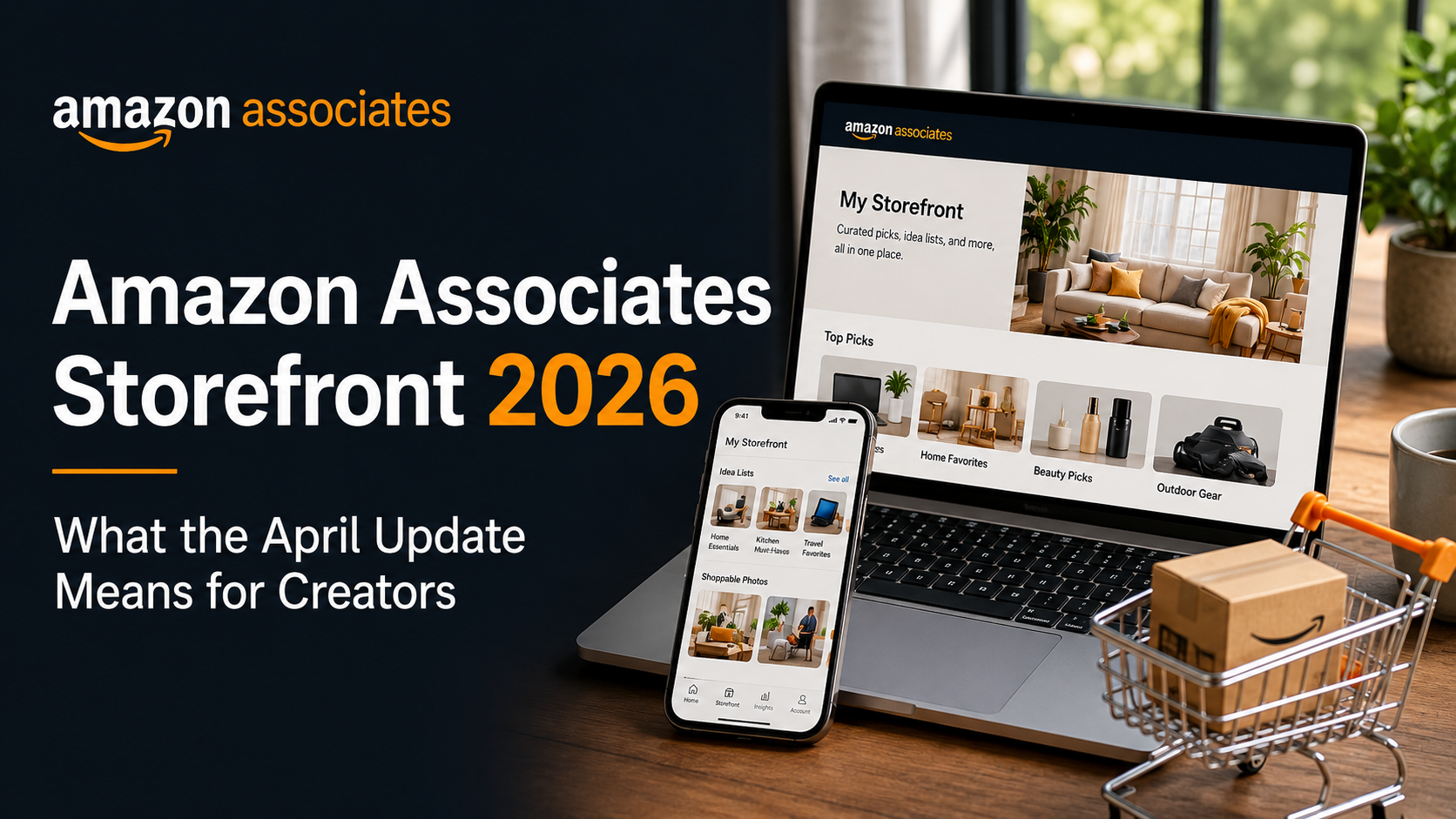
- Amazon Associates now get access to Storefronts – blurring lines with the Influencer program and creating fresh earning paths.
- ‘On-site’ placement and rate card structures remain a grey area; stay updated, experiment, and validate assumptions (don’t just trust Amazon docs).
- Master ‘Idea Lists’, optimize storefront content, and use data-backed workflows to make the most of these changes.
For years, Amazon’s creator ecosystem ran on a clear, unspoken hierarchy. Amazon Associates were the link-dropper affiliates who scattered tracking URLs across blogs, newsletters, and social posts to funnel external traffic onto the platform.
Amazon Influencers were the elevated tier: hand-picked creators with personalized Storefronts, shoppable carousels, and the ability to earn commissions from shoppers who discovered their content directly on Amazon.
That division officially ended on April 14, 2026.

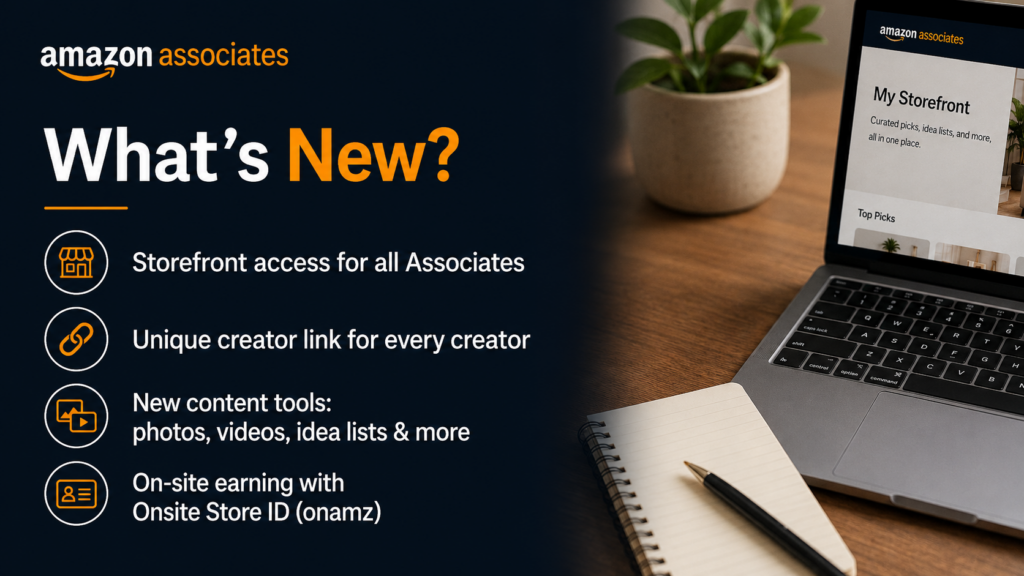
Amazon’s updated Associates Program Operating Agreement rewrote the rules: completing standard Associates registration now grants every creator access to a public Amazon Storefront and a unique creator link feature that was previously locked behind the Influencer application process.
If you run an affiliate site, a newsletter, or a niche content channel and you haven’t revisited your Amazon setup since this update, you’re likely leaving money on the table.
This guide breaks down exactly what changed, what the new commission structure means for your earnings, and the practical steps to turn your updated account into a consistent passive income stream.
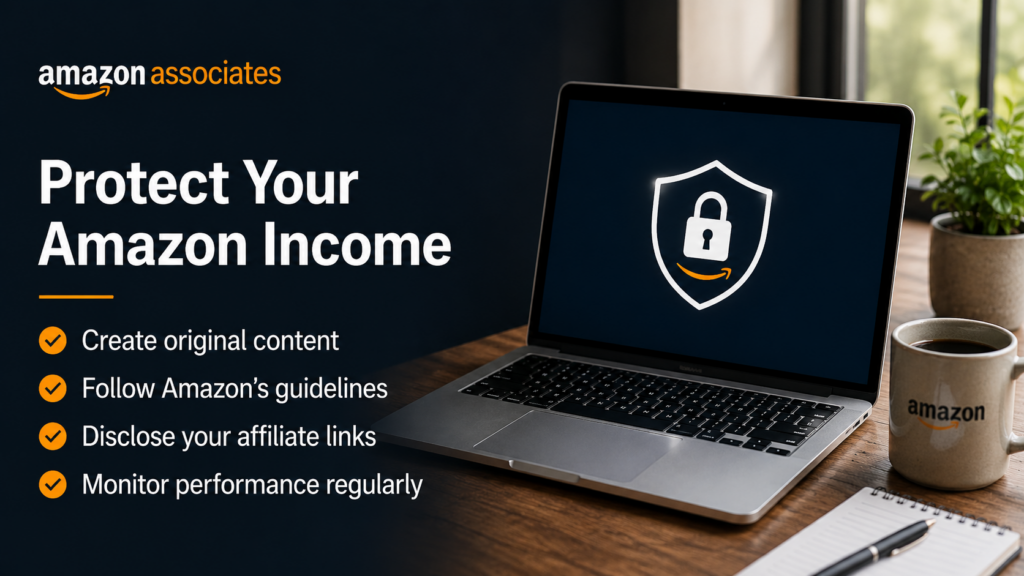
Table of Contents
- What Changed in the Amazon Associates April 2026 Update
- Why Amazon Made This Move
- The Onsite Commission Catch You Need to Know
- How to Unlock On-Site Product Page Placements
- How to Build a High-Converting Amazon Storefront in 2026
- How to Protect and Maintain Your Amazon Income
- Frequently Asked Questions
What Changed in the Amazon Associates April 2026 Update
Before April 2026, the Amazon Influencer Program was a separate, application-gated program. Creators needed to demonstrate a meaningful social media following, typically on YouTube, Instagram, TikTok, or Facebook, before Amazon would grant them a Storefront, a custom URL, and on-site earning potential.
Associates, by contrast, had access only to text links, banners, and the standard SiteStripe toolbar.
Their earnings model was entirely dependent on off-site traffic: get someone to click your link from outside Amazon, hope they buy something, earn 3–4% on qualifying purchases.
The April 14, 2026, update to the Associates Program Operating Agreement changed the baseline for everyone. Key changes include:
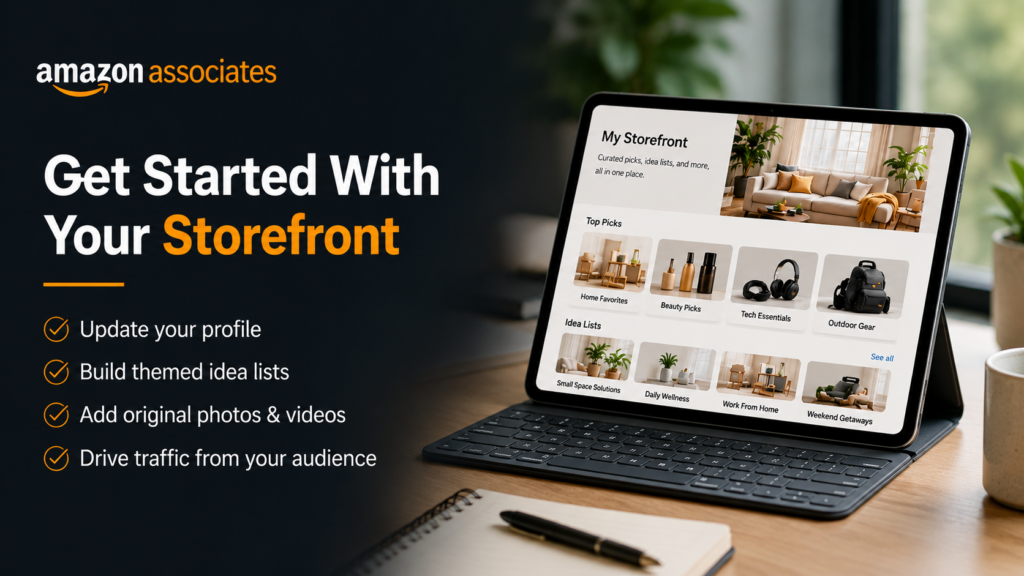
- Public Storefront access is now included in standard Associates registration
- A unique creator link (custom URL) is assigned to all registered creators
- Visual curation tools, Idea Lists, shoppable photo uploads, video uploads, and collages are available to Associates without a separate Influencer application
- On-site earning capability via a native Onsite Store ID (tracking strings beginning with onamz) is now accessible to standard Associates
- Original Content requirements are now explicitly defined in the program terms, with Amazon requiring genuine commentary, analysis, or transformation in creator content
To be direct: the Amazon Associates and Influencer programs have effectively merged at the entry level. The line between them is no longer structural; it’s how you use the tools you now both have access to.
Why Amazon Made This Move
E-commerce has become content-driven. TikTok Shop demonstrated at scale that consumers not only buy products they search for but also those they discover while consuming content.
Amazon’s historical strength is intent-based shopping: people arrive on Amazon knowing they want a standing desk. Its weakness has always been the discovery phase that happens before intent forms.
By opening Storefronts to all Associates, Amazon is building a user-generated content layer on its own platform.
Every niche creator who builds a well-curated Storefront around their area of expertise, home organization, trail running, low-carb cooking, and budget travel becomes a discovery surface that keeps shoppers on Amazon longer and introduces them to products they wouldn’t have found through search.
“The way I understood the wording in the info is that they do now have on-site, just like we do. Yes, Andrew, I just want to know if they have two separate rate cards. And I know it makes sense that they would. But we’re talking Amazon here, right? So… I need that to be confirmed.” Ileane Smith
From Amazon’s perspective, this is a highly efficient trade: more organic on-platform content, more discovery traffic, and more purchases, in exchange for slightly expanded commission eligibility on a tier of traffic where Amazon’s own algorithm does most of the heavy lifting.
For creators, the value is real. But it requires understanding how the new commission structure works.
The Amazon Onsite Commission
This is the part of the 2026 update that deserves the most attention. When Amazon serves your Storefront content to a shopper who is already browsing Amazon (meaning you didn’t drive that click from an external source), your earnings fall under Amazon’s Onsite Commission Rates.
These rates are structurally lower than the standard off-site rates, because Amazon is crediting itself for bringing the shopper to the platform.
Here’s how the difference plays out in practice:
Category |
Standard Off-Site Rate |
Onsite Rate |
|
Fashion |
4% |
1–3% |
|
Home & Kitchen |
3% |
1–3% |
|
Beauty |
3% |
1–3% |
|
Outdoors |
3% |
1–3% |
If your Storefront generates significant on-site impressions from Amazon’s algorithm, a meaningful portion of your earnings will come in at the lower rate, and if you’re not tracking it, you won’t know how much until it’s already affecting your monthly totals.
What you need to do: Log into Associates Central and locate your Onsite Store ID, the tracking string that begins with onamz.
Monitor this separately from your standard tracking IDs so you can distinguish between traffic you actively generated (earning standard rates) and traffic Amazon organically served (earning onsite rates).
This data should inform how much effort you put into driving your own external traffic versus how much you rely on Amazon’s algorithm.
The bottom line on commissions: your external audience, your email list, YouTube subscribers, Pinterest followers, and blog readers remain your highest-value traffic source.
Build your Storefront, yes. But keep building the audience that sends people to it.
How to Unlock On-Site Product Page Placements
Having a Storefront is not the same as having your content placed on Amazon’s product detail page carousels.
Those placements, the video and photo carousels that appear on high-traffic product pages, represent the highest-earning real estate in the ecosystem, and access to them is still gated.
Here’s what the pipeline currently looks like for new Storefront holders:
The Three-Sale Requirement: Before Amazon manually reviews your account for placement eligibility, you need to generate at least three qualifying sales within 180 days of joining the program. This is non-negotiable and unchanged by the 2026 update.
The Content Review: Legacy protocols for unlocking on-site placements, which historically involved a three-video submission trial, are being applied inconsistently to new Associates-turned-Storefront-holders. The creator community is actively tracking this in real time, and the process appears to still be standardizing.
The Original Content Gate: Amazon’s updated terms now explicitly require “Original Content,” meaning content that adds genuine commentary, analysis, or transformation. Slideshows of manufacturer images or aggregated product clips will not pass review and risk shadowbanning or account suspension.
Don’t architect your income model around on-site carousel placements while your account is new. Drive external traffic to your Storefront, generate those first three sales, and build your content library in parallel. The on-site placement opportunity is real, but it develops over months, not days.
How to Build a High-Converting Amazon Storefront in 2026
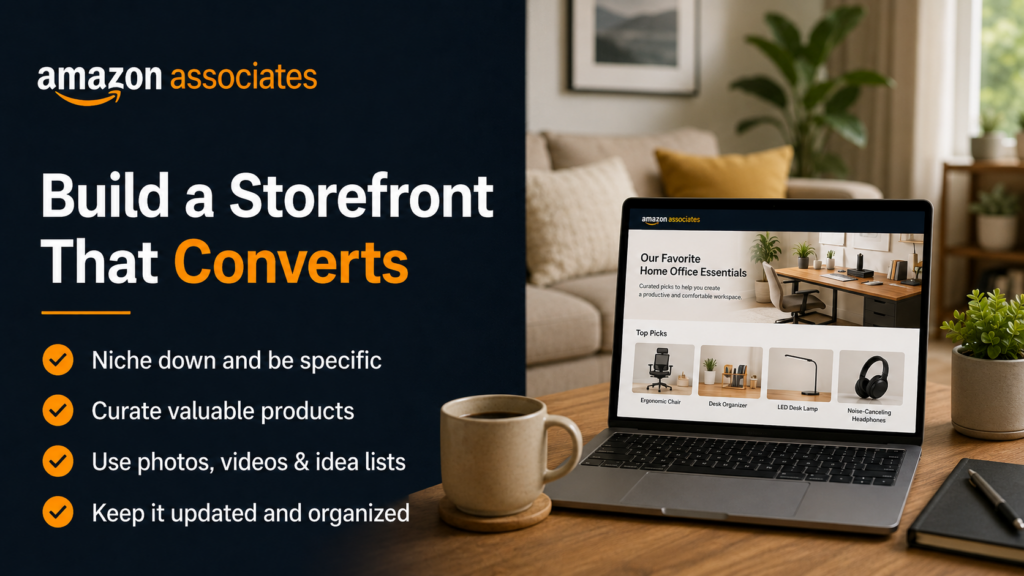
With access now open, the gap between creators who earn well from their Storefronts and those who don’t will come down almost entirely to content strategy. Here are the approaches that drive results.
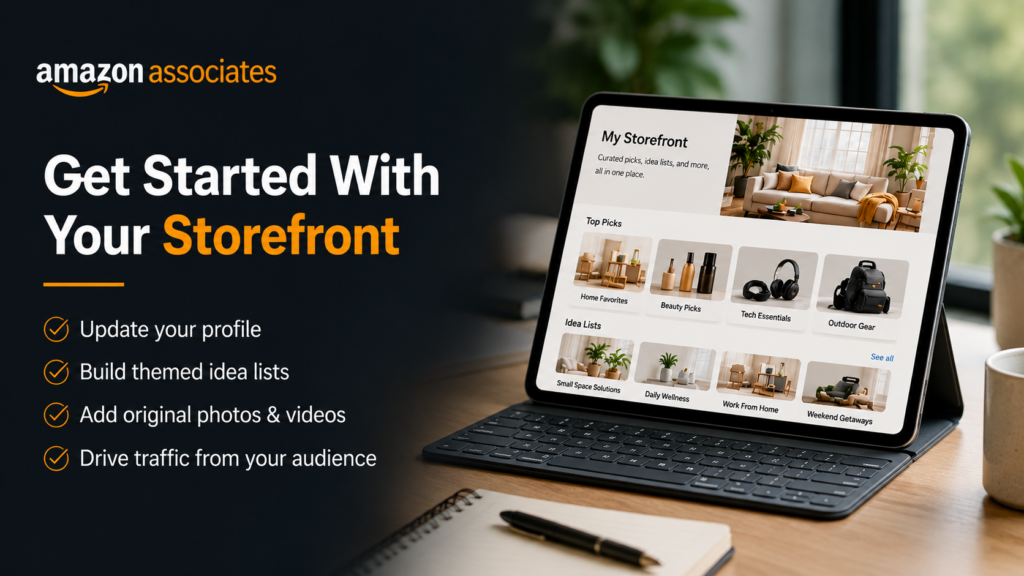
Use Amazon Idea Lists as Your Primary Curation Tool
Single product links are a low-ceiling strategy. Amazon Idea Lists, themed collections of multiple products, are the backbone of every serious passive income Storefront because they naturally increase average order value.
The mechanic is straightforward: when you group products around a problem or lifestyle theme, a shopper who came for one item discovers complementary items and often buys more than they intended.
A “minimalist home office” Idea List centers on a high-ticket standing desk, supports it with an ergonomic chair, and rounds it out with lower-cost accessories like a felt desk mat or cable management sleeves. One visit can result in three to four purchases.
Build your Idea Lists around specific, searchable themes rather than generic categories. “Best kitchen tools” is a category. “Tools for meal prepping on a Sunday afternoon” is a theme that solves a problem and attracts a defined shopper
Create Original Content That Meets the 2026 Standards
Amazon’s 2026 definition of “Original Content” is worth taking seriously. The platform now explicitly requires actual commentary, analysis, or transformation, not repurposed manufacturer content. Practically, this means:
- Your photo content should feature the product in real use, ideally with your own photos or styled shots rather than stock images
- Your video reviews should include your own voice, opinion, and direct comparison or demonstration
- Your written descriptions in Idea Lists should reflect personal experience or research, not manufacturer copy
This bar is an advantage for creators willing to meet it. Most people won’t. If your Storefront has a genuine, original perspective, it will rank better in Amazon’s internal discovery and be far less vulnerable to policy enforcement actions.
Format Visuals for Multi-Platform Distribution
Amazon’s native collage tool is built for Amazon’s feed dimensions, which is fine if Amazon is your only channel. But if you plan to cross-promote your Storefront on Pinterest, Instagram, or YouTube, you need assets that work across platforms.
Build your visual content in Canva using a 2:3 vertical aspect ratio. This format renders well on Amazon’s feed, travels cleanly to Pinterest (where 2:3 is the native pin format), and can be adapted for Instagram Reels and Stories. Each asset should link back to your Amazon Storefront, creating a consistent cross-platform funnel that compounds over time.
Focus on Keyword-Rich Storefront Titles and Descriptions
Your Storefront and Idea List titles are indexed. Treat them like SEO copy. “My Favorites” is not a useful Storefront title. “Minimalist Home Office Essentials for Remote Workers” is a title that can surface in both Amazon’s internal search and Google. Use the terms your target audience actually searches for.
How to Protect and Maintain Your Amazon Storefront Income
Building a Storefront is step one. Maintaining it as a reliable income stream requires ongoing operational discipline that most creators underestimate.
Audit Your Links on a Monthly Cycle
Dead links are the silent killer of Storefront income. When a product goes out of stock, gets delisted, or changes its ASIN, your Storefront link stops converting, and Amazon doesn’t notify you.
At scale, even a handful of dead links in a high-traffic Idea List can materially reduce your monthly earnings.
Set a monthly recurring reminder to audit your active Storefronts using tools like Logie or Oink, both of which are purpose-built for Amazon creator account management and automatically flag broken or underperforming links.
Diversify Your Revenue Across Platforms
Amazon’s commission rates, algorithm behavior, and program terms have changed before and will change again. Any creator running 100% of their affiliate income through a single retailer is one policy update away from a significant income disruption.
The smart structure embeds your Amazon Storefront inside a broader content ecosystem. Your Amazon links should also appear in:
- YouTube video descriptions (with affiliate disclosure)
- LTK (LikeToKnowIt) profiles for fashion and lifestyle categories
- Pinterest boards that link back to your Storefront or individual Idea Lists
- Email newsletters for your highest-intent audience segments
This diversification means your Amazon income doesn’t disappear if Amazon changes its terms, your audience relationships are distributed, and you can redirect traffic to alternative affiliate programs (ShareASale, Impact, brand-direct partnerships) when needed.
Stay Current on Program Operating Agreement Changes
The April 2026 update won’t be the last. Amazon periodically modifies its Associates Program Operating Agreement, sometimes with significant structural implications.
Make it a habit to read program update notifications rather than dismissing them, and stay connected to creator communities like Reddit’s r/Amazon_Influencer, Logie’s creator network,
, where policy changes are discussed and decoded quickly.
Frequently Asked Questions
Do I need a large social media following to get an Amazon Storefront in 2026?
No. Since the April 2026 update, a public Storefront is included with standard Amazon Associates registration. You no longer need to apply separately for the Influencer Program or meet a follower-count threshold to access Storefront features.
What is the difference between Amazon Associates and the Amazon Influencer Program in 2026?
The functional difference has narrowed significantly. Both now have access to Storefronts and visual curation tools. The Influencer Program previously granted exclusive access to on-site product page placements, but Storefront-enabled Associates can now also earn via Onsite Store IDs. The key remaining difference is that established Influencer accounts may have existing on-site placement history that new Associates-based Storefronts are still building toward.
What is an Amazon Onsite Store ID, and why does it matter?
An Onsite Store ID (typically beginning with onamz) is the tracking identifier assigned to earnings generated when Amazon serves your content to shoppers browsing the platform as opposed to traffic you actively drove from off-platform. On-site commissions are lower than standard rates, so monitoring this ID in Associates Central helps you understand the true composition of your earnings.
How do I qualify for on-site product page carousel placements?
You need at least three qualifying sales within 180 days to trigger an account review. Beyond that, Amazon evaluates your content quality and applies legacy placement protocols that are still being standardized for new Storefront holders. Creating original, high-quality video and photo content increases your likelihood of earning those placements over time.
How often should I audit my Amazon Storefront links?
Monthly is a reasonable baseline. Use influencer tools to flag dead links, out-of-stock ASINs, and underperforming items. For high-volume Storefronts or during peak shopping seasons (Q4, Prime Day), a bi-weekly audit cycle is worth the extra time.
Final Thoughts
Amazon’s April 2026 update is one of the more meaningful structural changes to the affiliate creator landscape in recent years.
The barrier to building a visual, branded presence on the world’s largest e-commerce platform has fallen, creating real opportunity for creators at every level.
But the opportunity is not automatic. It favors creators who understand how the commission structure actually works, who build original content that meets Amazon’s updated quality standards, and who treat their Storefront as a business asset that requires active maintenance rather than a passive income tap they can set and forget.
If you have an Associates account you haven’t touched in a while, now is the right time to log back in.
Update your Storefront, build a few well-themed Idea Lists, and start driving your existing audience there. The tools are meaningfully better than they were a year ago and the creators who move now will have a structural advantage over those who wait.
Last updated: May 2026. Amazon program terms are subject to change. Always verify current commission rates and program requirements in your Associates Central dashboard.