

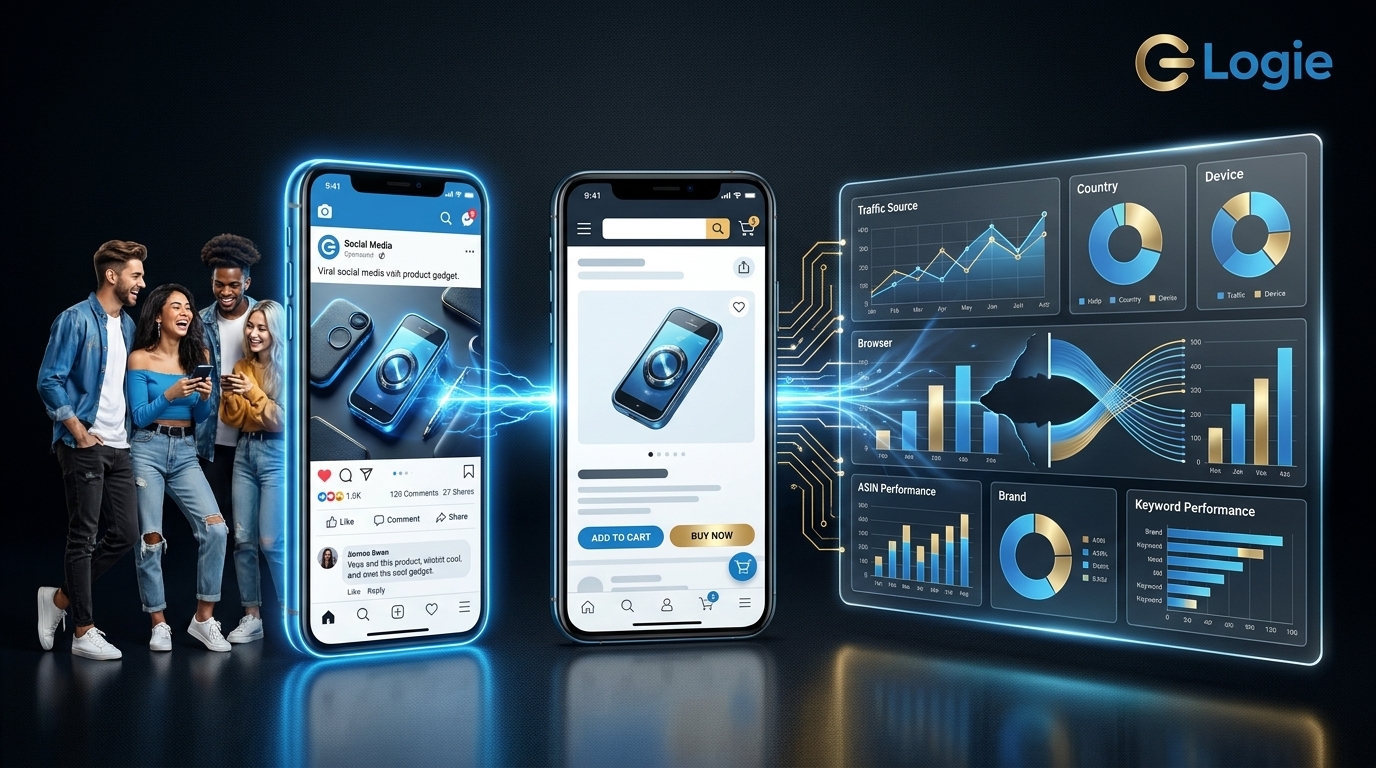
TL;DR: The Quick Strategy
- Reduce shopping friction: Eligible Amazon links that open the shopping app may help mobile customers reach a familiar, signed-in buying experience.
- Measure clicks and sales separately: Link analytics provide click context, while Amazon reporting remains the source for attributed orders, shipped items, and commissions.
- Test before changing everything: Create separate Logie Go Shopping links for comparable placements, verify the destination on real devices, and compare the results with Amazon outcomes.
You’ve done the hard part: helped someone find a product they want. Then they tap your link and hit a sign-in screen inside an unfamiliar social browser. That extra step may be enough to lose the sale.
Eligible Amazon links configured to open the shopping app are designed to reduce this friction. When the experience works as intended, a mobile shopper can move from creator content to the relevant Amazon page inside the app, where they may already have an active account, saved address, payment method, and familiar checkout flow.
That does not mean every Amazon short link opens the app or that every shopper gets the same experience. Results can vary by link type, operating system, app installation status, marketplace, social platform, embedded-browser rules, and user settings. Treat app opening as a feature to verify, not an outcome to assume.

An easier shopping experience is a good start. Creators also need to know which posts bring clicks and whether those campaigns are associated with attributed sales.
Why Opening the Amazon App May Help
Deep linking can improve the handoff between a recommendation and the product page. This matters most when someone already has strong buying intent, such as after watching a comparison, demonstration, deal alert, or direct answer to a product question.
- Existing account access: A shopper may already be signed in within the Amazon app, even if they are not signed in through a social platform’s browser.
- Familiar product controls: Reviews, delivery estimates, variants, cart controls, and checkout appear in an environment the customer already knows.
- Saved checkout details: Stored addresses and payment methods can reduce the work required to order.
- Better mobile continuity: The shopper may avoid manually switching from a social app to a browser and then to Amazon.
- Fewer chances to get distracted: Each extra step gives shoppers another reason to put the purchase off.
The important word is may. A smoother destination can support conversion, but it cannot fix a weak offer, unavailable product, poor product page, mismatched audience, or unclear recommendation. Claims about large conversion lifts should be evaluated against their original source, comparison group, conditions, and date before being used as a forecast.
Test the complete journey on iOS and Android where practical. Include app-installed and app-not-installed scenarios, plus the social platforms where the link will appear. Confirm that the link reaches the correct product and marketplace and preserves the required affiliate parameters.
What Amazon Reporting Can and Can’t Tell You
Amazon affiliate reporting and external link analytics answer different questions.
Amazon reporting is the authority for outcomes credited under Amazon’s attribution rules, including ordered or shipped items, revenue, and commissions where those fields are available. Separate Amazon tracking IDs can also help distinguish campaigns or placements when the relevant program and marketplace support them.
Click analytics describe the journey before Amazon. Depending on the link platform and current reporting configuration, that traffic breakdown may include the link or campaign used, approximate location, device type, browser, and associated product identifiers or creator-assigned labels.
This context can help creators investigate questions such as:
- Which placement generated the most clicks?
- Did mobile and desktop audiences use the links differently?
- Did traffic come from the marketplace or country the campaign intended to serve?
- Which linked products or ASINs attracted the most attention?
- Did one campaign produce many clicks but relatively weak Amazon earnings?
These reports have limits. A browser breakdown shows traffic composition, but it does not prove where someone abandoned checkout. Channel-level clicks do not establish that a campaign reached unique new people. Click-through rate also requires a reliable impression or view count from the publishing platform, not just link clicks.
Most importantly, clicks are not purchases. Link data can show interest in a destination. Amazon determines which orders receive affiliate attribution under its rules. Attribution windows, cross-device shopping, product substitutions, canceled orders, privacy controls, and reporting adjustments can prevent the two datasets from matching one to one.
Where Logie Go Shopping Links Fit
Logie Go Shopping links add a measurement layer to links shared outside Amazon. Instead of using one undifferentiated URL everywhere, creators can make separate links for important campaigns and placements, then compare the resulting click context.
Depending on the current dashboard and account configuration, reporting may organize clicks by dimensions such as source, country, device, browser, ASIN, brand, or keyword. Creators should confirm how each field is defined before using it in a performance decision. In particular, check whether “keyword” refers to a creator-assigned label, product metadata, or another classification rather than assuming it represents a shopper’s search query.
Source reporting also deserves care. Social apps sometimes suppress or alter referrer information. The most dependable way to distinguish placements is often to create and label a separate link for each one. Automatic source detection can supplement that structure, but it should not replace it.
That gives creators something useful to compare: which placements get clicks and which products attract attention. It does not replace Amazon’s order reporting or prove that a link caused a sale.
For story-specific planning, revisit the previous-quarter Q3 2026 deep-linking playbook for Stories. Creators distributing recommendations across several platforms can also review Logie’s guides to repurposing content across Amazon, TikTok, YouTube, and Instagram and compliant multi-platform Amazon affiliate posting. Always confirm that a promotional channel is permitted under the current terms for your account and marketplace, especially before using affiliate links in email, messaging, or private communities.
How to Run a Fair Deep-Link Test
A good test does more than compare a new link with an old link. Products, prices, content formats, audiences, and timing can all affect the outcome. Keep those variables as consistent as possible.
1. Write down the question
Choose one practical hypothesis. For example: “For comparable Instagram Story traffic, an app-opening link will produce stronger Amazon-attributed earnings per click than our current mobile link.”
This keeps the test focused. It also prevents raw click volume from becoming the only definition of success.
2. Establish a baseline
Record the current workflow’s clicks and Amazon-reported outcomes over a consistent period. Note the product, price, availability, placement, creative, audience, and Amazon tracking ID. Without a baseline, a later increase or decrease will be difficult to interpret.
3. Create separate, recognizable links
Give each material placement its own Logie Go Shopping link. Name links so you’ll still recognize them a month later. A label such as holiday-kitchen_instagram-story_mixer_nov is more useful than trying to remember what link-final-3 was for.
Where Amazon supports separate tracking IDs, assign them consistently to the test groups. This can improve your ability to compare attributed outcomes inside Amazon reporting.
4. Keep the comparison consistent
Use the same product, offer, audience type, and content format where possible. Randomly split comparable traffic if your publishing setup allows it. If it does not, describe the comparison as observational rather than a controlled experiment.
A viral deal post and an evergreen tutorial are not fair test groups. Neither are two products with substantially different prices, ratings, availability, or delivery times.
5. Test the shopping experience
Tap each final link from the actual platform where it will appear. Check the destination product, marketplace, affiliate parameters, redirect speed, app-opening behavior, and browser fallback. Avoid unnecessary redirect chains that add delay or create another failure point.
6. Review both reporting layers
Use Logie’s traffic breakdown to examine click patterns. Use Amazon reporting to review attributed orders, shipped items, revenue, and commissions. If you calculate earnings per click, use the same click source, attribution approach, and reporting period for every group.
Allow enough time for reporting, shipped-order data, cancellations, and other adjustments to settle. Small samples can produce dramatic percentage changes that disappear as more data arrives.
7. End with one decision
Choose a clear next step based on the evidence:
- Clicks and earnings both improve: Expand the workflow to another comparable placement.
- Clicks rise but earnings do not: Review traffic quality, audience fit, pricing, availability, and the product page.
- Clicks stay stable while earnings improve: The easier shopping path may be helping more high-intent visitors complete a purchase, although the result should be repeated before assigning causation.
- One product attracts clicks but weak outcomes: Test a better-reviewed, better-priced, or more readily available alternative.
- One placement produces fewer but more valuable clicks: Judge it by earnings efficiency, not traffic volume alone.
Metrics Worth Watching
You do not need every dashboard field to make a useful decision. Focus on the measures connected to your test.
- Content response: Views or impressions from the publishing platform, plus link clicks, can support a click-through-rate calculation when measured consistently.
- Traffic breakdown: Placement, approximate location, device, and browser can expose audience or technical mismatches without proving checkout behavior.
- Product interest: Clicks associated with each product, ASIN, brand, or clearly defined label show what attracted attention.
- Amazon outcomes: Attributed orders, shipped items, revenue, and commissions show the commercial result Amazon credited.
- Efficiency: Earnings per click and earnings per content asset can help compare campaigns of different sizes when their inputs and reporting periods are consistent.
Use these metrics as a connected funnel. High clicks with weak attributed earnings may indicate persuasive creative but poor product or audience fit. Lower click volume with stronger earnings per click may point to a smaller, more purchase-ready audience.
A Few Mistakes to Avoid
- Changing every link at once: Start with a limited test so you preserve a usable baseline.
- Using one link everywhere: This makes placement-level comparison difficult, especially when referrer data is missing.
- Assuming app opening is universal: Verify the experience on the devices and platforms your audience uses.
- Reading correlation as causation: A campaign associated with more clicks or attributed sales may also differ in timing, creative, audience, price, or availability.
- Ignoring program rules: Review current Amazon Associates or Influencer Program terms for the account, marketplace, link type, and promotional channel.
- Skipping disclosures: A smoother link does not remove the obligation to provide clear affiliate disclosures.
- Collecting unnecessary personal data: Creators usually need aggregated performance patterns, not the identity of individual shoppers.
The Takeaway
Getting shoppers into the Amazon app solves one problem. Understanding which recommendations work solves another.
Eligible app-opening links may create a smoother path for mobile shoppers, but creators should verify the experience rather than assuming every link or device behaves the same way. Logie Go Shopping links can add useful click context when links are separated and labeled carefully. Amazon reporting then shows the outcomes attributed under Amazon’s rules.
Use both layers, keep the test fair, and make decisions based on repeatable patterns rather than a single spike.
Start with one product and two placements. Create separate Logie Go Shopping links, check the shopping experience, and compare the results before changing every link.