

TL;DR: The Quick Strategy
- Sales do not equal video opportunity: A bestseller may be driven by professionals, repeat customers, or recurring orders that require little fresh research.
- Look for video intent: Prioritize products where shoppers need education, reassurance, setup guidance, visual comparison, or proof before buying.
- Check the economics last: Once you find a useful question to answer, evaluate commission, competition, filming cost, return risk, and content lifespan.
You’re choosing your next Amazon product to film. One sells an estimated 5,000 units a month. Another sells 500. The bestseller seems like the obvious choice, until you ask what shoppers actually need to see.
A high-volume listing may attract experienced professionals, subscribers, or customers reordering something familiar. A lower-volume product may attract first-time buyers who need to see its size, setup, compatibility, or performance before committing.
That difference can make the smaller product a stronger shoppable video opportunity. These figures illustrate a product-selection principle, not a documented earnings comparison. In this article, monthly sales means an estimated number of units sold per month, typically supplied by a third-party research tool rather than Amazon itself.

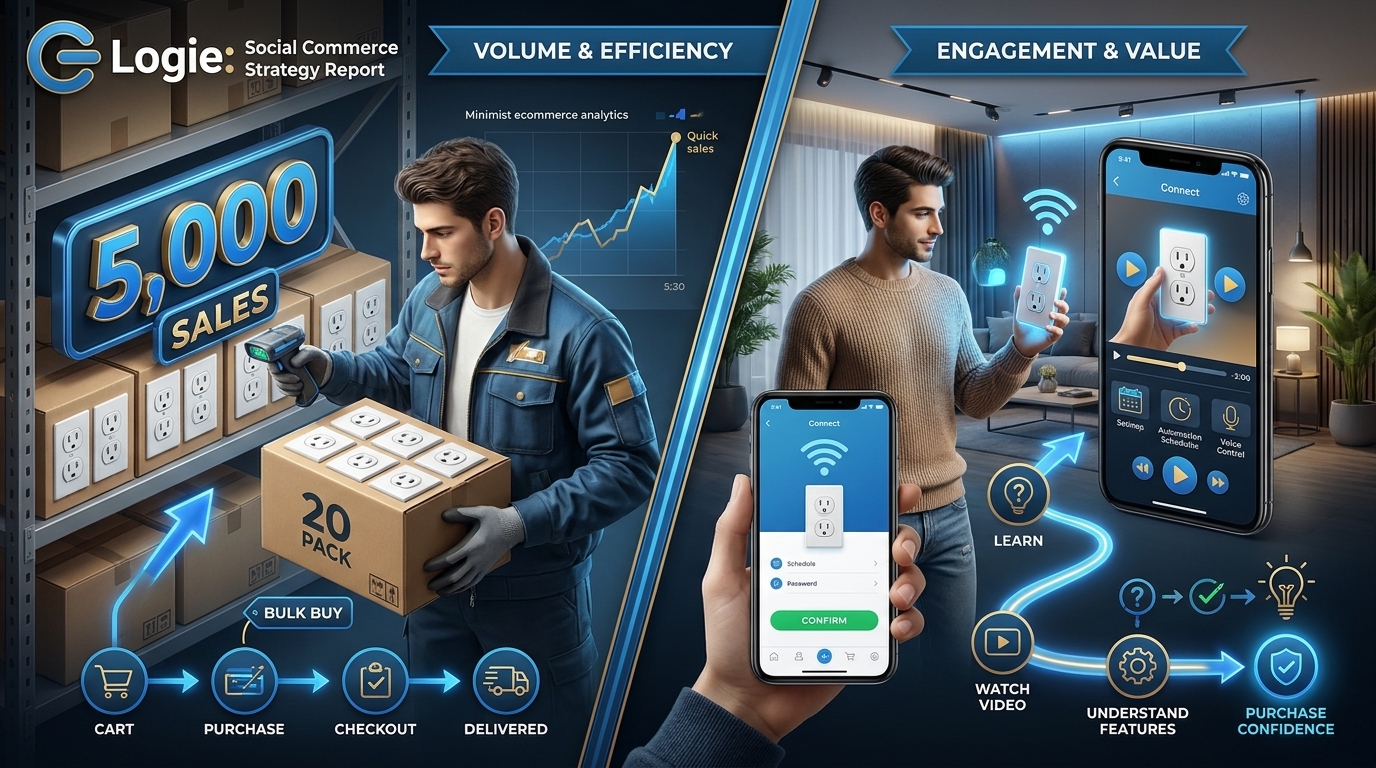
During a Logie webinar on product research, Ehud Segev explained that a product selling 500 units a month can offer a better video opportunity than one selling 5,000, depending on what shoppers need to see. The point is not that lower sales are inherently more valuable. It is that creators should filter demand through video intent.
A hypothetical 500-versus-5,000 comparison
Consider two hypothetical listings:
- Product A: A 20-pack of standard replacement outlets with an estimated 5,000 units sold per month.
- Product B: A Wi-Fi smart plug with an estimated 500 units sold per month.
Product A appears to win by a factor of ten. However, some of its demand could come from electricians, contractors, property managers, or experienced customers ordering a familiar specification. Those buyers may care primarily about model, dimensions, rating, availability, and price.
The Wi-Fi smart plug creates a different decision. A shopper may want to know whether it needs a hub, how it pairs with the app, whether it works with a preferred voice assistant, how far it sticks out from the wall, and whether it blocks the second socket. Nobody wants to unpack a smart plug and discover it blocks the socket needed for the lamp.
Those are buyer-behavior hypotheses to investigate, not conclusions you can draw from a sales estimate alone. A creator still needs to examine each listing, its reviews, available customer questions, existing videos, and likely audience.
What video intent means
Here, video intent means how likely a shopper is to need a demonstration before buying. A product does not have strong video intent simply because it looks good on camera. The video needs a practical job to do.
Four needs are especially useful signals.
1. Education
The shopper needs help understanding what the product does, who it suits, or how it differs from a familiar alternative. New technology, specialized features, unfamiliar formats, and multifunction products often create this need.
For a smart plug, useful education might cover schedules, remote control, automation routines, energy monitoring, or ecosystem compatibility. The strongest concept usually translates one technical feature into a real household use case.
2. Reassurance
The shopper understands the product but worries about a specific risk. Is it larger than expected? Does it feel durable? Is the app confusing? Will it fit the intended space? Does the product in the box resemble the listing images?
Repeated concerns in reviews can reveal the reassurance shoppers need. A clear fit check or honest demonstration may be more useful than another general feature overview.
3. Setup guidance
Products involving pairing, assembly, calibration, sizing, or configuration naturally invite video. A setup walkthrough lets shoppers preview the effort involved and identify any required tools, accessories, accounts, or compatible devices.
This applies to furniture, fitness equipment, kitchen tools, beauty devices, automotive accessories, and smart-home products. Keep demonstrations within your expertise, follow the manufacturer’s instructions, and avoid presenting unsafe technical work as a casual DIY task.
4. Proof
The buyer wants evidence that the product performs as described. Depending on the category, that may mean showing brightness, storage capacity, sound, stability, texture, speed, range, or a realistic before-and-after result.
Useful proof is specific and transparent. Show the testing conditions, avoid exaggerated conclusions, and do not imply that one demonstration guarantees identical results for every buyer.
What high sales can hide
Sales estimates show demand, but they do not reveal the full path behind each purchase. Several behaviors can increase volume without creating the same level of demand for creator video.
Professional purchasing
Professionals often shop with established knowledge. A contractor may search by part number, material, voltage, measurement, or compatibility standard. Video can still help when it demonstrates a new tool or faster workflow, but a familiar commodity component may need little explanation.
Repeat and replacement orders
Customers reordering consumables, filters, office supplies, replacement components, or household staples already know what will arrive. Their purchases count toward the sales estimate, but they may have little reason to watch another overview.
Recurring delivery
Subscription-based orders can further separate transaction volume from active product research. Video may help win the first purchase, but later deliveries may occur with little fresh evaluation. Creators generally cannot determine the exact subscription share from a public listing, so treat it as a possibility to research rather than a known fact.
Exact-match shopping
Some buyers arrive with a narrow requirement, such as a cable length, replacement model, or compatibility standard. A short video confirming dimensions or fit may help, but the listing’s total sales can overstate the number of people who need broader education.
A practical video-intent scorecard
Use this scorecard to stop sales volume from dominating your decision. Give each factor a score from zero to two: zero means the signal is absent, one means it is moderate, and two means it is strong.
| Factor | Question | Strong signal |
|---|---|---|
| Education | Does the product or feature need explaining? | The listing uses unfamiliar technology, terminology, or use cases. |
| Reassurance | Is a specific concern preventing purchase? | Reviews repeatedly mention fit, quality, difficulty, size, or compatibility. |
| Setup | Would a walkthrough reduce uncertainty? | The product requires pairing, assembly, calibration, sizing, or configuration. |
| Proof | Can you demonstrate the promised result? | Performance can be shown through a realistic test or comparison. |
| First-time consideration | Are buyers actively comparing alternatives? | The product solves a new problem or requires a considered choice. |
| Visual differentiation | Can video reveal what images cannot? | Scale, motion, interface behavior, texture, sound, or operation matters. |
This is a practical screening tool, not a tested earnings model. The factors are equally weighted for simplicity, and the total is not a validated predictor of views, placement, conversion, or revenue.
A hypothetical worked scorecard
Assume research suggests that the replacement outlets are mainly familiar purchases, while smart-plug shoppers repeatedly ask about pairing, socket clearance, and compatibility. Under those assumptions, the replacement outlets might score two out of twelve and the smart plug might score ten out of twelve.
That does not prove the smart-plug video will earn more. It shows that video has more unanswered work to do. Amazon placement, traffic, price, competition, commission, availability, production quality, and shopper demand still affect the outcome.
Research video intent before buying a sample
Before requesting a sample or buying something to film, check whether shoppers have a question you can answer.
Read reviews for uncertainty
Look beyond the star rating. Search recent reviews for phrases such as “hard to set up,” “bigger than expected,” “works with,” “instructions,” “assembly,” “app,” and “I wish I knew.” These phrases can expose the gap between the listing and the buyer’s understanding.
Positive reviews can help, too. If customers repeatedly praise one specific use case, you may have found an outcome worth demonstrating. Use the pattern as research, not as a claim that every customer will have the same experience.
Study customer questions when available
Customer questions can reveal purchase blockers involving compatibility, measurements, installation, included accessories, or model differences. Availability and visibility vary by Amazon marketplace and listing, so use reviews, brand support pages, manuals, and search suggestions when marketplace questions are unavailable.
Prioritize questions that benefit from visual answers. Whether two plugs fit in one outlet is easier to show than describe. The same is true for app navigation, scale, texture, sound, and movement.
Inspect existing videos for gaps
The presence of videos does not automatically eliminate the opportunity. A brand video may be polished but broad. A creator video may unbox the product without testing it. An older walkthrough may show a discontinued model or outdated app interface.
Look for a specific, commercially relevant gap. For creators organizing evidence from several sources, Logie’s guide to using AI answer engines for creator research offers a workflow for collecting source material while keeping human verification in the process.
Identify the likely buyer without assuming
Review search language, bundles, model numbers, listing copy, recent reviews, and the questions people ask. These clues may suggest whether the buyer is an expert, repeat customer, gift shopper, or first-time user, but they cannot reveal the exact buyer mix.
Check the economics after finding the question
Once you know what the video would help a shopper understand, evaluate whether the project makes financial sense. Consider:
- The product’s price and current applicable commission.
- The cost of the product or sample.
- Filming, editing, testing, and revision time.
- Competition from existing creator and brand videos.
- Return risk and the likelihood of model changes.
- Whether the question will remain relevant over time.
- Whether the product can support additional useful content without repetition.
A low-priced product with a complicated demonstration and rapidly changing software may not justify the effort. A product that stays relevant, with a setup question shoppers keep asking, could make that filming time more worthwhile.
Amazon policies and program details can change. Confirm current commission rates, video eligibility, placement rules, Creator Connections terms, disclosure requirements, and marketplace features before making a financial decision.
Turn the research into a focused pitch
Lead with the shopper’s question instead of offering generic content. Your message should show what you found, what you plan to demonstrate, and why it could help the buyer.
Example outreach pitch: “I noticed shoppers asking whether this smart plug blocks the second socket. I’d like to film a quick fit check and app setup walkthrough so they can see what to expect before buying.”
Use “I noticed” only when you have actually found that question in reviews, marketplace questions, customer feedback, or another credible source. If the evidence is less direct, frame the idea as a proposed shopper concern rather than an observed pattern.
A focused concept can also support direct outreach after a formal campaign closes. Logie’s guide to pitching brands after Creator Connections campaigns explains how to continue the conversation with a specific content idea.
Build the video around the purchase blocker
A high-intent product can still underperform if the video avoids the question shoppers care about. Structure the content around the decision:
- Name the situation: Establish the shopper’s real-world problem quickly.
- Show the product in context: Make its size, controls, placement, and required accessories clear.
- Demonstrate the critical action: Show setup, operation, fit, comparison, or performance.
- Address the main concern: Explain relevant compatibility, difficulty, limitations, or tradeoffs.
- Clarify who it suits: Help shoppers decide whether the product matches their needs.
For the smart plug, that could mean showing it in a two-socket wall outlet, pairing it with the app, creating a schedule, and turning on a connected lamp. If it requires a hub or blocks the other socket, say so. Decision-relevant limitations can build more trust than an uncritical list of benefits.
A short note for brands
The bestselling SKU is not always the best choice for a creator campaign. A newer or lower-volume product may have a larger gap between shopper interest and shopper understanding.
Ask which listing generates recurring questions about fit, setup, compatibility, or performance. That gives brands a better brief, too: answer this question, rather than just unbox this product.
Creators should disclose applicable affiliate, gifted-product, and paid brand relationships. Brands and creators should also avoid promising guaranteed Amazon placement, sales, views, or earnings.
Choose the question before the product
Before choosing your next product, write down the one thing a shopper needs to see before buying. If you can demonstrate it clearly, check the commission, competition, and filming cost. That gives you a stronger starting point than the sales estimate alone.
Ready to test the framework? Audit ten listings in your niche. Score each for education, reassurance, setup, proof, first-time consideration, and visual differentiation. Prioritize the product with the clearest unanswered shopper question, not simply the highest sales estimate.