
TL;DR: The Quick Strategy
- Free does not mean profitable: A sample still costs testing, filming, editing, and publishing time, especially when many creators receive the same product.
- Treat silence as a reason to investigate: After four or five calendar days without a response, recheck the listing, content gap, campaign timing, eligibility, and potential return. Silence alone proves nothing.
- Buy only when the downside is affordable: Self-fund a product only when it answers a real shopper question, fits your audience, and has a realistic path to recovering both cash and production costs.
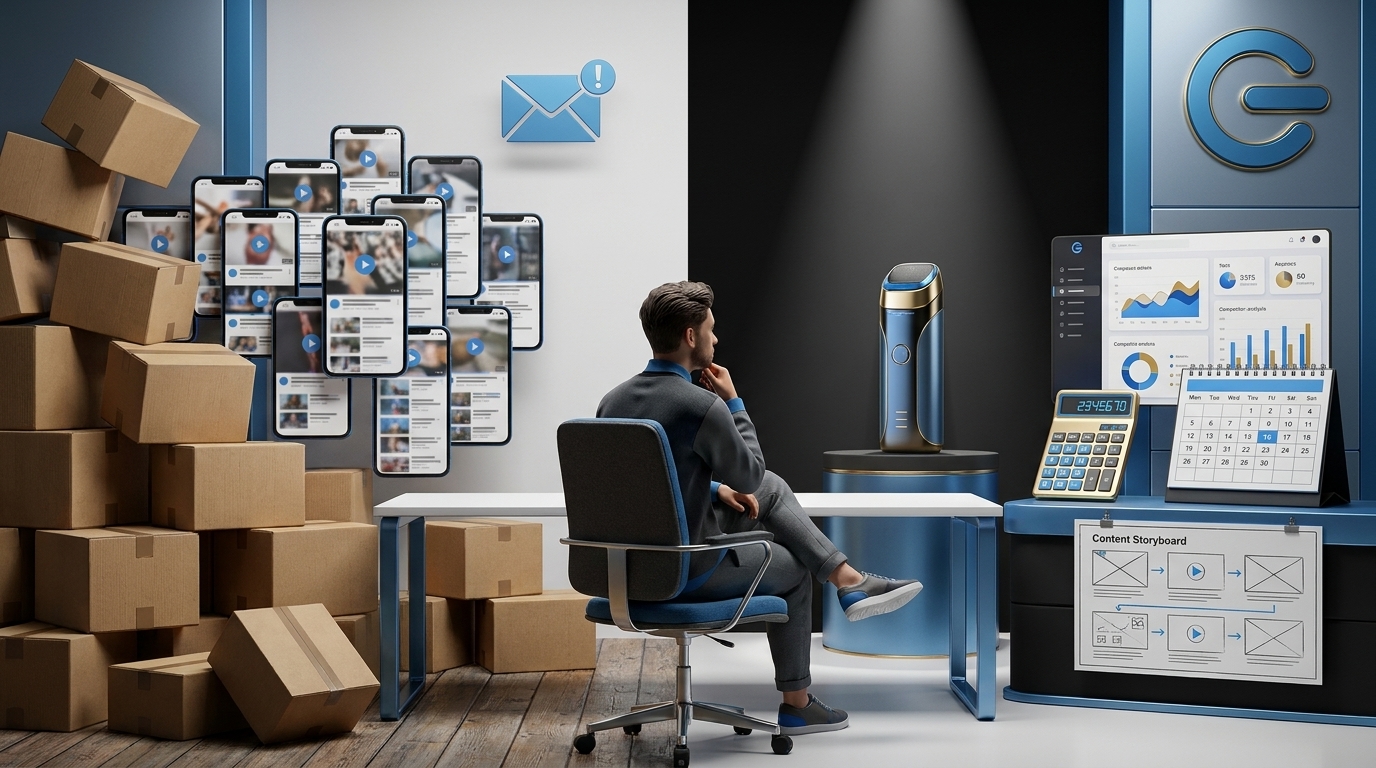
A free sample feels like a small win. You get a product to try, a new video idea, and one less business expense. But when the boxes pile up faster than the earnings, “free” starts to look different.
When a brand approves sample requests broadly, many creators may receive the same item at roughly the same time. That can lead to a wave of similar unboxings, demonstrations, and reviews. By the time your video is ready, several other creators may have answered the same basic shopper questions.
The product cost was zero. The hours spent receiving it, testing it, planning the angle, filming, editing, publishing, and reviewing the results were not.

That is the Amazon sample trap: collecting more products without asking whether they are worth your time.
The free-sample trap
A shelf full of samples creates a satisfying sense of momentum. It gives you visible work and a steady publishing queue. It can also hide weak results.
That unopened box on your desk is not just a freebie. It is another task waiting for you.
Every product has an opportunity cost. Time spent producing a generic video for a crowded listing cannot be used to improve a proven piece of content, answer a less competitive shopper question, or approach a better-aligned brand.
A productive week is not necessarily one with five deliveries. It might be one useful video that earns commissions, teaches you something about your audience, or helps you build a stronger brand relationship.
Before requesting a sample, ask what the product can contribute beyond filling your content calendar. A worthwhile product should offer at least one of the following:
- A clear and relevant shopper question you can answer
- A visual demonstration that improves the buying decision
- A natural fit with your existing niche and audience
- A realistic opportunity to recover your cash and time
- Content that can be reused across eligible channels
- Proof that may support a future brand conversation
If the only appealing feature is the word “free,” the product probably does not deserve priority.
What brand silence really tells you
An unanswered request gives you a question to investigate, not an answer.
The brand may be slow to respond, short-staffed, inactive in the platform, out of sample inventory, selective about creator fit, or focused on another campaign. One unanswered request cannot tell you how the brand is treating other creators, and it does not establish that competition will be low.
The opportunity comes from what you find when you recheck the product, not from the silence itself.
A silent brand creates two common mistakes:
- “The brand did not answer, so the opportunity is dead.” That assumption may cause you to overlook an under-covered product that fits your audience.
- “The brand did not answer, so I should buy it.” That assumption turns a useful research prompt into impulsive spending.
The practical takeaway is not “buy when ignored.” It is “check whether the product still deserves your attention.”
Your decision should be based on observable factors such as current content coverage, unanswered shopper questions, product demand, price, applicable commission terms, campaign eligibility, time remaining, and the amount of work required. Remember that visible listing content is only a snapshot. What you see may not represent every shopper’s experience, every placement, or all competing content.
A five-step Amazon sample strategy
Step 1: Evaluate the product before requesting it
Do not wait for approval to decide whether a product fits your business. A free item that has no connection to your audience or content strengths is still expensive when measured in hours.
Start with five questions:
- Does it fit your niche? A creator who regularly covers home organization is usually better positioned to explain a storage product than someone requesting it only because it is available.
- Is there a real shopper problem? Look for questions about sizing, setup, compatibility, cleaning, noise, texture, portability, durability, or use in a specific environment.
- Can you demonstrate the answer? Visible tests, comparisons, workflows, and before-and-after results tend to provide more decision support than general descriptions.
- Is there enough time? Work backward from the campaign end date. Include response time, shipping, testing, filming, possible reshoots, publication, and time for eligible shoppers to discover the content.
- Would you cover it without a free sample? This question helps remove the emotional pull of receiving merchandise at no cost.
Also confirm that your planned content, placement, links, and purchases are eligible under the campaign’s current terms. Creator Connections incentives, affiliate commissions, and on-Amazon video earnings should not be treated as interchangeable. Check current Amazon documentation and the specific campaign details before estimating a return.
Step 2: Send a focused request and record it
Submit the request, then record the product, brand, request date, campaign end date, estimated production time, and intended content angle.
Write it down so you do not spend the next week wondering whether that sample is coming.
A one-sentence angle is enough at this stage. For example:
- “Show whether the compact bag actually fits under an airline seat.”
- “Demonstrate the setup step shoppers repeatedly describe as confusing.”
- “Test whether the organizer fits the drawer dimensions listed on the page.”
If you cannot name the shopper question before requesting the sample, approval probably will not create a useful angle for you.
A structured tracker can prevent pending requests and unexpected deliveries from overwhelming your calendar. Logie’s five-stage creator sample tracking workflow offers one way to assign each product a status, deadline, obligation, and next action.
Step 3: Use four or five calendar days as a checkpoint
Allow roughly four or five calendar days before conducting a second review. This is an editorial checkpoint, not an Amazon response standard, and it does not predict whether the brand will eventually reply.
During that period, keep the request in a pending state. Do not count the product as incoming inventory or reserve significant production time for it.
Adjust the checkpoint when a campaign is close to ending. A product that arrives too late for adequate testing and publication may have little campaign value, even if the brand provides it for free.
Step 4: Audit the opportunity again
If the brand has not responded, return to the product page as a shopper and competitor. Look for evidence instead of interpreting silence.
Review the following:
- Visible video coverage: How much creator content can you currently see?
- Content quality: Are the existing videos useful demonstrations or mostly repetitive unboxings?
- Content freshness: Has new coverage appeared since your first review?
- Information gaps: Which important shopper questions remain unanswered?
- Product demand: Does the listing appear active, credible, and capable of converting interested shoppers?
- Time remaining: Can you order, test, produce, and publish while the relevant opportunity is still active?
- Downside value: If the content earns nothing, would the product still have personal utility, resale potential, or a place in evergreen content?
Do not rely on a raw video count. Five relevant demonstrations may create more competition than 15 shallow clips. A page with several videos may still contain an opening if none of them answers the question your audience cares about.
The goal is not simply to be early. It is to publish a differentiated and useful answer.
Step 5: Buy only when the numbers and content gap support it
Buying the product yourself may make sense, but only after you have checked what you could realistically earn back.
Start by separating cash recovery from full profitability.
Cash break-even sales = total cash cost ÷ expected net commission per eligible sale, rounded up.
Total cash cost may include the product, tax, shipping, and nonrefundable expenses. Use the net commission you reasonably expect from an eligible sale. Model fixed, capped, or conditional campaign bonuses separately. Do not assume incentives stack with commissions unless the current campaign terms clearly say they do.
Next, include the value of your labor:
Full investment = total cash cost + production hours × your target hourly value.
Full-cost break-even sales = full investment ÷ expected net commission per eligible sale, rounded up.
A hypothetical break-even example
Suppose a product costs $36 including tax and shipping, and you expect to earn $3 per eligible sale. You need 12 eligible sales just to recover the purchase cost.
If production takes two hours and you value your time at $25 an hour, your full investment becomes $86. At $3 per eligible sale, you would need 29 sales to cover both the cash purchase and the assigned value of your labor.
This hypothetical example excludes returns, cancellations, and other adjustments. It also assumes the $3 rate applies to every counted sale, which may not reflect actual reporting or eligibility. Use conservative assumptions and verify current program terms.
You cannot guarantee a return. You can decide how much money and time you are willing to risk.
Make a self-funded product worth filming
If you decide to buy, do not default to a generic unboxing. The purchase makes sense only if you act on the information gap you identified.
A strong product video might:
- Demonstrate the item in a realistic environment
- Answer a pre-purchase question with visual proof
- Show setup, sizing, compatibility, maintenance, or storage clearly
- Explain who the product is and is not suitable for
- Compare expected use with actual use without making unsupported claims
- Identify an important limitation in a fair and useful way
Focus on shopper intent instead of marketing adjectives. Words such as “premium,” “innovative,” and “must-have” offer little help with a buying decision. Measurements, demonstrations, limitations, and specific use cases are more useful.
Follow applicable disclosure requirements and Amazon’s current rules for gifted products, affiliate relationships, and incentivized content. Receiving a free sample does not remove the need for clear disclosure where required.
Three scenarios that clarify the decision
Scenario 1: Free sample, crowded product page
A brand approves your request quickly, but the product already has several polished videos covering setup, dimensions, and common use cases. You cannot identify a meaningful unanswered question.
Likely decision: Accept only if the product is highly relevant and you can bring a genuinely different angle. A free product is not automatically worth several hours of work.
Scenario 2: No response, clear content gap
The brand has not replied after five calendar days. The product fits your niche, visible coverage is limited, and shoppers need a demonstration you can perform. There is enough time to produce the content, and the cash break-even requirement fits your budget.
Likely decision: Consider purchasing. The silence did not prove the opportunity. Your second review uncovered it.
Scenario 3: No response, weak return
The brand is silent and visible competition appears limited, but the product is expensive, expected earnings per eligible sale are modest, and the campaign ends soon.
Likely decision: Pass. Low visible competition cannot rescue poor numbers or an unrealistic production schedule.
Budget safeguards and results tracking
Self-funding should not become uncontrolled shopping. Put safeguards in place before buying test products:
- Set a monthly test budget. Use only money the creator business can afford not to recover.
- Limit unfinished purchases. Avoid buying another product while previous items are waiting for production without a clear reason.
- Set a maximum production time. Do not turn a simple test into an elaborate shoot unless the potential value supports it.
- Require an angle before checkout. Write the shopper question, working title, or demonstration concept first.
- Make budget and eligibility mandatory. No score or content gap should override an unaffordable purchase or an ineligible campaign plan.
- Review decisions in batches. After several requests, look for patterns worth testing across a larger set. Ten requests can produce early observations, not reliable proof of correlation.
Measure outcomes rather than the number of samples received. Depending on what your reporting makes available, track:
- Products received compared with products published
- Average time from arrival to publication
- Production hours per product
- Content pieces created from each product
- Reported clicks, eligible conversions, and earnings
- Time required to recover self-funded cash costs
- Reusable content or brand conversations generated
- Revenue and strategic value per production hour
Do not imply that every purchase can be attributed to a specific video if your reporting does not provide that level of detail. Use only the metrics available to you and label estimates clearly.
A self-funded video can still become a useful case study. If it answers an overlooked question and generates measurable results, you can show a brand that you identified a need, invested thoughtfully, and created useful content. Logie’s guide to winning brand deals with proof rather than follower count explains how results can strengthen a creator pitch.
If the campaign ends, the work may still support a focused follow-up. Logie’s article on pitching brands after Creator Connections campaigns end outlines how a relevant shopper insight can open a new conversation.
The strategic takeaway
Brand responsiveness can be useful, but it is not proof that a product deserves your time. Brand silence is not proof of low competition either.
Separate the excitement of acquiring a product from the value of creating content about it. Request the sample, record the decision, allow a reasonable response window, and then reassess the product using current evidence.
Do not buy a product because a brand ignored you. Buy only when you can answer a shopper’s question, afford the downside, confirm the relevant eligibility rules, and see a realistic path to earning back your investment.