


TL;DR: The Quick Strategy
- Turn your U.S. video library into an expansion asset: Audit proven Amazon shoppable videos before investing time in new international content.
- Distribute selectively from one workflow: Logie’s Manage Content workflow can duplicate eligible videos across Amazon Canada, the UK, Australia, and YouTube without requiring a complete rebuild.
- Expect marketplace-specific friction: If a destination rejects an AI-generated title or thumbnail, test a manual title, a clean video-frame thumbnail, or a more conservative combination of both.
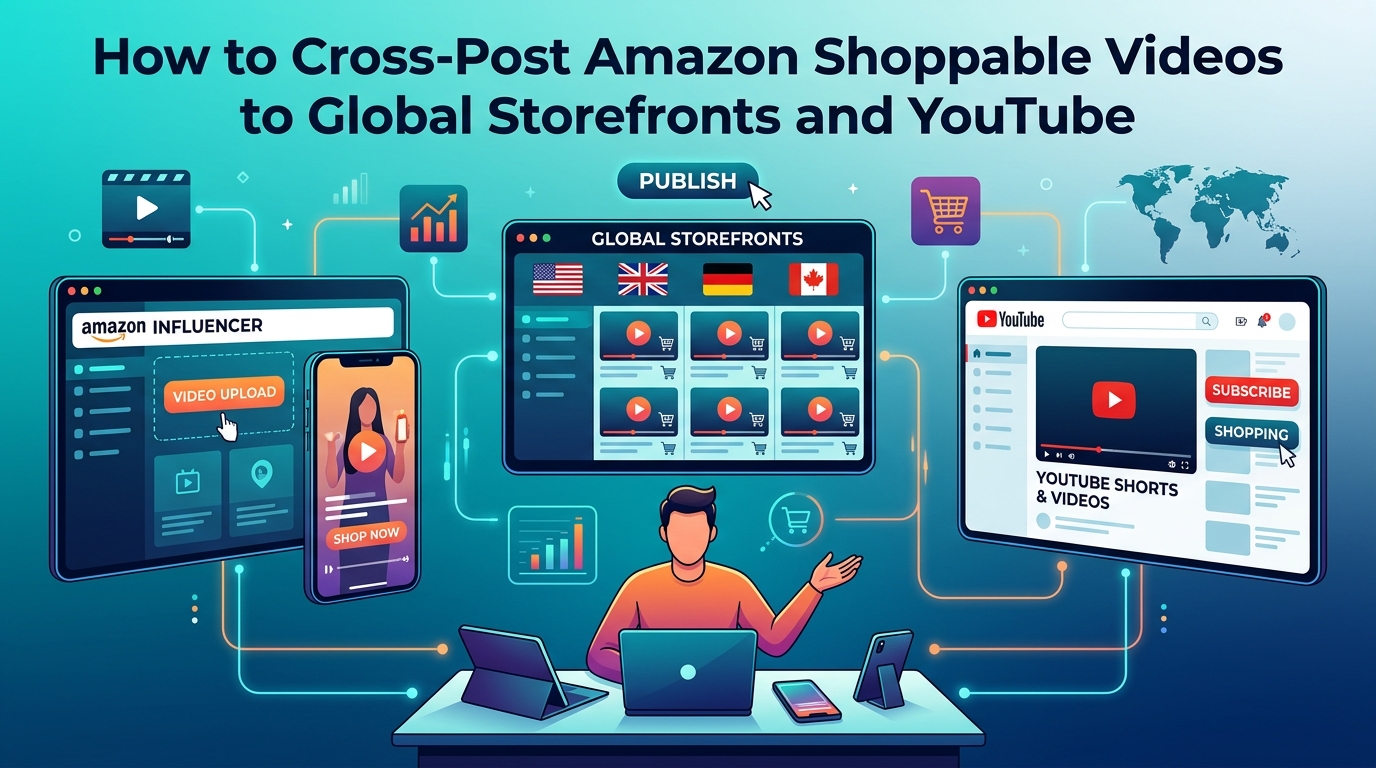
For established Amazon influencers, the next meaningful revenue opportunity may not require another filming day. It may already be sitting inside a U.S. storefront library.
Creators often think about international growth as a new content operation: new videos, new publishing routines, new metadata, and separate management for every destination. That assumption makes expansion feel expensive before it has even begun. A syndication-first approach changes the equation. Instead of asking what you need to create for each storefront, begin by asking which existing videos have not yet been distributed there.

During a Logie session, Sandy demonstrated how the Manage Content workflow can help creators duplicate existing Amazon shoppable videos across English-speaking international storefronts and YouTube.
As Sandy put it, And with a single click, you can duplicate them on all of your other English-speaking storefronts, like Canada, UK, and Australia, as well as YouTube.
The strategic value is larger than the convenience of one click. This workflow allows creators to treat their back catalog as reusable commercial infrastructure. One useful product video can support discovery in multiple markets, extend its productive life, and create additional opportunities for attributable commissions subject, of course, to account eligibility, destination approval, product availability, local program rules, and customer demand.
Why Your Existing Video Library Is an International Growth Asset
A mature U.S. Amazon video library represents a significant investment. Each video required product research, filming, editing, publishing, and enough operational knowledge to make the content useful to a shopper. Once that work is complete, limiting the asset to one storefront can leave potential distribution value unrealized.
This does not mean every U.S. video should automatically be sent everywhere. It means every video should be evaluated for reuse. Creators who approach the library as an inventory of publishable assets can make expansion decisions based on likely value rather than starting from a blank content calendar.
The opportunity is especially relevant when a video has characteristics that travel well across English-speaking markets:
- The product is sold in the destination market. Confirm that the same or an appropriately equivalent product listing exists in Canada, the UK, or Australia.
- The demonstration is visually clear. Videos showing dimensions, setup, material, fit, operation, or a before-and-after result can remain useful even when regional terminology differs.
- The claims are restrained and supportable. Straightforward product education tends to create fewer localization and compliance problems than aggressive promotional language.
- The content is not tied to U.S.-only details. Spoken references to U.S. prices, shipping promises, electrical standards, sizing conventions, warranties, or seasonal events may reduce relevance elsewhere.
- The footage still reflects the current product. A strong historical performer is not a good syndication candidate if the design, packaging, features, or listing has materially changed.
Thinking this way shifts the creator’s role from constant producer to portfolio manager. Production still matters, but distribution becomes a distinct growth discipline. The goal is not merely to make more content. It is to extract more qualified reach from content that has already earned a place in the library.
The Core Workflow: Audit, Match, Distribute, Verify
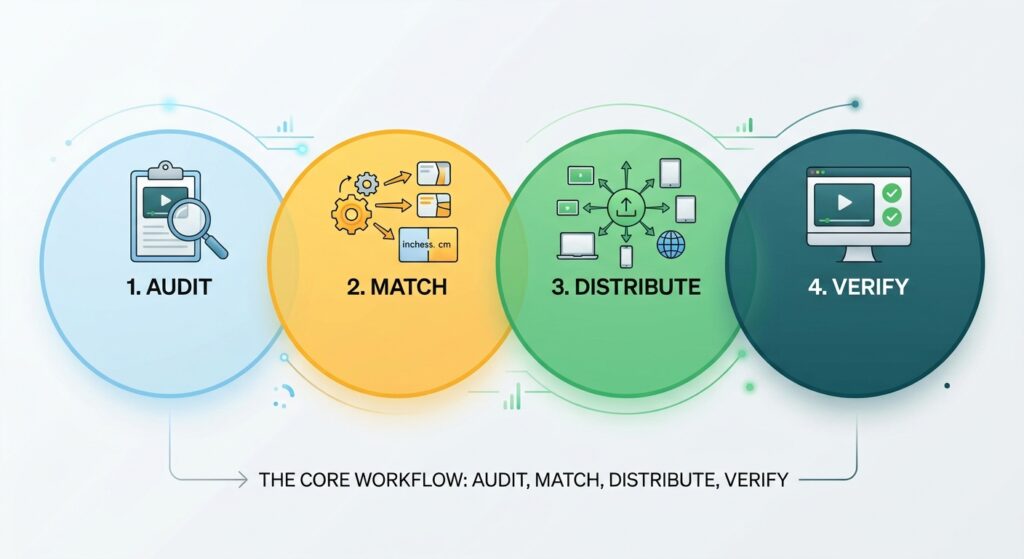
A one-click publishing capability is most valuable when it sits inside a deliberate operating process. Without an audit, creators may republish outdated, unavailable, or market-specific videos. Without verification, they may assume a video is live when a title, thumbnail, or destination-level review has blocked it.
A reliable workflow has four stages.
1. Audit the U.S. video library
Begin with a structured inventory rather than scrolling through content at random. At minimum, capture the video title, product or ASIN, publication date, category, current U.S. status, known performance indicators, and whether the video has already been sent to each target destination.
If the library is large, divide it into practical batches. A creator might review the top 25 evergreen videos first, then recent seasonal content, then the long tail. This makes the project manageable and gives the team an early opportunity to learn which products and metadata patterns transfer cleanly.
Useful first-pass questions include:
- Is the video still accurate?
- Is the associated product active in the destination storefront?
- Does the video contain market-specific pricing, units, plugs, sizing, availability, or claims?
- Has the content already been published to Canada, the UK, Australia, or YouTube?
- Is the video sufficiently strong to represent the creator in a new market?
Creators should also look beyond top performers. U.S. results are a useful prioritization signal, but they are not a perfect forecast of international demand. A video with modest domestic reach may support a product category that is more relevant, less saturated, or more seasonally appropriate elsewhere. Treat past performance as evidence not as the only filter.
2. Match the video to the right destinations
Next, decide where each asset belongs. Canada, the UK, and Australia share substantial English-language compatibility, but they are not interchangeable markets. Product availability, naming conventions, measurements, climate, holidays, electrical requirements, and shopper expectations can vary.
For example, a spoken reference to inches or Fahrenheit may still be understood, but a metric measurement could be more useful to many international shoppers. A kitchen appliance designed for U.S. voltage should not be presented as universally appropriate. A product described with distinctly American terminology may benefit from a revised title, even if the underlying footage remains usable.
The key is selective syndication. Send a video where its product and message make sense; do not confuse technical ease with strategic fit.
3. Use Manage Content to cross-post eligible assets
Once a video has passed the audit, creators can use Logie’s Manage Content workflow to select the appropriate destinations. Sandy’s demonstration centered on duplicating existing U.S. Amazon shoppable videos to English-speaking Amazon storefronts – Canada, the UK, and Australia – as well as YouTube.
This is operationally important because it reduces repetitive setup. The creator is not being asked to reconstruct the entire asset independently for every destination. Instead, an existing video becomes the starting point for controlled distribution.
That distinction matters at scale. Saving a few minutes on one upload is convenient. Saving repeated upload and setup work across hundreds of library assets can materially improve the economics of expansion. It allows more time for higher-value work: checking product-market fit, refining packaging, responding to errors, studying results, and creating genuinely new content where the portfolio has gaps.
4. Verify the destination status
Publishing should never be treated as complete until the destination confirms that the asset has been accepted or made live. A submission can encounter a marketplace-specific title or thumbnail problem even when a similar package worked elsewhere.
Create a lightweight status system for each video and destination:
- Not reviewed: The asset has not yet been assessed for that market.
- Ready: Product availability and content suitability have been confirmed.
- Submitted: The video has been sent but does not yet have a confirmed live status.
- Live: Publication has been verified at the destination.
- Needs revision: A title, thumbnail, product match, or other issue requires intervention.
- Hold: The asset is unsuitable, outdated, unavailable, or not currently worth distributing.
This simple discipline prevents the most common scaling failure: mistaking an attempted cross-post for a completed expansion.
How to Prioritize a Large Back Catalog
Creators with hundreds or thousands of videos should avoid treating the entire library as one migration project. Prioritization helps generate useful feedback early while limiting avoidable review work.
| Priority | Video profile | Recommended action |
|---|---|---|
| Highest | Evergreen, accurate, strong U.S. signal, product confirmed in one or more target markets | Review and distribute first |
| High | Clear demonstration, broadly relevant product, little or no U.S.-specific language | Cross-post after a metadata check |
| Medium | Useful content with regional terminology, measurements, or seasonal references | Assess whether packaging changes are sufficient |
| Low | Old product version, weak visual quality, uncertain product match, or destination availability gaps | Hold, update, or retire |
| Do not distribute | Inaccurate claims, discontinued item, incompatible technical specifications, or misleading market context | Exclude from syndication |
A scoring model can make the process even more consistent. Assign each video a simple score for product availability, evergreen relevance, visual clarity, market neutrality, historical performance, and compliance confidence. The exact formula matters less than using the same criteria repeatedly.
Teams should also consider category clusters. Processing ten videos from one category may reveal recurring issues – such as unit conventions, thumbnail styles, or title patterns – faster than reviewing ten unrelated products. Those lessons can then inform the next batch.
Compliance Friction Is Part of the Workflow
Cross-posting does not mean every destination will accept identical packaging. Marketplaces and channels can apply different automated checks, review standards, field requirements, or interpretations. A title or thumbnail accepted in one location may be declined in another.
This is not necessarily evidence that the video itself is unusable. Often, the problem is in the publishing layer around the footage.
If an AI-generated title is declined
Replace it with a direct manual title. The safest title usually describes what the shopper will actually see without making exaggerated claims or forcing unnecessary keywords.
A practical structure is:
Product type + primary demonstration + specific use context
For example, a restrained title such as “Insulated Travel Mug Lid and Leak Test” is clearer and easier to defend than a superlative-heavy promise such as “The Only Travel Mug You’ll Ever Need.” The manual version is not merely a fallback. In many cases, it is better metadata because it tells both the review system and the shopper exactly what the content contains.
When revising a rejected title:
- Remove unsupported superlatives and absolute claims.
- Avoid guarantees about results, price, availability, or delivery.
- Delete excessive punctuation, urgency, and promotional phrasing.
- Keep the title faithful to the footage.
- Use the language shoppers in that market are likely to understand.
- Change one major variable at a time so you can identify what resolved the issue.
If an AI-generated thumbnail is declined
Try a clean frame selected from the video. Choose an image that clearly shows the product, demonstration, or result without relying on dense overlays or attention-grabbing claims. A natural frame can be less visually elaborate, but it may also be more representative of the content and less likely to introduce a mismatch.
A strong video-frame thumbnail should have:
- A recognizable view of the product;
- Good lighting and sufficient contrast;
- Minimal motion blur;
- No misleading before-and-after implication;
- No unnecessary text or claims;
- A composition that still reads at a small size.
If both title and thumbnail may be contributing to the rejection, test systematically. Start with a conservative manual title and a clean video frame. Document the combination submitted, the destination, the error shown, and the outcome. This creates an internal troubleshooting library rather than forcing the team to rediscover the same solution later.
Why YouTube Should Not Be Treated as Just Another Mirror
The same distribution workflow can also extend an Amazon-focused asset to YouTube, but the strategic role of YouTube is different. On a marketplace, the shopper is often already close to a product decision. On YouTube, the viewer may be researching a problem, comparing options, learning how a feature works, or discovering the category for the first time.
The footage can be reused, but the packaging should reflect that discovery context. A useful YouTube title typically emphasizes the question answered, the feature demonstrated, or the decision supported. The description should provide context and include any required affiliate disclosures in a clear, conspicuous way. Creators should follow the current rules of the platforms and affiliate programs they use.
Before cross-posting to YouTube, ask:
- Does the opening make sense to someone who did not arrive from a product page?
- Does the title explain the viewer benefit without overstating it?
- Can the description add essential product context?
- Are disclosures and links presented appropriately?
- Is the video complete enough to stand alone?
Some short Amazon videos will transfer cleanly. Others may work better as supporting clips, Shorts, or components of a longer comparison. Syndication should reduce redundant labor, not eliminate channel judgment.
Build a Repeatable Global Content Operations System
The creators most likely to benefit from cross-posting are those who turn it into a recurring process rather than a one-time library cleanup. A monthly or quarterly review can identify new U.S. videos that have not yet reached other storefronts, submissions that require intervention, and products that have recently become available in another market.
A practical operating cadence might include:
- Inventory: Export or review the latest U.S. video catalog.
- Gap analysis: Identify which videos are missing from Canada, the UK, Australia, and YouTube.
- Eligibility review: Check current product availability, content accuracy, and market fit.
- Batch distribution: Submit a controlled group through Manage Content.
- Status review: Verify which assets are live and which need revisions.
- Error resolution: Replace declined AI-generated titles or thumbnails with manual alternatives.
- Measurement: Record destination-level signals and decide what to distribute next.
For teams, ownership should be explicit. One person may approve the candidate list, another may operate the publishing workflow, and another may monitor errors and outcomes. For solo creators, the same roles still exist; they simply need to be handled in focused blocks rather than mixed into every filming day.
What to Measure After Expansion
The purpose of syndication is not to maximize upload count. It is to produce efficient, qualified reach and additional revenue opportunities. Measurement should therefore connect activity to outcomes.
Track metrics that are available and permitted within your relevant dashboards, such as:
- Number of library videos reviewed;
- Number and percentage eligible for each destination;
- Submissions and confirmed live videos by storefront;
- Rejection or revision rate by destination;
- Common title and thumbnail error patterns;
- Time required per successfully published asset;
- Views, engagement, clicks, conversions, or commissions where reported;
- Performance by product category, content format, and video age.
Be careful with attribution. International commissions can be affected by product availability, local pricing, conversion behavior, program terms, placement, seasonality, and account eligibility. Cross-posting creates more opportunities for discovery and conversion; it does not guarantee that every destination will produce the same outcome.
The most valuable early finding may not be immediate revenue. It may be identifying which categories transfer well, which storefront has the highest acceptance rate, or which packaging changes reduce review friction. Those insights improve every future batch.
A 30-Day Rollout Plan
Week 1: Build the inventory
Select a manageable group of established U.S. videos. Confirm accuracy, product status, and destination gaps. Start with a batch large enough to reveal patterns but small enough to troubleshoot carefully – often 20 to 50 videos, depending on team capacity.
Week 2: Confirm market fit
Check whether each product is available in Canada, the UK, and Australia. Review the videos for region-specific language, measurements, technical requirements, and claims. Decide which destinations make sense for each asset.
Week 3: Cross-post and monitor
Use Manage Content to distribute approved videos to the selected storefronts and YouTube. Record submission dates and statuses. Do not assume that selecting multiple destinations means every asset will clear every destination identically.
Week 4: Resolve errors and analyze
For declined packaging, test a direct manual title and a representative video-frame thumbnail. Verify live status again, summarize recurring errors, and compare early destination-level signals. Use those findings to define the rules for the next batch.
The Strategic Shift: Create Once, Operate Globally
The biggest lesson is not simply that a creator can send one video to more places. It is that content creation and content distribution should be managed as separate sources of growth.
Creators already understand the value of building a library. The next step is to operate that library intentionally: audit what exists, identify destination gaps, match content to real product availability, distribute selectively, and resolve local packaging issues without rebuilding the underlying asset unnecessarily.
For a creator with a substantial U.S. catalog, even a partial expansion can uncover meaningful unused capacity. The footage has been filmed. The product has been demonstrated. The core explanation already exists. With the right workflow, that sunk production effort can support new storefronts and a broader discovery channel.
Open Logie’s Manage Content workflow and audit your first batch today. Identify the strongest U.S. videos missing from Canada, the UK, Australia, and YouTube, then cross-post selectively, verify every destination, and turn your back catalog into a global growth engine.