
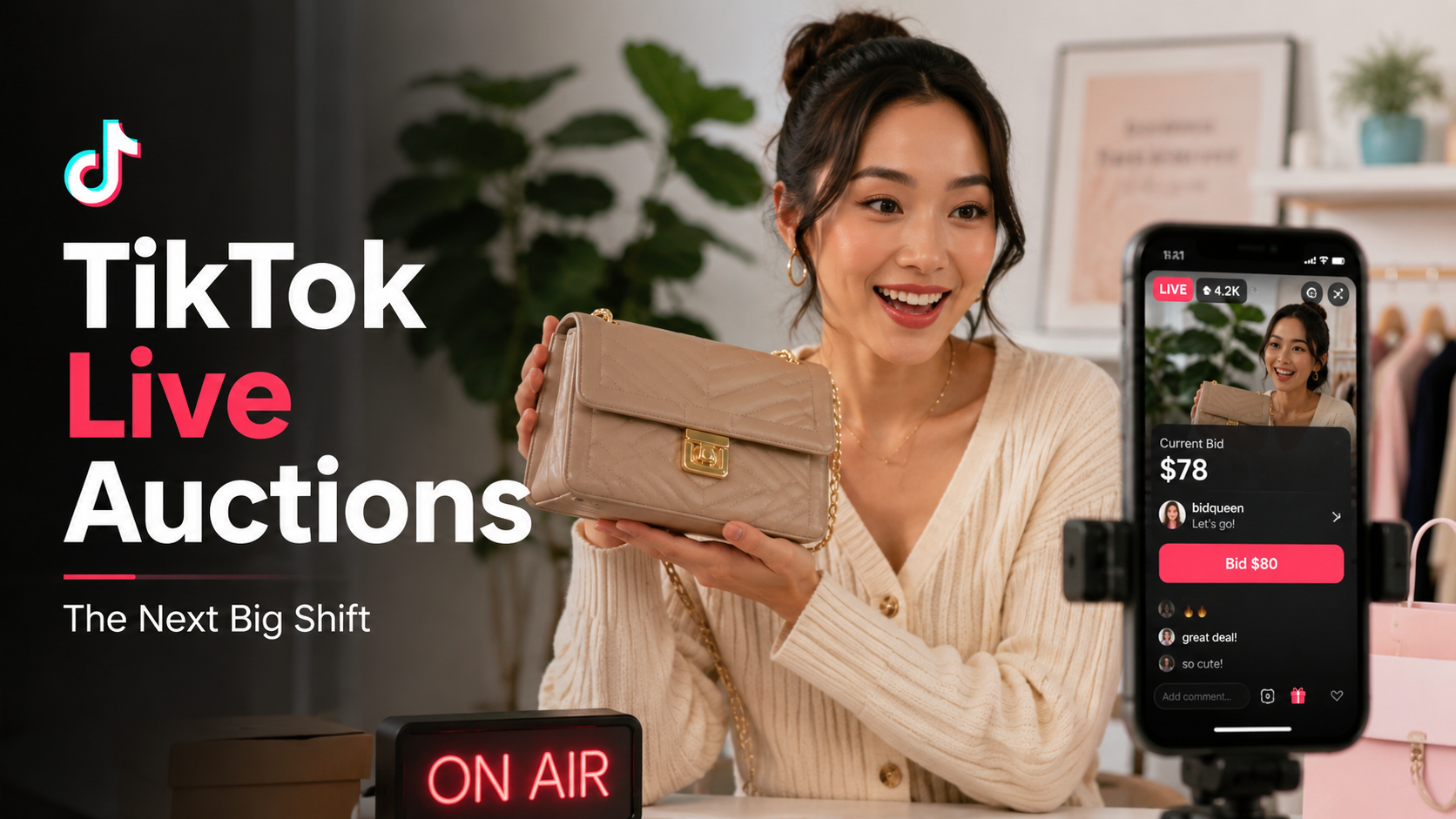
- TikTok is now competing directly with Whatnot and eBay by launching in-app, ultra-fast auction shopping – reshaping social commerce dynamics.
- Early adopters are scoring bargain inventory and building hype, but there are risks: product authenticity, payment friction, and regulatory blind spots.
- To capitalize, creators should test selling and sourcing, track trends, and blend auction finds with evergreen multichannel content for maximum impact.
Introduction: Shopping Is Becoming Entertainment
Something fundamental is changing in how people buy things online, and it has very little to do with better product pages or faster shipping.
For most of the last two decades, e-commerce was a logistics problem. You built a website, wrote a product description, optimised your checkout, and waited for search traffic or paid ads to bring someone to your door.

The experience was transactional at best, sterile at worst. Shopping was something you did, not something you watched.
That model is being dismantled in real time.
This new in-app auction capability lets sellers host ultra-short, 15-second live bidding rounds on anything from sneakers to drones to high-demand collectibles. As Altovise Pelzer explained to the Logie community:
“Have you seen that they can now do auctions on TikTok? I feel like it’s them trying to compete with Whatnot. Because so many people have been going to Whatnot… It’s like an auction, a live auction, and you can go ahead and get it. Listen!… It’s a live auction. You can bid on a product. They normally do the bidding time, like 15 seconds, or something like that.”
Today, a Gen Z viewer in the United States can open TikTok, stumble onto a live stream, watch someone unbox a trading card, feel the electricity of a bidding war, and complete a purchase all without leaving the app, all in under five minutes.

The product didn’t find them through an algorithm. The moment found them. And that is a fundamentally different kind of commerce.
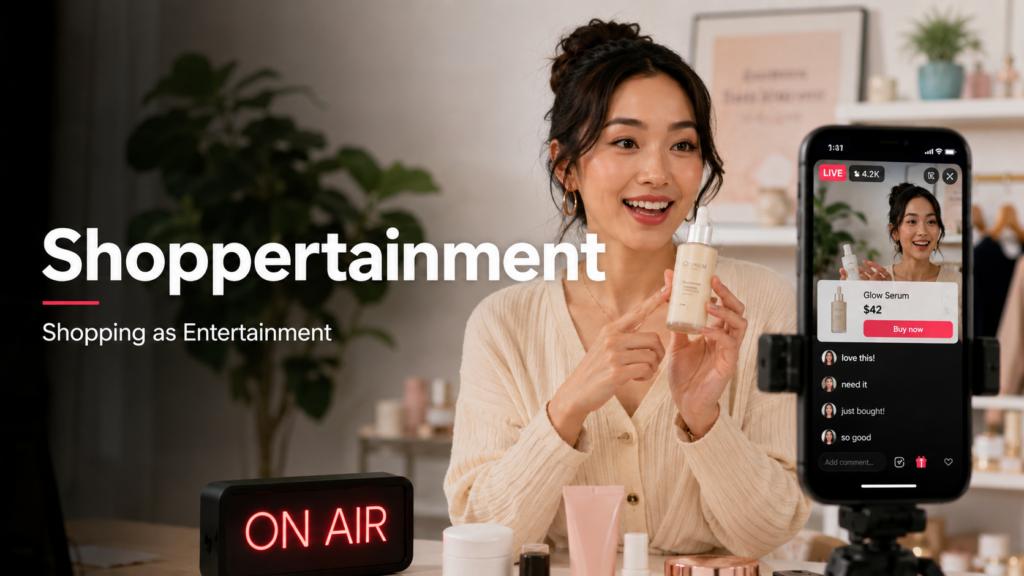
This is what the industry has begun to call shoppertainment: the convergence of entertainment and shopping into a single, uninterrupted experience.
It’s not a gimmick. Social commerce crossed $1.2 trillion in global sales in 2025, and U.S. social commerce alone is projected to surpass $100 billion in 2026. The numbers are no longer aspirational; they’re operational.
TikTok’s Countdown Bidding feature is the clearest signal yet that the platform is not content being a product discovery engine. It wants to be the stage where buying happens, and it wants that stage to feel like a show.
For creators, sellers, and brands who are paying attention, this shift represents one of the most meaningful opportunities to emerge from social commerce in years. But opportunity, as always, comes bundled with complexity. This article unpacks all of it.
What Is TikTok Countdown Bidding?
If you haven’t encountered it yet, here’s the simple version: TikTok Countdown Bidding is a live auction feature built directly into TikTok LIVE. Sellers can list products for auction; viewers place real-time bids; a countdown timer creates urgency; and when the clock runs out, the highest bidder wins and completes checkout through TikTok Shop.
That’s it at its core. But the mechanics are worth understanding a little more carefully.
Sellers set up auction products either by creating a temporary listing directly in the LIVE Manager with no inventory sync, or by creating a permanent listing in Seller Center.
The temporary listing option is particularly notable, as moderation typically takes less than two minutes, allowing sellers to be spontaneous. You can decide mid-stream that a particular item is going to auction and get it live within minutes.
During the auction, the countdown timer and limited inventory work together to push viewers toward faster decisions.
TikTok’s own seller documentation describes this explicitly: the feature is “built for urgency,” designed to keep viewers engaged, increase competitive bidding behaviour, and convert passive watchers into active buyers.
The combination of social proof, other people visibly bidding, competition, the risk that someone else might win, and live host interaction, the seller reacting in real time, creates an environment that is genuinely difficult to replicate in traditional e-commerce.
There are some structural rules that creators and sellers need to understand from the start. Countdown Bidding is currently available to sellers with a Seller Performance Score (SPS) of 2.5 or higher or a null SPS.
Once an auction starts, auction terms cannot be modified. Bids are binding and final, unlike standard TikTok Shop orders; auction purchases do not carry the usual one-hour cancellation window.
Sellers are obligated to fulfil orders once the auction ends, and a winning bid is placed. These aren’t small print details. They are the foundation of the feature’s credibility, and any seller who treats them casually will quickly erode trust.
One creative extension worth noting: TikTok has also introduced a “Surprise Set” format within Countdown Bidding, where sellers build a prize pool with multiple products of varying values.
The winner of the bidding is revealed a random prize via a spinning wheel, live on stream, while remaining prizes stay visible to keep the audience engaged and bidding.
It’s a format that borrows directly from the entertainment playbook, part auction, part game show.
Why TikTok Is Serious About Live Auctions
To understand why TikTok built this, you have to look east.
Douyin, TikTok’s Chinese sister platform operated by ByteDance, generated approximately $490 billion in GMV in 2024, representing roughly 30% year-over-year growth.
TikTok’s international operation generated around $30 billion in GMV over the same period. That is a staggering gap, and it is not primarily explained by population differences or platform age.

It is explained by behaviour. Chinese consumers have fully normalised buying products through live video. International audiences are still warming up to the idea.
TikTok’s leadership knows this and is actively engineering the conditions to close that gap. Countdown Bidding is a deliberate move in that direction. The feature does four things for TikTok simultaneously.
First, it extends the session time. Auctions are inherently hard to leave. You are invested. You bid. You want to see if you win. Every minute a viewer stays in a LIVE stream is a minute TikTok’s algorithm learns more about their preferences and serves more relevant content and products.
Second, it creates a mechanism for urgency that standard product listings simply cannot match. TikTok has always been a platform where trends explode and disappear quickly, where FOMO, the fear of missing out, is a core part of the user experience. Countdown Bidding productises that feeling and attaches it directly to commerce.
Third, it brings TikTok into direct competition with auction-native platforms like Whatnot, which we will address in detail shortly. TikTok is signalling its intent to absorb the auction-commerce category rather than cede it to a specialist competitor.
Fourth, and perhaps most importantly, it makes TikTok Shop feel less like a marketplace and more like an event. This distinction matters enormously for creator culture. Creators don’t want to run stores.
They want to host experiences. Countdown Bidding gives them a format that aligns with how they already think about content.
The Whatnot Comparison
Anyone who has spent time in live commerce circles knows Whatnot. The platform, often described as “eBay meets Twitch”, helped popularise the model of fast-paced, personality-driven live auctions for communities built around collectibles, trading cards, sneakers, vintage fashion, and niche hobby categories.
The numbers are genuinely impressive. Whatnot crossed $3 billion in GMV in 2024 and is projected to exceed $6 billion in 2025. In October 2025, it raised $225 million at an $11.5 billion valuation.
Sellers on the platform spend an average of 80 minutes per day in the app, more than on Instagram or TikTok. Over 500 sellers have crossed $1 million in annualised sales, and one in eight sellers now works the platform full-time.
Downloads jumped 541% year-over-year in November 2025 alone. By any measure, Whatnot has built something real.
But Whatnot and TikTok are solving different problems, and that distinction shapes how Countdown Bidding should be understood.
Whatnot is auction-first. Its entire architecture is built around the live auction format. Community is built through repeat sellers, niche categories, and the loyalty of dedicated collectors. If you come to Whatnot, you know what you’re getting.
TikTok is attention-first. The platform’s superpower is discovery at scale, serving content to people who didn’t know they wanted it. TikTok’s algorithm is arguably the most powerful product recommendation engine in the world, but it works through entertainment rather than search intent.
What Countdown Bidding does is graft auction mechanics onto TikTok’s discovery engine, and the implications of that combination are significant. A bidding war on Whatnot is witnessed by a dedicated community.
A bidding war on TikTok can become a viral clip. The seller’s reaction to a record bid can be clipped and shared. The unboxing that follows a winning auction can live on TikTok’s short-form feed, on YouTube Shorts, on Pinterest, and in a newsletter. The auction is not just a sale. It is content that generates more content.
This is the core insight that creators should hold on to: the moment of an auction on TikTok has a second life that auctions on dedicated platforms often lack. That is a structural advantage that no amount of community-building by Whatnot can fully replicate.
What This Means for Creators
For creators, the arrival of Countdown Bidding opens up several distinct strategic positions, and the right one depends entirely on your current situation, audience, and content style.
As a seller, the most direct opportunity is using auctions to move products with genuine scarcity, create event-like LIVE streams, and test pricing dynamics for items where market value is uncertain. If you have access to limited-edition products, pre-owned items, or unique finds, Countdown Bidding gives you a mechanism that rewards those items with attention they wouldn’t get in a static listing.
As a buyer and content creator, the angle is less obvious but arguably more powerful. Winning an auction, especially for something surprising, valuable, or visually compelling, is a story.
The bidding process, the tension of the countdown, the reveal of the win, the unboxing, the reaction: each is a content beat. A single auction win can generate a TikTok video, a YouTube Short, a Pinterest pin, a blog review, and an affiliate recommendation, all from the same $40 purchase.
As a livestream host, Countdown Bidding gives you a format anchor. The challenge of unstructured LIVE selling is that it can feel shapeless. Auctions give your stream a rhythm: a beginning, a middle, and a resolution. Viewers know what they’re watching and why they should stay.
As a content strategist, the meta-opportunity here is being early. Social commerce formats reward the people who learn them before they are commoditised.
The creators who understood TikTok’s algorithm in 2019 built audiences that still benefit them today. The creators who mastered affiliate content through TikTok Shop in 2023 and 2024 built revenue streams their competitors are still trying to replicate. Countdown Bidding is early. The playbook is still being written.
Best Product Categories for TikTok Auctions
Not every product category is well-suited to live auction selling, and pretending otherwise would be doing you a disservice.
The best auction categories share a few common characteristics: they have some degree of rarity or condition variation, they benefit from live demonstration or reveal, and they carry emotional or community significance for the buyer. With that framework in mind, here are the categories most likely to perform well.
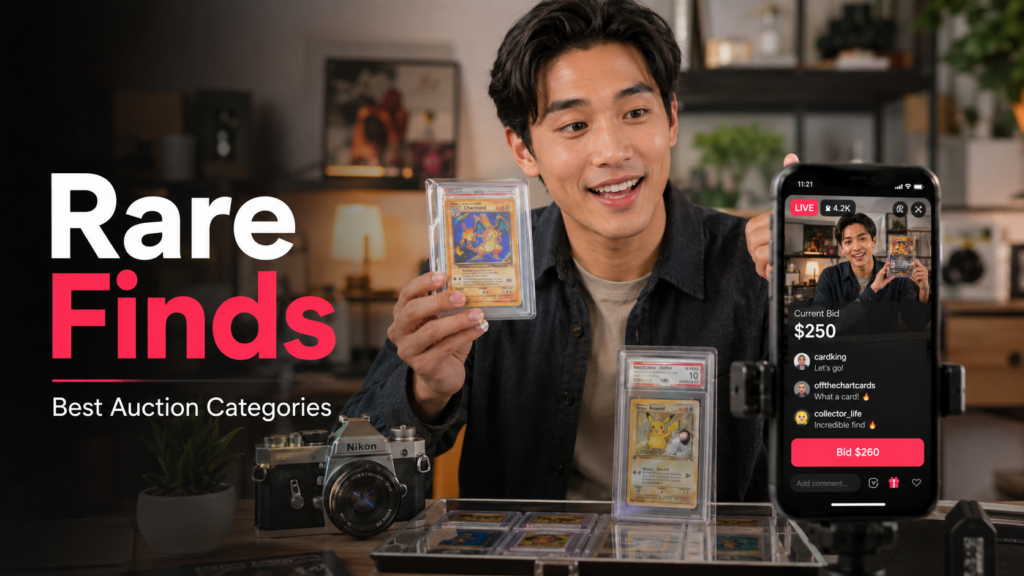
Collectibles are the natural fit. Trading cards, Pokémon, sports memorabilia, vintage toys, comics, and hobby items already have established price discovery dynamics and passionate communities. Whatnot proved the model; TikTok can extend the reach.
Fashion, particularly pre-owned, vintage, or limited drops, works well because condition matters, and live video is the best way to demonstrate it.
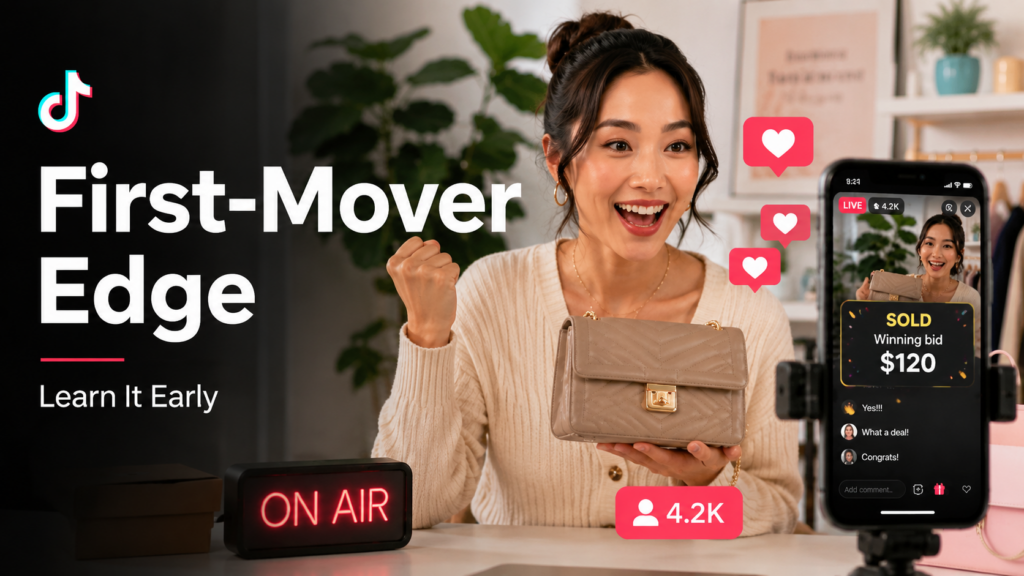
A vintage jacket you can spin, show the lining, and discuss its provenance is a very different product experience from a static product image.
Pre-owned and refurbished luxury is an emerging category with significant upside. Buyers of pre-owned luxury goods are particularly concerned with authenticity and condition.
A live auction where the seller walks through every detail, answers questions in real time, and establishes credibility is genuinely valuable.
Beauty bundles and mystery-style sets perform well in auction environments because the element of surprise drives entertainment.
A curated beauty set with a revealed value higher than the winning bid creates a powerful sense of win for the buyer.
Tech accessories with limited availability or that are discontinued have a natural appeal of scarcity. The live format allows sellers to demonstrate functionality in ways product listings cannot.
Creator merch and limited drops make sense for creators with established audiences who want to reward their community with access rather than just products. An auction creates a moment around a drop that a standard shop listing cannot.
Seasonal products and niche hobby items round out the list. Anything with a defined season, a clear community, or a passionate collector base is worth testing.
A word of caution on product selection: the authenticity standards at live auctions are high because buyers have no return cushion.
TikTok’s auction items are subject to standard fulfilment and category refund policies, but the lack of the normal cancellation period means buyers are trusting sellers significantly.
If your product category carries any ambiguity around condition, authenticity, or value, you need to over-communicate, not under-communicate. The trust you build in one stream compounds. The trust you lose is far harder to rebuild.
The Psychology of Urgency, Scarcity, and FOMO
If you’ve ever bid on something you didn’t plan to buy, you already understand the psychology intuitively. But the academic literature on this is worth understanding, because it explains why live auctions work so reliably and why the risks are real.
Research on live shopping behaviour consistently shows that countdown timers and limited inventory serve as arousal triggers, elevating urgency and emotional tension.
Once arousal reaches a threshold, the brain’s reward system begins to favour emotion-based decisions over rational analysis.
This is not a design flaw; it is the feature working exactly as intended. The scarcity principle holds that people perceive limited-time offers as more valuable precisely because they are limited, regardless of their intrinsic value.
In a live auction, these mechanisms stack. There is a countdown timer. There is visible competition; someone else is bidding.
There is social proof that other viewers are watching and reacting. There is the host’s energy and commentary. There is the community element; you are part of something happening right now, and if you leave, you miss it.
TikTok’s own research confirms this: scarcity cues in live environments are amplified through visual and verbal reminders, creating what one study described as a “high-pressure but enjoyable atmosphere that prompts immediate purchasing decisions.”
The entertainment layer is what separates TikTok’s version of this from a standard eBay auction. In a cold, text-based auction interface, the psychology is present but muted.
In a live stream where a charismatic host reacts to every bid, the chat is alive with reactions, the countdown timer is visible, and the stakes feel real; the emotional intensity is categorically different.
This is why TikTok’s holiday shopping intent jumped from 76.1% in 2024 to 83.2% in 2025 among U.S. social media users. The platform has become what researchers call a daily Black Friday: the same emotional triggers of scarcity, urgency, and social proof, served algorithmically, every day, in-feed.
Understanding this psychology is important for two reasons. For sellers and creators, it is the engine you are working with. Respect it and use it honestly. For buyers, it is the force you need to be aware of so that excitement doesn’t replace judgment.
How Creators Can Turn Auctions Into a Content Workflow
Here is where the practical playbook starts to take shape.
The biggest mistake a creator could make with Countdown Bidding is treating it purely as a selling mechanism.
It is also, perhaps primarily, a content-generation mechanism. Every auction has the structure of a story: setup, tension, resolution. Stories are the raw material of content. The job is to capture those stories and extend their life across platforms.
Step one: Watch before you sell. Spend time in other sellers’ live auction streams. Study what products generate the most aggressive bidding.
Notice which moments in the auction create the biggest chat reactions. Observe how hosts manage the energy between items. This is free market research and creative direction at the same time.
Step two: Start with low-risk, high-entertainment products. Your first auctions should not be your highest-value inventory. Choose products where the loss from a low final bid is acceptable, but the entertainment potential is high. Surprising price outcomes both above and below your expectations make for better content anyway.
Step three: Record everything. Your LIVE stream is raw footage. From it, you can pull: the moment a bid spikes unexpectedly, the reveal of a winning item, your genuine reaction to the final price, viewer comments that are funny or insightful, and the unboxing if you are also the buyer.
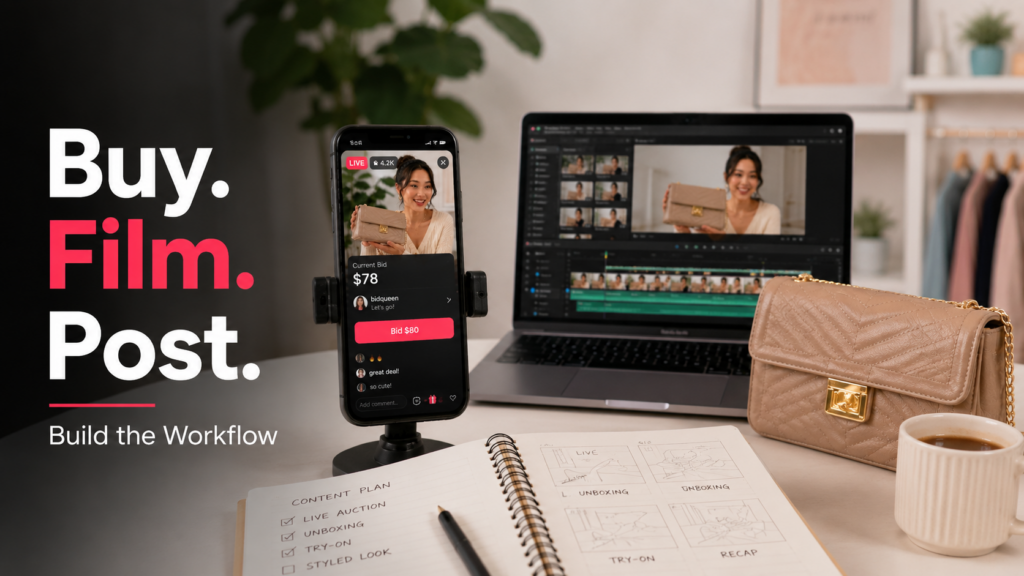
Step four: Build the post-auction content stack. A single auction win or sale can become a TikTok recap clip, a YouTube Short, a Pinterest pin of the winning item, a blog post about the product category, a newsletter feature on what sold and why, and an affiliate recommendation for similar products. The auction is the event. The content stack is the residual.
Step five: Track the data. Final selling prices are market signals. A product that consistently sells above retail in live auctions tells you something about demand that no amount of keyword research can replicate. Creators who treat auction outcomes as data will make sharper decisions about what to source, feature, and recommend.
Step six: Build consistency in your format. The creators who win in live commerce are not necessarily the ones with the biggest audiences. They are the ones with the most consistent, recognisable formats. If your audience knows you run fashion auctions every Thursday night, they will show up. Consistency is distribution.
The Risks: Overbidding, Trust, Fulfillment, and Buyer Pressure
Honest coverage of any emerging commerce feature requires confronting the risks clearly, and Countdown Bidding has genuine ones.
For buyers: The binding, non-retractable bid structure is the most important thing to understand. Unlike standard TikTok Shop orders, auction wins cannot be cancelled within an hour. When you bid, you are committing.

The excitement of a live stream can absolutely push you to bid more than you intended or more than the product is worth. The research on this is unambiguous: emotional arousal in live shopping environments literally overrides rational analysis.
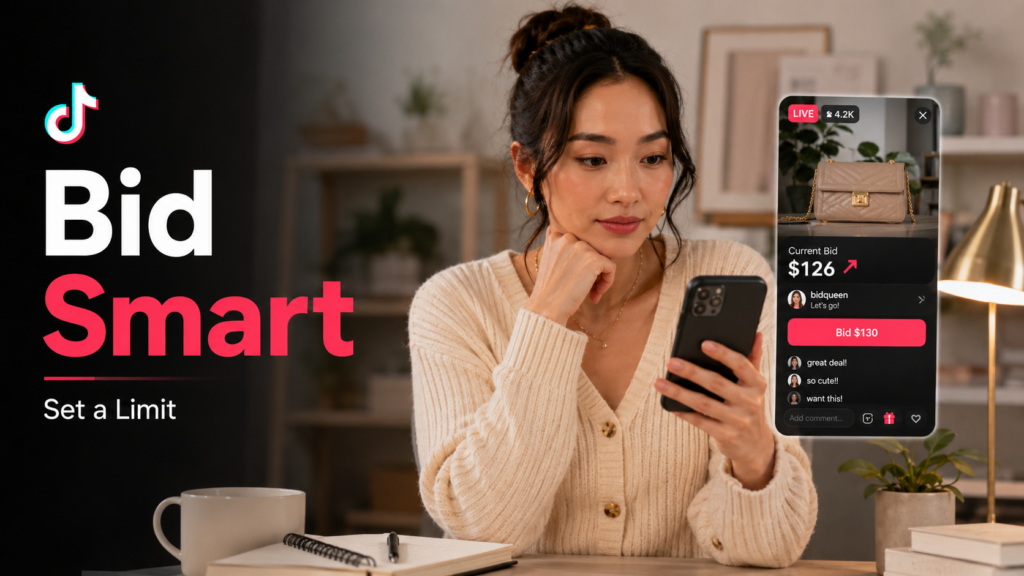
The practical countermeasure is simple: decide your maximum bid before the auction starts and do not revise it upward because the countdown is making your heart race.
For sellers: Speed creates errors. Products misrepresented in a live auction, whether intentionally or through careless description, create fulfilment problems that damage both your seller rating and your audience’s trust.
The lack of a cancellation window makes this worse, not better, because disappointed buyers have less recourse and more reason to be vocal about it publicly.
For both parties, the fulfilment and payment infrastructure for live auctions remains relatively unfamiliar to many TikTok users. Buyers should verify the seller’s credibility before bidding, check ratings, review history, and review past live stream performance.
Sellers should ensure their inventory, shipping timelines, and return policies are explicitly clear before a single bid is placed.
For the platform: The audit trail for live auction claims is thin. A seller can assert almost anything about a product’s condition, authenticity, or provenance during a live stream, and real-time verification is effectively impossible.
This is a structural vulnerability that TikTok will need to address more robustly as auction volume grows.
The strong advice here is straightforward: never buy because a live stream is exciting. Buy because the product is right at the price you decided before the emotion kicked in. And if you’re selling, build your reputation before you build your volume.
Compliance and Platform Rules:
This section is particularly important for anyone building a creator business, and it often gets overlooked in the rush to test new features.

TikTok has very specific rules about what constitutes an acceptable auction experience on the platform, and they exist for good reason. Informal auction-like formats, comment-based bidding, creator-run raffles, lucky draws and unofficial competition structures are not the same as Countdown Bidding and are not governed by the same protections.
If you are running anything that looks like an auction outside of TikTok’s official tools, you are operating in grey space that could result in account penalties, content removal, or loss of TikTok Shop eligibility.
The rules that matter most:
- Use TikTok’s official Countdown Bidding tools where eligible. Do not freelance your own auction mechanics.
- Auction terms cannot be modified once the auction starts. Set them correctly from the beginning.
- All auction items remain subject to standard fulfilment obligations and category refund policies.
- Products must comply with TikTok Shop’s standard product and category rules. The auction format does not create exceptions.
- Sellers are obligated to fulfil orders once an auction ends, and a winning bid is placed. This is not optional.
- For Surprise Sets and mystery formats, the minimum prize value must be disclosed to buyers.
The broader principle here is that compliance is a competitive advantage in early-stage platform features.
The sellers who build clean reputations during the formative period of Countdown Bidding will be positioned to scale when the feature matures, and TikTok begins promoting its top auction sellers the way it promotes top shop affiliates today.
What Sellers and Brands Need to Get Right
For brands and larger sellers, live auctions require a different operational posture than standard e-commerce, and many underestimate the gap.
A live auction is not a product listing. It is a performance. The host matters enormously. A charismatic, knowledgeable, trustworthy host who can describe products compellingly, manage the chat, build suspense, and react authentically to bidding outcomes is worth far more than the auction format itself.
Brands that try to run auctions with bored or underprepared hosts will not only fail but also create content they don’t want anyone to see.
Inventory control is the second critical variable. The appeal of an auction format depends on genuine scarcity.

If your “limited” auction item is actually available on your website in unlimited quantities, the format feels manipulative. Buyers are not naive, and the TikTok community is particularly attuned to authenticity.
Fulfilment readiness matters more in auctions than in standard listings because the timeline expectations are set live.
If a host says “ships in two days” during a live stream, that becomes a contractual commitment in the viewer’s mind. Brands need to ensure their logistics can support the commitments their hosts make in the heat of a live auction.
Finally, trust-building takes time. The brands winning on Whatnot today did not build their audiences in a single auction. They showed up consistently, delivered on their promises, and earned repeat buyers. The same principle applies to TikTok. Auction Day is a feature. Community is the asset.
How to Test TikTok Auctions Without Losing Money
For creators at the beginning of this journey, a staged approach reduces both financial and reputational risk.
Start as a viewer. Spend 2 to 3 weeks watching various live auction streams before you sell or bid strategically. Note what sells, what doesn’t, what prices products achieve, and which hosts create the most engaged rooms.
Make your first purchase intentionally. Find a product that genuinely interests you, in a category you understand, from a seller with a solid track record. Win an auction at a price you decided on beforehand. Document the bidding experience, the win, the delivery and the product itself.
Create content from that experience. An honest, detailed unboxing and review of an item you won at a live auction is highly watchable content. It’s informative, has a narrative structure and authenticates your perspective as someone who actually uses the platform, not just promotes it.
Start selling with temporary listings of low-value products. A temporary listing means no permanent inventory record and low moderation time. Use it to test which products generate competitive bidding and which ones land with a thud.
Scale deliberately. Once you have data on what sells, at what prices, and in which formats, you have the foundation for a repeatable live auction strategy. At that point, scaling is a function of consistency and operational quality, not luck.

The Bigger Prediction:
Zoom out for a moment from the specific mechanics of Countdown Bidding and consider the direction of travel.
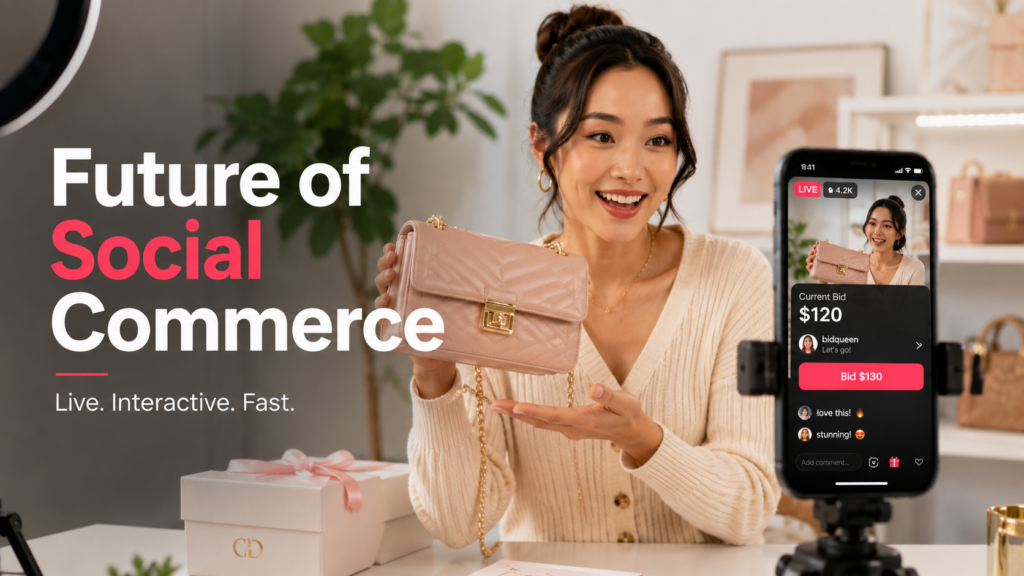
Social commerce in the United States is projected to reach $109.4 billion in 2026. TikTok Shop alone is forecast to generate $23.4 billion in sales, a 48% year-over-year increase that would put it ahead of Target, Costco, and Best Buy in U.S. e-commerce. Globally, TikTok Shop’s GMV is projected to hit $112 billion in 2026, up from roughly $64 billion in 2025. These are not rounding errors. These are structural shifts in where commerce happens.
Live shopping, as a subset of that, is accelerating. TikTok LIVE generated 8 billion watch hours in Q1 2025 alone. More than 28% of internet users watch live streams every week.
The research consistently shows that live shopping delivers outcomes traditional performance advertising struggles to match: it holds attention long enough for intent to form, provides social proof at scale, and collapses the distance between discovery and purchase.
Within live shopping, the auction format represents a specific and powerful subset: high-engagement, high-urgency, community-driven commerce that rewards sellers with charisma and authenticity. It is not the right format for every seller or every product. But for the right combination of person, product, and platform, it is one of the most powerful commerce formats available.
The creators who are learning Countdown Bidding now are studying what works, building their formats, making their early mistakes cheaply, and documenting the experience as content accumulates an advantage that will matter more as the feature scales and competition increases.
TikTok live auctions will not replace affiliate content, product reviews, or short-form shopping videos. What they offer is an additional lane: one that is more interactive, more urgent, and more entertaining than most of what came before.
The creators who learn to drive in that lane early may well be the ones writing the playbook everyone else follows later.
Final Takeaway
The shift happening in social commerce right now is not primarily about features. It’s about a fundamental change in the relationship between attention, entertainment, and commerce.
Platforms are no longer serving ads alongside content. They are making commerce feel like content, and consumers, particularly younger ones, are responding.
TikTok’s Countdown Bidding is a concrete expression of that shift. It takes the format of the live auction, with deep psychological roots in competitive instinct, social proof, and scarcity, and places it inside the most powerful discovery engine in social media history.
For creators, the opportunity is real. But it rewards the same qualities that have always separated good creators from great ones: genuine knowledge of what you’re selling, authenticity with your audience, consistency over time, and the willingness to learn in public before you perform in public.
The features change. Those qualities don’t. Start there.