Brands are exhausted by shallow influencer outreach and default “sample requests” – they’re seeking proven partners, not product collectors.
Creators who pitch concrete performance stats and approach collaborations as joint ventures stand out – especially in the current Amazon landscape.
Get noticed by communicating, showing your results, and using insight-driven tools and strategies to match your content to real brand needs.
For a long time, the Amazon influencer ecosystem operated on a simple, almost invisible loop.
Creators would publish content. Performance data would validate what worked. Brands would double down on the creators driving results.
Nothing about that loop felt complicated. It didn’t need to be explained because it worked quietly in the background.
A creator could post a video, see how it performed, understand what resonated, and approach a brand with something concrete. A brand could review that same performance and decide, with a reasonable level of confidence, whether this creator was worth investing in again.
With recent Amazon influencer reporting changes particularly the reduced visibility into conversions, sales, and order-level performance from the creator side that alignment has weakened.
According to Logie’s coverage of the March reporting reset, creators lost access to key metrics they relied on to understand performance and demonstrate ROI to brands.
And when clarity begins to fade, the effects are not immediate; they cascade.
Creators still post.
Brands still send products.
But the confidence that used to connect those actions is no longer automatic.
To understand what’s happening now, you have to look at what reporting was actually doing beneath the surface.
Reporting Was the Bridge Between Creativity and Commercial Decisions
Most creators experienced reporting as feedback.
Brands experienced it as evidence.
That distinction explains why its absence is being felt differently on both sides.
Amazon’s own guidance on creator-led commerce still emphasizes measurable outcomes clicks, conversions, and customer relationships built through content.
And in practice, Amazon’s Creator Connections reporting has historically allowed brands to track:
This is what allowed a piece of content to move from:
“this performed well”
to:
“this generated measurable business impact”
That translation is what made collaboration efficient.
Without it, both sides are left interpreting results from different angles and often arriving at different conclusions.
What Happens When That Shared Visibility Disappears
When reporting weakens, it changes behavior. Not dramatically at first but enough to alter how decisions are made.
Creator positioning begins to weaken
A creator who previously could say:
“This product converted at 12% with my audience”
Now often says:
“My audience really likes this category”
Without concrete performance data, even strong creators begin to sound similar to weaker ones.
Brands start filtering more aggressively
Brands are not just looking for content they are looking for outcomes.
And increasingly, they are expected to justify those outcomes internally.
Shopify’s guidance on influencer marketing makes this clear: brands are evaluating campaigns based on revenue, conversions, and cost efficiency, not just reach or engagement.
When reporting becomes less transparent, brands don’t stop investing.
They become more selective.
fewer creators considered
more reliance on known performers
slower decisions on new partnerships
This is often interpreted by creators as rejection. In reality, it is a caution.
The feedback loop that sustains partnerships weakens
Long-term creator-brand relationships depend on iteration.
Sprout Social highlights that effective influencer partnerships rely on:
clear performance tracking
consistent communication
ongoing relationship management
When reporting weakens, that loop becomes harder to maintain.
Instead of:
“this worked, let’s build on it”
You get:
“let’s try this and see”
That subtle shift is what turns partnerships into transactions.
Why Brands Feel Burned Out
From the outside, it looks like brands are overwhelmed by creator outreach.
That’s partially true.
But what they are really overwhelmed by is lack of differentiation.
Without strong performance context, most outreach looks the same:
“I’d love to collaborate”
“Send me a sample”
“I create high-quality content”
Individually, these messages are reasonable.
Collectively, they are indistinguishable.
And when everything looks the same, the easiest decision is to ignore most of it.
This is not a failure of creators alone.
It is a symptom of a system where signals have become harder to see.
“All this information allows you to be able to go to a brand and say, hey… Clients really like my content for this particular category. I had this product, I did a video for it, it got this amount of clicks, it converted this percentage-wise. I would love to do a video for your particular product. It works. Because now you’re starting an actual conversation with the brand, as opposed to just saying to the brand, send me a sample.”Altovise Pelzer
What’s important here is not just the presence of data.
It’s what the data allows the creator to do.
It allows them to:
explain patterns
demonstrate understanding
propose outcomes
Without that layer, the interaction remains shallow.
With it, the interaction becomes strategic.
The Gap Most Creators Don’t See: Data vs Understanding
Many creators are trying to compensate for reduced reporting by sharing whatever numbers they still have.
But numbers alone are not the differentiator.
Understanding is.
A creator who says:
“I got 2,500 clicks”
is sharing information.
A creator who says:
“I got 2,500 clicks because my audience responds to comparison-driven content under 60 seconds, and I’d apply that same structure to your product”
is demonstrating capability.
Brands are not just looking for performance.
They are looking for repeatable performances.
And repeatability comes from understanding not from isolated metrics.
Where Structure Begins to Replace Missing Clarity
As reporting becomes less accessible from the creator side, the creators and brands who continue to see results are the ones who introduce structure back into the process.
This shows up in subtle but important ways:
clearer expectations before collaboration
more intentional communication
defined timelines and deliverables
deliberate follow-up with results and insights
This is where platforms like Logie begin to matter more not because they replace Amazon, but because they reinforce what is missing.
Logie’s approach to creator-brand collaboration focuses on:
organizing interactions
clarifying expectations
enabling better communication of performance
In a system where reporting alone no longer provides full clarity, structure becomes the mechanism that restores it.
What This Means for Brands Evaluating Creators Today
Brands are no longer operating in an environment where performance is immediately obvious.
That means evaluation has to shift.
Instead of asking:
“Does this creator have reach?”
The more relevant questions become:
Can this creator explain their audience?
Can they connect content to buying behavior?
Do they communicate clearly and consistently?
Do they follow through after the content goes live?
The brands that adjust to this shift will identify strong creators earlier.
The ones that don’t will continue to feel like “nothing is working.”
What This Means for Creators Trying to Stand Out
For creators, the implication is direct.
Waiting for better reporting is not a strategy.
Adapting to reduced clarity is.
That means:
documenting performance wherever possible
understanding your category deeply
communicating insights not just outcomes
treating every collaboration as the start of a relationship, not the end
It also means moving away from behaviors that rely on visibility alone:
generic outreach
one-off content
minimal follow-up
Because those behaviors depend on a system that no longer supports them as strongly.
The Shift That’s Actually Happening
This is not just about reporting.
It’s about how the Amazon influencer ecosystem is evolving.
From:
access-based participation
To:
performance-based differentiation
That shift does not remove opportunity.
It redistributes it.
Toward creators who can:
create clarity
communicate effectively
reduce uncertainty for brands
And toward brands that can recognize those signals early.
Facebook just rolled out deep Amazon Influencer integration, now enabling shoppable Reels and posts with direct affiliate links – if you hit the 5,000-follower threshold.
Early access is spotty, but real creators are sharing first impressions, best practices, and the small print on using business pages vs. personal profiles.
This is a big move for diversifying sales channels, but there are several pitfalls – tech bugs, follower gates, and confusion about where (and how) banners actually work.
For years, Facebook has sat in a strange position within the creator ecosystem.
Content performed there. Communities existed there. But when it came to driving actual purchases, most creators looked elsewhere.
Meta’s 2026 rollout of Amazon affiliate integration introduces something fundamentally different: the ability to embed shoppable products directly into Facebook content.
This shifts Facebook from being a passive distribution layer into an active transaction channel, where the gap between seeing a product and buying it is significantly reduced.
What the Meta × Amazon Integration Does
The feature allows creators to:
Link their Amazon Influencer account to Facebook
Tag products directly in Reels and posts
Display a clickable shopping banner within the content
Send users directly to Amazon with affiliate attribution
Instead of sending users through multiple steps, the journey becomes:
Content → Tap → Amazon → Purchase
This is a significant improvement over traditional affiliate workflows, which rely on:
link-in-bio
comment links
external landing pages
Each of those steps introduces friction, and friction reduces conversion.
Meta’s approach removes those barriers by embedding the purchase path directly into the content experience.
For a foundational playbook on how to maximize Amazon earnings, revisit How to Make Money as an Amazon Influencer. This integration now brings many of those tactics to Facebook’s billion-plus audience.
Eligibility, Setup, and Current Limitations
The feature is not universally available yet.
To access it, creators typically need:
A Facebook business page or professional profile
An active Amazon Influencer account
Approximately 5,000 followers (based on early rollout conditions)
Setup is handled through:
Meta Business Suite → Monetization → Affiliate Partnerships
Once connected, product tagging becomes available within eligible content formats.
Current Limitations to Be Aware Of
The rollout is still evolving, and several constraints exist:
Feature access is inconsistent across regions and accounts
Shopping banners may not appear on desktop
Some users report delayed activation even when eligible
The feature is currently limited to Reels and posts, not Groups or all surfaces
These limitations mean that early results can vary significantly between creators.
Why This IS Important
Social commerce has always been a game of reducing steps.
Every additional action required from a viewer, clicking a link, opening a new page, searching for a product, creates a drop-off point.
Meta’s integration directly addresses this:
“The easier it is for someone to go from ‘that looks useful’ to ‘I bought it,’ the better the odds of conversion.”
By embedding the shopping interaction into content itself, Meta is not just adding convenience; it is capturing intent at the moment it appears.
Logie’s Creator community, never shy about testing new tools, has already begun sharing on-the-ground impressions. As host, Ileane Smith explained in a recent community call:
“CONNECT YOUR AMAZON INFLUENCER AND FACEBOOK ACCOUNTS. WOW! ISN’T THAT COOL? BECAUSE, as I SAID, I KNOW A LOT OF YOU GUYS USE FACEBOOK… ENHANCE YOUR FACEBOOK REELS AND PHOTOS WITH A TAPPABLE SHOPPING BANNER.”
What does this change for the Creator Strategy?
The introduction of in-content shopping does not automatically increase revenue. What it does is change where performance is determined.
Previously, conversion depended heavily on:
external navigation
link placement
user patience
Now, performance depends more on:
content clarity
product relevance
audience intent
This shifts responsibility back to the creator.
What Content Works Best in This Model
Not all content benefits equally from embedded commerce.
The formats most likely to perform share three characteristics:
1. Clarity
The viewer immediately understands:
What the product is
What problem does it solve
2. Intent Alignment
The content targets viewers who are already:
considering a purchase
comparing options
solving a specific problem
3. Immediacy
The value is communicated early, not delayed.
High-Performing Content Formats
Product demonstrations
Before-and-after transformations
Comparisons (“this vs that”)
Short, structured recommendations
Problem-solution hooks
These formats naturally support the next step: clicking to buy.
The Role of Scripting in Shoppable Content
One common misconception is that adding a clickable product removes the need for persuasion.
It does not.
If users do not notice or understand the product, they will not engage with it.
Creators should:
clearly mention the product
explain its value in context
guide the viewer toward action
This becomes even more important because:
banners may be subtle
Visibility varies across devices
What About Earnings and ROI?
At this stage, there is limited public benchmark data on conversion rates for Facebook-Amazon integration specifically.
However, one thing is clear:
The advantage of this feature is not higher commission rates.
It is better conversion conditions.
Fewer steps
Stronger intent capture
Cleaner attribution
This creates the potential for improved performance but does not guarantee it.
Where Facebook Fits in a Modern Commerce Stack
This integration does not replace other platforms. It complements them.
A more accurate model looks like this:
YouTube → builds intent and trust
Facebook → reduces friction and captures action
Amazon → completes the transaction
This multi-platform approach is increasingly necessary because:
No single platform is stable enough to rely on alone
Audiences behave differently across environments
Who Benefits Most From This Feature
The creators most likely to benefit are those whose content naturally supports product consideration.
This includes:
home and lifestyle creators
beauty and wellness creators
tech and accessories reviewers
parenting and practical content creators
It also applies strongly to:
review-based content
curated recommendations
“best of” or comparison formats
These content types align closely with purchase-ready audiences.
Who Should Be Cautious
This feature is not a shortcut to monetization.
Creators should avoid over-relying on it if:
They are below the eligibility threshold
Their content is not product-focused
They have not yet built audience trust
Direct shopping tools amplify:
strong positioning
clear recommendations
They do not compensate for weak audience relationships.
Key Pitfalls to Watch
As with any early-stage feature, there are risks:
Access and Rollout Issues
Not all creators have access yet, even if they meet requirements.
Visibility Challenges
Shopping elements may not be prominent enough to drive passive clicks.
Overuse
Tagging too many products can reduce trust and content quality.
Platform Volatility
Meta has changed commerce features before and may continue to iterate rapidly.
What Creators Should Do Now
A measured approach is the most effective.
Test Early
Early adoption creates a learning advantage.
Focus on Intent-Driven Content
Not all content should be shoppable; only content that supports buying behavior.
Integrate, Don’t Isolate
Use Facebook as part of a broader system, not a standalone strategy.
Track Practical Metrics
Focus on:
clicks
product interest
conversion patterns
Rather than vanity metrics like views alone.
Embedded Commerce Is the Direction
Meta’s integration with Amazon is part of a larger trend.
Across platforms, we are seeing:
product tagging
in-content shopping
Reduced friction between discovery and purchase
This is not temporary.
It represents a shift toward embedded commerce, where:
Content and transactions happen in the same environment
creators operate across the full funnel
platforms compete on conversion, not just attention
Conclusion
Meta × Amazon integration marks a meaningful evolution in how creators monetize content.
It does not eliminate the need for strategy.
It does not guarantee higher earnings.
But it does introduce a more efficient path between:
attention
intent
and action
For creators who understand how to align content with that path, the opportunity is clear:
Less friction. Better attribution. Stronger conversion potential.
And in an ecosystem where stability is increasingly rare, that alone makes this channel worth serious attention.
Products that flop in the U.S. can find new life – and real sales – on international Amazon marketplaces like Canada, UK, France, and Australia.
International uploading is easier than you think: English content works; track sales with smart tools, and use virtual assistants for scale.
Now is the moment: With U.S. saturation and tighter Amazon data, global storefronts are not just a growth hack – they’re a creator necessity.
For years, Amazon creators approached international storefronts as a secondary play, something to explore only after maximizing performance in the U.S.
That approach worked when visibility was easier to achieve and competition was manageable. Today, that environment has shifted significantly.
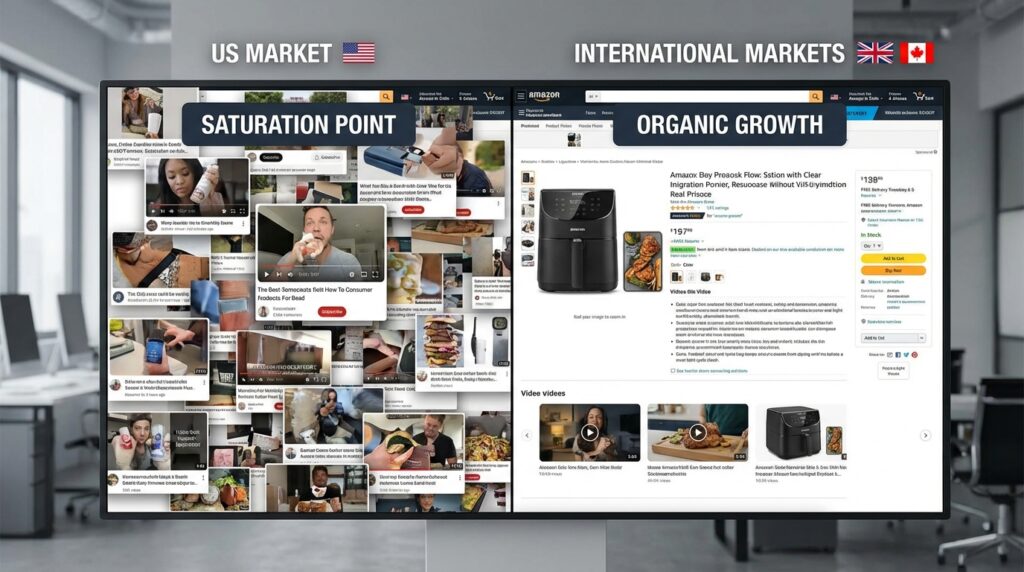
The U.S. marketplace is saturated with creator content, product pages are crowded with videos, and consistent visibility has become harder to maintain even for experienced creators.
At the same time, Amazon has continued to expand its global infrastructure, supporting storefronts, affiliate programs, and cross-border monetization tools across multiple regions.
The Influencer Program operates in markets like the U.S., UK, and Canada, while the broader Associates Program spans over 17 marketplaces.
In practical terms, creators are no longer just competing within one marketplace; they are distributing content across multiple demand pools. Those who continue to focus only on the U.S. are increasingly exposed to a single, highly competitive environment.
When U.S. Content Fails but Wins Abroad
One of the most compelling signals driving international expansion is the consistent observation that content which underperforms in the U.S. can generate steady sales in other regions.
As Altovise Pelzer noted, I have a product, I have one product in particular that I have content for in the US, and it sells nothing on my US storefront. It has consistently sold on my UK storefront, and it has started to sell on my Canada storefront.
A product may fail in the U.S. because it is competing against dozens of similar videos, because it missed a key seasonal window, or because the algorithm prioritized other creators.
However, those same constraints are not uniformly present in international markets. In regions like the UK or Canada, there are often fewer creator videos per product page, meaning less competition for placement.
Additionally, regional demand varies; products tied to climate, lifestyle, or local trends may perform differently depending on the market.
What appears to be a “failed” asset in one region can simply be an under-distributed asset, and international storefronts provide a mechanism to correct that imbalance.
Why International Markets Behave Differently
A critical misconception is treating Amazon as a single, uniform marketplace. In reality, each regional Amazon site operates within its own ecosystem of supply, demand, and competition.
Consumer preferences differ, product availability varies, and even seasonal trends shift depending on geography.
For example, demand for certain home products may peak at different times in the UK compared to the U.S., while pricing and brand availability can also influence purchasing decisions.
Data from platforms like Similarweb consistently shows that Amazon’s regional domains, such as Amazon UK and Amazon Canada, dominate their respective e-commerce markets.
This reinforces the idea that these are not secondary or marginal marketplaces; they are fully developed ecosystems with strong buyer intent.
Performance is not solely determined by content quality, but also by the context in which that content is placed.
A less saturated environment with strong demand can outperform a highly competitive one, even with identical content.
Choosing the Right Markets
Expanding internationally is not simply about uploading content everywhere; it requires prioritization.
The most effective strategy is to begin with markets that minimize friction while maximizing learning.
The UK and Canada are typically the best starting points because they combine strong purchasing power with minimal barriers to entry.
English-language content works immediately, and consumer behavior closely mirrors that of the U.S., allowing creators to test performance without introducing additional complexity. Australia often follows as a second phase, offering lower competition and steady conversion potential, even if overall volume is smaller.
European markets such as France and Germany introduce additional considerations, particularly language and cultural nuance.
While English content can still generate initial traction, long-term performance often improves with localization.
The key is sequencing: start with markets that allow rapid testing, validate what works, and then expand into regions that require more effort but offer higher upside.
This approach prevents creators from turning international expansion into an operational burden rather than a growth strategy.
What Products Work Internationally
Not all products perform equally across markets, and understanding what translates well is essential.
Products that succeed internationally tend to share three characteristics:
solve a clear problem,
can be demonstrated visually, and
not heavily dependent on cultural context.
This is why categories like home organization, kitchen tools, beauty devices, and office accessories often perform consistently across regions.
If a product category is universal, this matching process is more effective, increasing the likelihood of conversion.
Tools like Geniuslink highlight the importance of routing users to the correct regional storefront, emphasizing that demand is often present globally, even if access is fragmented.
An important nuance here is that creators should not limit themselves to their top-performing U.S. content.
In many cases, the strongest international performers are videos that had solid fundamentals but were overshadowed by competition in the U.S.
These assets are already created, which makes international expansion a highly efficient way to extract additional value from existing work.
Does Amazon Give You a “Fresh Start” Internationally?
Amazon does not explicitly state that international uploads receive preferential treatment. However, the structural differences between marketplaces often create an effect that feels similar to a reset.
In less saturated environments, there are fewer competing videos, which increases the likelihood of placement on product pages. The algorithm has fewer signals to evaluate, and as a result, content may surface more easily.
This perceived “fresh start” is a byproduct of lower competition and different content density. It means that international success is not guaranteed, but it is often more achievable because the barriers to visibility are lower.
In practical terms, this creates an opportunity to gain traction more quickly, particularly for content that struggled to stand out in the U.S.
When does translation matter?
One of the biggest misconceptions about international expansion is the belief that content must be fully localized before it can be effective.
In reality, English content performs well in markets like the UK, Canada, and Australia, and can even generate meaningful engagement in parts of Europe during the testing phase.
Translation becomes relevant once performance is validated. At that point, localized subtitles, titles, or voiceovers can improve conversion rates by making content more accessible to non-English-speaking audiences.
However, introducing translation too early adds complexity without guaranteeing results. The more effective approach is to treat localization as an optimization step rather than a prerequisite.
This allows creators to focus on speed and iteration in the early stages, and refinement once there is clear evidence of demand.
Tracking Performance in a Less Transparent Environment
Performance tracking has become more nuanced as Amazon’s reporting evolves. While the platform still provides earnings reports, consolidated views, and cross-market tracking, many creators have observed that granular product-level insights are less accessible than before.
Creators are noting the need to interpret broader performance trends rather than relying on precise attribution.
This does not mean data is unavailable; it means that creators need to adopt a more layered approach to measurement.
A practical tracking setup includes Amazon’s native reporting as a baseline, and external platforms such as Geniuslink for click-level insights.
The goal is not perfect visibility, but actionable understanding, identifying which markets are generating traction and which products are worth scaling further.
Common Mistakes That Limit International Growth
Several patterns consistently limit success in international expansion. One of the most common is expanding too quickly, which dilutes focus and makes it difficult to identify what is working.
Another is over-optimizing too early, particularly through translation or localization before demand has been validated.
Creators also frequently overlook product availability, assuming that an item listed in the U.S. will have a direct equivalent in other markets.
When this is not the case, conversion rates can drop significantly. Finally, relying solely on Amazon’s internal reporting can lead to incomplete insights, especially in a less transparent data environment.
Is This Strategy Only for Large Creators?
International expansion is often perceived as a strategy for large creators with extensive resources, but this is not necessarily the case.
In fact, smaller creators may benefit disproportionately because they can extract more value from a limited content library.
By distributing existing assets across multiple markets, they can generate additional revenue without increasing production.
Larger creators have an advantage in terms of scale, particularly through the use of virtual assistants and structured workflows.
However, the core principle of leveraging content across markets is accessible to creators at any level. The key differentiator is not size, but consistency and the ability to test and adapt quickly.
Revenue Expectations
International expansion should not be viewed as an immediate multiplier of income. In most cases, it begins with incremental gains and additional sales that gradually accumulate across markets.
Over time, as more content is uploaded and optimized, these gains can evolve into meaningful diversification.
For some creators, international revenue may eventually match or even exceed U.S. earnings. However, this typically requires sustained effort, consistent uploads, and strategic scaling.
The most important factor is not a single successful product, but the accumulation of multiple assets performing across different regions.
From Local Optimization to Global Distribution
Amazon is increasingly designed to support content that can move across markets, rather than being confined to a single region.
At the same time, the challenges within the U.S. marketplace competition, saturation, and evolving data visibility make reliance on a single market less sustainable.
Creators who adapt to this shift are building a more resilient business model. They treat their content as a scalable asset, capable of generating value across multiple environments.
Final Take
International storefronts are no longer an experimental strategy; they are a practical response to how Amazon operates in 2026. The opportunity lies in leveraging existing content, testing new markets, and scaling what works.
A simple starting point is often enough:
Take a small set of videos, upload them to the UK and Canada, and monitor performance. The results will quickly indicate whether international expansion is worth pursuing further.
Longer videos (2–5 minutes) correlate directly with more earnings for Amazon Influencers – data proves it.
Short “snackable” videos might work on other platforms, but Amazon’s algorithm and shoppers reward in-depth, authentic content.
Efficient batching, high-value storytelling, and AI-driven thumbnail design further amplify success.
For years, Amazon Influencers were encouraged to keep product videos short, often between 10 and 30 seconds. That guidance shaped how creators approached content: quick demonstrations, minimal explanation, and rapid production cycles.
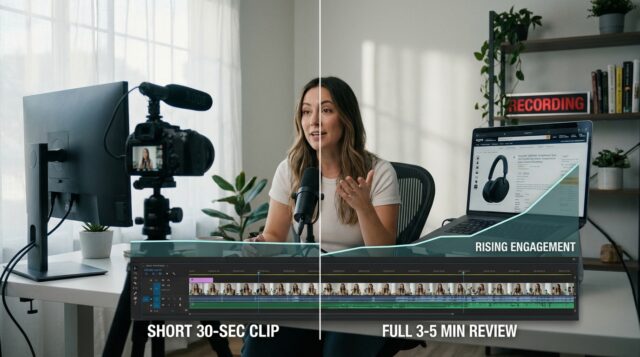
However, emerging data and creator experiences now point in a different direction. The current landscape suggests that longer, more detailed product videos, typically between 2 and 5 minutes, are outperforming shorter clips in both visibility and earnings.
This shows how Amazon is surfacing content and how shoppers make decisions. As competition increases and buyer expectations grow, depth, clarity, and trust-building are becoming more valuable than brevity alone.
The Shift from Conversion to Watch Time
One of the most significant changes in Amazon’s content ecosystem is the growing importance of watch time as a ranking signal.
“The best predictor of carousel placement is actually watch time… it was a 6 times better predictor of carousel placement than conversion rate.”
This insight challenges a long-standing assumption that conversion rate is the primary driver of visibility. Instead, it suggests a sequential dynamic:
Watch time drives placement
Placement drives visibility
Visibility enables conversions
Short videos, even when fully watched, inherently limit total watch time. In contrast, longer videos create more opportunities for sustained engagement, signaling value to Amazon’s algorithm and increasing the likelihood of higher placement in product carousels.
Why Longer Videos Are Correlating with Higher Earnings
The relationship between video length and earnings is supported by direct creator data.
Claire’s analysis revealed a clear performance gap:
“The data shows that the Amazon Influencers making 3, 4, 5-minute videos are making significantly more than those in this 0 to 2-minute range.”
This trend reflects two reinforcing mechanisms:
1. Increased Watch Time and Algorithmic Favorability
Longer videos accumulate more total viewing time, improving their chances of being surfaced in high-traffic placements.
2. Stronger Buyer Confidence
More detailed content allows creators to:
Address common questions
Demonstrate real-world use
Highlight pros and limitations
Compare alternatives
These factors contribute to higher trust, which ultimately supports conversion, even if conversion is not the primary ranking signal.
The 30-Second Rule Is Becoming Obsolete
While onboarding guidance has historically emphasized brevity, creator experiences suggest that this advice may no longer reflect optimal performance strategies.
As noted during one of our previous Logie sessions, onboarding recommendations often still suggest keeping videos between 10 and 30 seconds. However, this appears to be more aligned with reducing friction for new creators rather than maximizing long-term performance.
Longer videos, when executed effectively, align better with current algorithmic preferences and shopper expectations.
What Makes Longer Videos Effective
Length alone does not guarantee performance. The effectiveness of longer videos depends on how well they maintain attention and deliver value.
A successful long-form Amazon product video typically follows a clear structure:
1. Immediate Hook
Capture attention within the first few seconds by addressing a specific problem, question, or use case.
2. Core Overview
Provide a concise explanation of the product and its primary function.
3. Detailed Demonstration
Show real usage scenarios, including:
Setup
Practical application
Variations in use
4. Addressing Buyer Questions
Incorporate insights from:
Product reviews
Frequently asked questions
AI-generated summaries
5. Honest Evaluation
Include balanced perspectives, such as limitations or ideal use cases, to reinforce credibility.
As highlighted in the discussion:
“Start fast and end slow.”
This approach ensures strong initial engagement while allowing sufficient depth to build trust.
Authenticity Outperforms Overproduction
Another key insight from the data is that production quality alone does not determine success.
Claire observed:
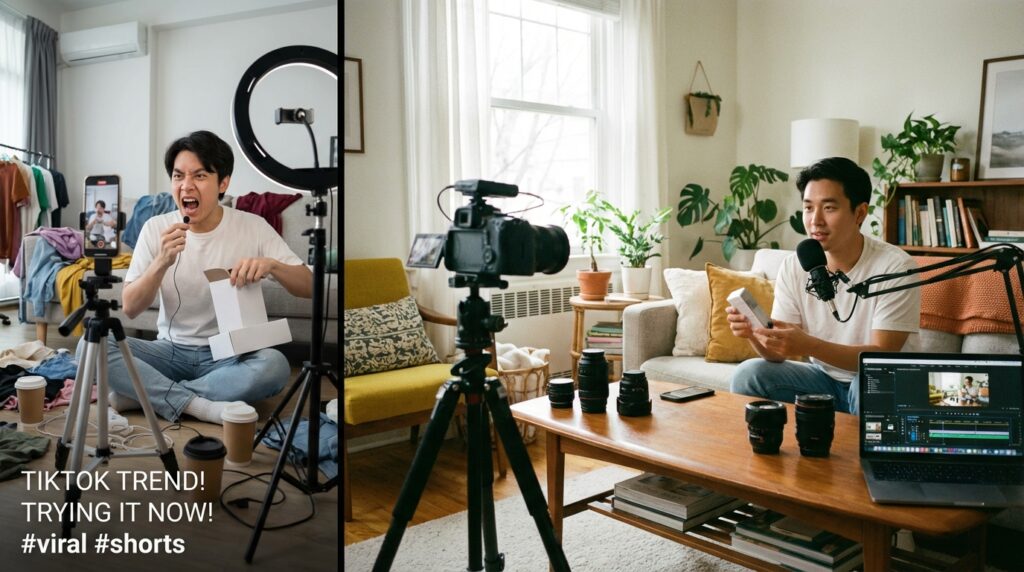
“Slightly messy, personal, authentic videos do well on Amazon.”
This suggests that shoppers respond more strongly to:
Genuine experiences
Conversational delivery
Real-world demonstrations
Over-editing can sometimes reduce authenticity, making content feel less trustworthy. The most effective videos strike a balance between clarity and relatability.
Content Efficiency Still Matters
Despite the shift toward longer videos, efficiency remains a critical factor in scaling.
Claire noted that the median time spent per video was approximately 14 minutes, and that:
“Time spent per video was not a strong predictor of earnings.”
This highlights an important distinction:
Value creation drives results
Not simply a time investment
Effective creators focus on:
Batching content production
Reusing setups across multiple products
Creating multiple videos per product
Delegating editing or operational tasks
The Role of Repurposing and Multi-Platform Strategy
Top-performing creators are increasingly extending their content beyond Amazon.
Claire shared that high earners often derive only a portion of their income from on-platform commissions:
“Top earners are only getting about 30–35% of their income from on-site commission.”
The remaining revenue comes from:
Off-site traffic
Brand collaborations
Creator tools and partnerships
Repurposing Amazon videos to platforms such as YouTube, TikTok, and Pinterest allows creators to:
Increase content lifespan
Reach broader audiences
Generate additional income streams
YouTube as a Strategic Extension
YouTube, in particular, is becoming a valuable complement to Amazon’s content strategies.
Recent updates to YouTube’s monetization structure have made it easier for creators to access affiliate and commerce features earlier in their growth journey.
Creators can now apply for the YouTube Partner Program with as few as 500 subscribers, with additional watch time requirements, unlocking access to features like shopping and monetization tools sooner than before.
Once part of the program, eligible creators can participate in the YouTube Shopping affiliate program, which allows them to tag products directly in content and earn commissions from purchases.
Additionally, YouTube functions as a search engine, where longer product reviews can capture ongoing demand from users actively researching purchases.
Adapting Strategy
The evolving landscape suggests a broader strategic shift:
From short, high-volume content
To longer, high-value content with strong retention
This does not mean abandoning efficiency. Instead, it means aligning efficiency with impact, producing content that maximizes both watch time and usefulness.
The New Standard for Amazon Influencer Content
The data and creator insights point to a clear conclusion:
Short-form content is no longer sufficient as a primary strategy on Amazon.
Longer videos, when structured effectively and focused on delivering real value, offer a stronger path to:
Increased visibility
Higher trust
Greater earnings potential
As the platform continues to evolve, creators who adapt to this model, prioritizing watch time, authenticity, and strategic workflows, are likely to see the greatest long-term success.
The opportunity is no longer in producing more content, but in producing content that holds attention, builds confidence, and scales across platforms.
Influencer marketing is no longer a brand-awareness experiment; it has become a measurable, revenue-generating channel for e-commerce brands. In 2025, global influencer marketing spend is projected to surpass $32.5 billion, with brands earning an average of $5–$6 for every $1 invested.
Despite this growth, many brands still struggle to turn influencer campaigns into consistent profit. Manual creator discovery, spreadsheet-based tracking, delayed reporting, and weak attribution models waste budget and slow performance. As campaigns scale, these inefficiencies compound, making ROI harder to achieve and even harder to prove.
This is why automation has emerged as the critical advantage. Automation has become the defining factor separating profitable influencer programs from expensive experiments.
AI-powered platforms like Logie.ai automate creator matching, campaign execution, and real-time sales attribution, enabling ecommerce brands to launch faster, optimize continuously, and turn influencer marketing into a predictable revenue engine rather than a guessing game.
One of the biggest ROI killers in influencer marketing is poor creator selection. Traditional discovery relies heavily on surface-level metrics like follower count, likes, and aesthetic fit, signals that rarely correlate with actual sales performance.
Automation changes this entirely. AI-powered platforms analyze creator and product relevance at scale, ensuring brands partner with influencers most likely to convert, not just those who look good on paper.
How Automation Improves Conversion Rates
Automated creator discovery evaluates performance signals that manual processes simply can’t process efficiently:
Audience-product fit scoring – measures how closely an influencer’s audience aligns with a product’s buyer profile.
Category and past-performance signals – identify creators who have historically driven results in similar niches.
Purchase-intent analysis – detects audiences more likely to take action, not just engage.
Platforms like Logie.ai replace guesswork with intelligence. By automating creator discovery using proven performance data, ecommerce brands reduce wasted spend, improve conversion rates, and build influencer programs designed for revenue from day one.
2. Faster Campaign Launches Mean Faster Revenue
In e-commerce, speed is not a luxury; it’s a revenue driver. Yet traditional influencer agencies often take weeks to launch campaigns, slowed down by manual creator outreach, approvals, negotiations, and back-and-forth coordination. By the time campaigns go live, momentum and opportunity are already lost.
Automation removes these bottlenecks. AI-powered platforms dramatically compress launch timelines, allowing brands to move from strategy to live campaigns in days or even hours, not weeks.
How Automation Accelerates Campaign Launches
Instant creator matching – AI identifies relevant, high-performing creators immediately.
Automated outreach and approvals – no manual emails, spreadsheets, or follow-ups.
Faster time-to-market – campaigns go live while demand, trends, and product interest are still high.
This speed advantage is not theoretical. High-performing marketing teams are 2× more likely to use automation than their lower-performing peers. Platforms like Logie.ai enable e-commerce brands to launch revenue-generating influencer campaigns without delays. Faster execution means faster data, faster optimization, and faster revenue, turning influencer marketing into a responsive, performance-driven growth channel rather than a slow-moving brand play.
You can’t optimize what you can’t measure, and this is where traditional influencer agencies consistently fall short.
For years, influencer performance has been evaluated using vanity metrics like likes, impressions, reach, and comments. While these numbers may look impressive in reports, they rarely answer the most important question for e-commerce brands: What actually drove revenue? Worse, traditional agencies often deliver results weeks after campaigns end, making it impossible to act on performance while it still matters.
Automation fundamentally changes this dynamic. AI-powered platforms replace delayed, surface-level reporting with real-time, revenue-focused attribution, giving brands immediate visibility into what’s working and what isn’t.
Why Vanity Metrics Fail E-commerce Brands
Likes and impressions don’t correlate reliably with sales.
Automation improves ROI by making performance transparent at every level:
Sales attribution by creator – see exactly which influencer drove each purchase.
Click-to-conversion tracking – follow the customer journey from content to checkout.
Live performance dashboards – monitor revenue, conversions, and ROI as campaigns run.
Instead of guessing which creators “performed well,” brands may see measurable impact in real time and adjust spend accordingly.
Platforms like Logie.ai are built around this revenue-first approach. Its dashboards prioritize sales, conversions, and revenue generated, not engagement alone. This allows ecommerce teams to double down on top-performing creators, pause underperformers early, and scale campaigns with confidence.
When attribution is clear, influencer marketing stops being a risk. It becomes a controllable, optimizable growth channel, one where every dollar spent is tied directly to revenue outcomes.
Reporting alone doesn’t drive ROI. Optimization does. Traditional influencer agencies typically analyze performance after campaigns end. By then, the budget has already been spent, underperforming creators have run their full course, and opportunities to scale top performers are lost. Decisions are reactive, not strategic.
Automation flips this model. AI-powered platforms continuously monitor campaign performance and optimize spending while campaigns are live, ensuring every dollar works harder.
How Automated Optimization Improves ROI
Automation enables brands to make performance-based decisions in real time:
Identify top-performing creators instantly – see which influencers are driving conversions, not just engagement.
Reallocate budget on the fly – shift spend toward creators and content delivering the highest returns.
Pause underperformers early – stop wasting budget on creators that aren’t converting.
This real-time optimization delivers measurable results. Companies using AI-driven optimization report a 20-30% higher marketing ROI than with traditional approaches.
Turning Campaigns Into Profit Engines
Platforms like Logie.ai are built for continuous optimization, not post-campaign analysis. Performance data feeds directly back into the system, allowing campaigns to improve as they run.
Instead of static, one-off influencer campaigns, brands gain a dynamic system that learns, adapts, and scales. High performers are amplified. Low performers are filtered out. The budget is deployed with precision.
The result is not just better reporting, it’s compounding efficiency. Influencer marketing evolves from a fixed cost into a scalable profit engine, driven by automation and refined in real time.
5. Lower Operational Costs Increase Net ROI
In influencer marketing, ROI isn’t only about how much revenue you generate — it’s also about how much it costs to get there. Traditional influencer agencies come with heavy operational overhead that quietly eats into profit margins.
Account managers, manual creator coordination, spreadsheet-based reporting, and long execution cycles all add cost without directly improving performance. As campaigns scale, these inefficiencies multiply, making influencer marketing increasingly expensive to manage.
Automation removes this burden.
AI-powered platforms streamline campaign operations, allowing brands to achieve more with fewer resources and significantly lower overhead.
How Automation Reduces Costs Without Sacrificing Performance
Platforms like Logie.ai allow ecommerce brands to shift budget away from agency overhead and into performance-driving activities, more creators, more testing, and more scalable campaigns.
Instead of paying for manual processes, brands invest in results. Operations become leaner. Margins improve. Influencer marketing transforms from a high-maintenance expense into an efficient, ROI-focused growth channel powered by automation.
6. Predictive Analytics Improve Long-Term ROI
Short-term performance matters, but sustainable ROI comes from making smarter decisions over time. This is where predictive analytics gives automated influencer marketing a decisive edge.
Traditional agencies operate reactively. They analyze results after campaigns end and start the next campaign from scratch. Insights are lost, patterns are missed, and brands repeat the same costly mistakes.
Automation changes this by turning historical performance data into forward-looking intelligence. AI-powered platforms continuously learn from every campaign, creator, and conversion, enabling brands to predict outcomes before budgets are committed.
What Predictive Analytics Enables
Automation helps e-commerce brands anticipate performance with greater confidence:
Which creators are most likely to convert – based on past sales, audience behavior, and category performance.
Which products will perform best with influencers – identifying high-conversion products-creator combinations.
Optimal content formats and timing – understanding which content types, posting windows, and platforms drive revenue.
Platforms like Logie.ai use past performance as fuel for smarter future campaigns. Every creator interaction, conversion, and campaign result feeds back into the system – refining recommendations and improving accuracy over time.
Instead of guessing, brands build momentum. Campaigns launch with higher confidence. Budgets are allocated more intelligently. Results compound.
Predictive analytics transforms influencer marketing from a series of isolated campaigns into a continuously improving growth engine, one that delivers stronger ROI not just today, but quarter after quarter.
Influencer marketing delivers the strongest ROI when it’s not treated as a one-off campaign, but as an always-on revenue channel. Traditional agency models struggle here. They rely on manual coordination, fixed timelines, and limited capacity, making continuous execution expensive and difficult to sustain.
Automation removes these constraints. AI-powered platforms allow ecommerce brands to run influencer programs continuously, without adding operational complexity or headcount.
How Automation Unlocks Scalable Growth
With automation in place, brands may:
Run multiple campaigns simultaneously – launch product drops, seasonal promotions, and evergreen campaigns at the same time.
Manage hundreds of creators effortlessly – AI handles discovery, execution, tracking, and optimization at scale.
Scale without hiring more staff – growth is driven by systems, not headcount.
From Campaigns to a Revenue Engine
Platforms like Logie.ai transform influencer marketing into a continuous, performance-driven sales channel. Campaigns don’t pause between launches. Data flows uninterrupted. Top-performing creators stay active, while new ones are tested and optimized in parallel.
The result is consistency. Predictability. Compounding returns. When influencer marketing is always on, ROI doesn’t spike and disappear, it grows steadily. Automation makes that possible, and Logie.ai is built to lead that shift.
Why Logie.ai Delivers one of the Highest ROI in Automated Influencer Marketing
Not all influencer marketing platforms are created equal. While many tools offer analytics or partial automation, Logie.ai is built from the ground up for ecommerce performance. It’s AI-first, revenue-focused, and designed to maximize ROI at every stage of the influencer marketing lifecycle.
Key Differentiators
Built specifically for e-commerce – unlike generic platforms, Logie.ai is tailored to the unique needs of online retailers and direct-to-consumer brands.
AI-first, not manual-with-tools – every campaign leverages machine intelligence for creator discovery, product matching, and optimization.
Revenue attribution over engagement metrics – sales, conversions, and ROI take priority over likes or impressions.
End-to-end automation – from discovery to campaign execution, optimization, and reporting- processes run seamlessly without manual overhead.
How Logie.ai Maximizes Campaign ROI
Smarter creator matching – AI identifies creators with audiences most likely to convert, reducing wasted spend.
Faster launches – automated workflows compress time-to-market from weeks to days.
Real-time optimization – campaigns adjust dynamically based on live performance, maximizing efficiency.
Lower costs, higher returns – automation reduces operational overhead, allowing the budget to focus on creators and content that drive revenue.
By combining ecommerce-specific intelligence, predictive analytics, and continuous automation, Logie.ai transforms influencer marketing from a costly, experimental channel into a scalable, revenue-generating engine. For brands serious about ROI, it’s not just a tool, it’s the foundation of predictable, high-performing influencer campaigns.
Manual influencer marketing can’t keep up with the speed, scale, or precision required to maximize revenue. Automation is no longer optional, it’s the profit multiplier that turns campaigns into measurable growth engines.
For e-commerce brands serious about ROI, Logie.ai sets the benchmark. From smarter creator matching and faster launches to real-time optimization and revenue-first dashboards, it delivers predictable, scalable results.
For a long time, Pinterest was treated like a side platform. A place for mood boards, recipes, outfit inspiration, and home décor ideas. Useful, maybe, but not central to serious creator growth.
That view no longer holds up. Pinterest is now a visual discovery engine built around search behavior.
Pinterest itself describes the platform as a visual discovery engine, and its business materials repeatedly position it as a place where people actively look for ideas, products, and new brands. In other words, people do not only scroll Pinterest. They search for it, plan on it, and then act on it.
That distinction changes everything.
Because once you stop treating Pinterest like social media and start treating it like search, your strategy shifts. Followers matter less.
Keyword structure matters more. Random posting matters less. Search intent, board architecture, seasonal timing, and pin relevance matter more.
And that is exactly why Pinterest SEO has become such an important growth lever for creators, bloggers, affiliate marketers, and product-led brands.
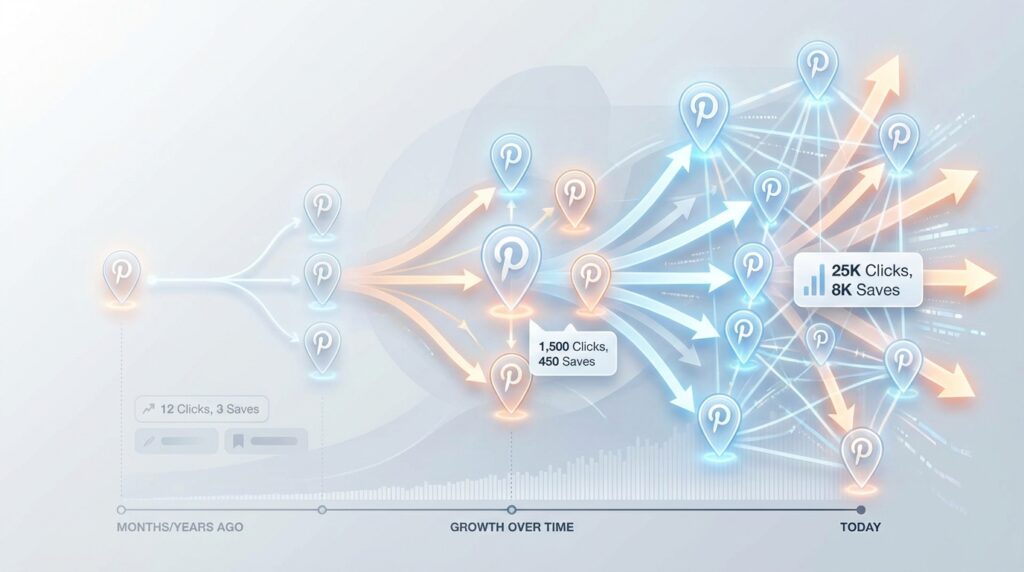
The big opportunity is this: a strong pin can continue surfacing in search, getting saved, and driving clicks long after it is published.
That makes Pinterest one of the few platforms where content can behave less like a post and more like a long-term searchable asset.
Pinterest’s guidance reinforces this search-first logic by advising creators to optimize Pin titles, descriptions, board titles, board descriptions, and URLs with relevant keywords so the platform can better understand and distribute content.
Pinterest is a search-first platform.
Many creators still bring Instagram or TikTok instincts to Pinterest. They think in terms of audience size, aesthetic consistency, and posting cadence alone. But Pinterest works differently.
The platform is built around discovery. Someone arrives with a need, a curiosity, or an intention. They search phrases like “small kitchen organization ideas,” “spring capsule wardrobe,” “birthday table decor,” “healthy high protein lunch,” or “content creation desk setup.” Pinterest then tries to match that user with the most relevant visual results.
As Michelle Johnson shared, “The main thing with Pinterest is that it is SEO heavy. Everything needs to be a circle, and then everything else needs to be a Venn diagram with that… because every little thing you do is telling Pinterest, that’s what this pin means.”
That means every element of your content becomes a signal. Your board title is a signal. Your Pin title is a signal. Your description is a signal. Text on the image can reinforce clarity. Your website URL and destination relevance matter too.
Pinterest’s help documentation explicitly says descriptions help its algorithm determine relevance for delivery, and it recommends entering descriptions to help get Pins in front of the right audience.
The point is not just to “post nice pins.” It is to help Pinterest understand exactly what your content is about so it can place that content in front of people already searching for related ideas.
On Pinterest, clarity beats cleverness surprisingly often. A beautifully designed pin with vague copy may underperform a simpler pin that is unmistakably relevant to a real search query.
What Pinterest SEO actually means
Pinterest SEO is the practice of making your content easier for Pinterest to interpret, categorize, and surface in search and discovery environments.
It is not identical to Google SEO, but the overlap is clear. In both ecosystems, keyword relevance matters.
Topic, Structure, Metadata, and User response matter. The difference is that Pinterest does all of this through a visual interface, where the image, the title, the board context, and topical relevance work together.
A practical way to think about Pinterest SEO is this: Pinterest is trying to answer the question, “What is this pin about, who is it for, and when should it be shown?”
Your job is to make that answer obvious.
Pinterest recommends reviewing previously published Pins and optimizing keywords across Pin titles, descriptions, board titles, board descriptions, and URLs. It also points users toward Pinterest Analytics, individual Pin stats, and Conversion Insights to evaluate what is actually resonating and converting.
So Pinterest SEO is not a narrow keyword trick. It is a full system made up of topic selection, board structure, metadata quality, visual clarity, and performance feedback.
The mindset shift creators need to make
The biggest Pinterest mistake is treating it like a content dump.
A creator makes one board called “My Favorites” or “Products I Love,” uploads a mix of unrelated visuals, writes vague descriptions, posts inconsistently, and hopes for traction. Then, a few weeks later, they conclude Pinterest “doesn’t work.”
But Pinterest usually rewards specificity.
A board called “Products I Love” tells the platform almost nothing. A board called “Small Apartment Kitchen Organization” tells it much more. So does “Minimalist Work Outfits for Women,” “Wedding Guest Dresses for Outdoor Ceremonies,” or “Home Office Desk Setup Ideas.” These are search-aligned topical containers.
Pinterest content needs coherence. Boards, pins, titles, descriptions, and imagery should reinforce one another instead of competing with one another. That thematic consistency helps the platform connect your content to the right search intent.
Think less like a poster and more like an information architect.
Keyword research is the foundation of Pinterest SEO
If Pinterest is search-driven, then keyword research is where the work begins.
The goal is to understand how people phrase their interests, problems, needs, and shopping intentions on Pinterest itself.
Pinterest provides one of the most important tools for this directly: Pinterest Trends. Its business resources describe Pinterest Trends as a way to understand what people are searching for, with filters for demographics, region, season, and more.
That makes it useful not only for idea generation but also for timing and audience alignment.
Third-party platforms such as PinClicks position themselves as Pinterest-focused keyword research and analytics tools, helping users explore popular keywords, related terms, and top-performing pins.
Those tools can be useful for expanding keyword ideas, but the core principle matters more than the software: keyword research on Pinterest should start with the language users actually search.
The strongest Pinterest keywords usually fall into a few categories.
First, there are broad topic keywords such as “meal prep,” “living room decor,” or “summer nails.” These can give you directional visibility, but they are often competitive and too vague on their own.
Second, there are long-tail keywords such as “high protein meal prep for beginners,” “small living room decor ideas apartment,” or “summer almond nails with flowers.” These tend to be more useful because they reflect clearer intent.
Third, there are buyer-intent or action-oriented keywords such as “best desk chair for small office,” “teacher outfit ideas under $100,” or “gift ideas for new moms.” These are especially valuable for creators and brands because they often sit closer to action.
Fourth, there are seasonal and moment-based keywords, which matter a great deal on Pinterest.
Pinterest explicitly encourages planning around seasonal and personal moments, and its marketing calendar materials emphasize that people on the platform are often looking ahead.
A smart Pinterest SEO strategy combines all four: broad relevance, long-tail precision, actionable intent, and seasonal timing.
How to find the right Pinterest keywords
A practical workflow starts with search behavior already visible on the platform.
Begin by typing a core term into Pinterest search and paying close attention to the suggestions that appear.
These suggestions are useful because they are rooted in user behavior and platform language. Then use Pinterest Trends to compare related terms, check whether interest is rising, and understand when the audience tends to search for that topic.
From there, build out clusters.
For example, if your main topic is “home office setup,” nearby keyword clusters may include “small home office setup,” “desk organization ideas,” “work from home office decor,” “minimal desk setup,” and “productivity desk accessories.”
That cluster gives you enough depth to create multiple boards, multiple pins, and multiple content angles without sounding repetitive.
The best keyword choices usually satisfy three tests. They are relevant to your niche, reflect a real use case or desire, and are specific enough that someone searching them would be pleased to land on your content.
That is why chasing only the biggest keywords can be a mistake. A smaller, sharper term with stronger intent often performs better than a broad, crowded term with fuzzy intent.
Boards are part of your SEO structure.
Boards are often treated like filing cabinets. On Pinterest, they are much more than that.
A board helps Pinterest understand the topic environment around a Pin. If you save a Pin about “small patio decor ideas” to a board called “Outdoor Entertaining Ideas,” that context reinforces the theme. If you save it to a vague or unrelated board, that clarity weakens.
Pinterest itself recommends optimizing board titles and descriptions, which confirms that boards are meaningful metadata, not just organizational tools.
This means boards should be intentional.
A good board title is descriptive, search-friendly, and focused on a recognizable topic. A good board description expands that topic naturally using supporting language rather than stuffing keywords awkwardly. The board itself should hold content that genuinely belongs together.
One board does not need to target only one exact keyword forever, but it should clearly represent one topical zone.
That is why segmentation matters. Instead of building one giant board for all fashion content, a creator may get better SEO clarity from having separate boards for “Work Outfit Ideas,” “Spring Capsule Wardrobe,” “Casual Chic Outfit Inspiration,” and “Airport Outfit Ideas.” The same principle applies to food, beauty, home, wellness, parenting, tech, travel, or creator education.
You are not just organizing for yourself. You are organizing for the search engine.
What makes a pin searchable
Pinterest says Pin titles can be up to 100 characters, though only the first portion may show in feed, and descriptions can be up to 800 characters.
More importantly, descriptions do not always display prominently to users, but Pinterest says they are used by the algorithm to determine relevance. That means titles and descriptions are doing both communication work and ranking work.
A high-quality Pinterest pin usually includes the following:
A clear image or video with one obvious focal point.
A title that reflects an actual search phrase.
A description that gives Pinterest more contextual language about the topic.
A destination URL that matches the promise of the pin.
Design that supports comprehension rather than obscuring it.
Text overlays can also help because they make the pin’s purpose instantly legible. If the user is searching quickly, a pin that clearly says “Easy High-Protein Lunch Ideas” or “Small Bedroom Storage Hacks” has a better chance of earning the click than a vague visual with clever but non-descriptive text.
This is where many creators over-design. They aim for mystery when they should aim for relevance.
Pinterest is not usually the place to make the audience guess.
Design still matters, but not in the way many people think
Good design matters on Pinterest, but not only because it looks polished. It matters because it improves comprehension, clickability, and savings.
The platform is visual. Your pin has to earn attention in a dense discovery environment. But attention without clarity is weak. The strongest pins often pair good aesthetics with immediate usefulness.
That usually means:
Clean composition,
Easy-to-read overlay text
A clear hierarchy
An image that directly supports the topic.
Pinterest’s specs also reinforce the importance of format. For video and image ads, it recommends square or vertical formats such as 1:1, 2:3, 4:5, and 9:16, depending on the creative type, and titles remain important because they can surface in the home or search feed.
For creators working organically, the broader lesson is simple: use formats that are native to how people browse Pinterest, and make sure your pin communicates its value quickly.
Timing matters more on Pinterest than many people realize
One of the most powerful things about Pinterest is that users often search ahead of the moment.
They are searching for what matters today and also what they will need next month, next season, next event, next phase of life.
Pinterest’s own seasonal marketing guidance explicitly advises marketers to think beyond traditional calendars and plan around different kinds of moments, including both fixed seasonal occasions and personal milestones.
That matters for SEO because timely content often needs lead time.
A holiday pin published too late may miss the search buildup. A spring wardrobe pin published after everyone has already planned spring purchases may arrive after the peak intent period.
A wedding guest outfit pin needs time to circulate before the event season peaks.
This is why trend-aware creators often work weeks ahead. Pinterest Trends helps here because it gives visibility into what users are searching for and when that interest rises.
A strong Pinterest strategy, therefore, mixes evergreen content, which can perform year-round, with seasonal content, which captures timely demand.
Evergreen content builds the library. Seasonal content captures the wave.
Why followers matter less than people think
This is one of the most freeing truths about Pinterest.
Unlike more feed-dependent platforms, Pinterest discovery is not primarily limited by the size of your follower base.
Because Pins can surface through search and related recommendations, a creator with a small audience can still get meaningful visibility if the topic, keyword structure, and creative are strong.
That does not mean followers have zero value. It means follower count is not the main growth engine.
The main growth engine is discoverability.
This is especially important for newer creators and niche publishers. You do not need to wait until you have a “community” before your content can work.
If your Pin answers a real search need, Pinterest can put it in front of the right person.
That is why Pinterest can feel more meritocratic than some algorithmic social feeds. Strong relevance can travel farther than social clout.
How to measure Pinterest SEO success
Success on Pinterest is often misread because creators focus on whichever metric flatters them most.
Impressions can be useful, but they do not prove business value on their own. Saves can indicate resonance, but they do not always indicate conversion.
Outbound clicks, Pin clicks, downstream traffic quality, and conversion behavior usually tell a fuller story.
Pinterest’s own documentation points users to Pin stats, Analytics overview, and Conversion Insights to understand engagement and which Pins drive stronger conversion activity.
So what should you actually watch?
Start with four layers.
First, track visibility: are impressions and search appearances rising?
Second, track engagement quality: are people saving, clicking, or opening the Pin?
Third, track traffic behavior: are visitors from Pinterest spending time on the destination page, browsing more, or bouncing immediately?
Fourth, track business outcomes: are those visitors subscribing, shopping, or taking the intended action?
A pin that gets modest impressions but strong clicks may be more valuable than a pin with huge reach and weak action.
A board that grows slowly but sends steady monthly traffic may be more useful than a viral spike that disappears.
Pinterest SEO rewards patience. A pin may not reveal its full value in a few days.
The compounding effect is what makes Pinterest special
This may be Pinterest’s most underrated advantage.
On many platforms, content is temporary by design. It burns hot, then disappears. On Pinterest, useful content can continue to be discovered over time because it remains searchable and savable.
That makes each well-optimized pin part of a compounding library rather than a fleeting post.
The material you shared captured this beautifully through the idea that a Pin can still convert long after publication.
That matches the broader logic of the platform. Because Pinterest is built around future intent and search retrieval, old content can regain relevance when demand returns or when the algorithm better understands where it belongs.
That changes how creators should think about output.
You are not merely posting this week’s content. You are building a long-term searchable asset base.
A practical Pinterest SEO workflow for creators
The most effective Pinterest strategies are rarely random bursts of inspiration. They are systems.
A simple, repeatable workflow looks like this.
Choose one content pillar at a time. Do not try to dominate ten topics at once.
Research search language inside Pinterest and with Pinterest Trends.
Build or refine boards around distinct themes within that pillar.
Create multiple pins around one topic, each with slightly different angles or visual framing.
Write direct, keyword-aligned titles and useful descriptions.
Publish consistently.
Review analytics and repeat what earns meaningful clicks or conversions.
Refresh older ideas with stronger titles, visuals, or seasonal angles.
What matters is not just output volume but output relevance.
The creators who do well on Pinterest tend to treat SEO as an editorial discipline. They choose topics intentionally, package them clearly, publish with a plan, and keep learning from results.
The biggest Pinterest SEO mistakes
The first mistake is using vague board names and vague pin titles. If Pinterest cannot clearly interpret the topic, discoverability suffers.
The second is overvaluing aesthetics while undervaluing search clarity. Beautiful pins that do not map to real search behavior often stall.
The third is publishing without keyword research. Guessing is a weak strategy when the platform offers search suggestions and Trends data.
The fourth is mixing too many unrelated topics on the same board. That muddies topical authority.
The fifth is treating descriptions as optional. Pinterest explicitly says descriptions help determine relevance, even when users do not visibly see them in the feed.
The sixth is posting too late for seasonal demand. On Pinterest, waiting until the moment arrives is often waiting too long.
The seventh is giving up too early. Because Pinterest compounds, some of the best-performing content can take time to find its rhythm.
What Pinterest SEO looks like in practice
A creator who understands Pinterest SEO does not simply ask, “What should I post today?”
They ask better questions.
What is my audience searching for right now?
What will they be searching six weeks from now?
Which boards help Pinterest understand this topic cluster?
Which long-tail phrases match genuine user intent?
How can I make the pin immediately understandable?
What type of click am I trying to earn?
What did my last few winning pins have in common?
That is a very different mindset from casual posting.
It is also the mindset that turns Pinterest from a passive platform into an active growth channel.
Pin like a publisher, not just a creator
Pinterest SEO rewards creators who think structurally.
The creators who win here are usually the ones who understand that every board is a topic signal, every pin is a search entry point, every title is a relevance clue, and every trend window is a timing opportunity.
That is why Pinterest remains so valuable. It allows creators to build content that can keep working after the publish button is hit.
It gives newer voices a way to be discovered through relevance rather than pure audience size. And it rewards those who create with intent instead of posting on instinct alone.
So the real opportunity is not just to “use Pinterest more.”
It is to use Pinterest more intelligently.
Treat it like the search engine it is. Build boards like topical ecosystems. Write titles like Discoverability Matters. Use descriptions like metadata matters. Watch trends like timing matters. And create pins that solve, inspire, or guide with enough clarity that Pinterest knows exactly who should see them.
Many creators start strong on Amazon and social platforms, but eventually hit the same wall.Content creation becomes overwhelming.
You’re filming videos, editing clips, writing captions, translating descriptions, posting across multiple platforms, and tracking performance, often all in the same day.
The result? Creator burnout.
But the most successful creators today aren’t simply working harder.
They’re building automation systems powered by AI.
Instead of manually repeating the same tasks every day, they use smart workflows that allow one piece of content to turn into:
multiple social posts
blog articles
translated descriptions
cross-platform uploads
all automatically.
The result is simple but powerful: more reach, less stress, and more time to focus on creating great content.
Let’s look at some real, field-tested strategies you can start using right away, no coding required. These are based on workflows and ideas shared by creators like Lane from Dad Reviews, a Logie and Amazon creator, whose automation setup has helped him reach far beyond what manual effort alone could achieve.
Why AI Automation Is Changing the Creator Economy
The creator economy has evolved rapidly over the past few years, and with that growth comes higher expectations. Today, successful creators are managing content across multiple platforms at once, from YouTube and TikTok to Instagram, Facebook, blogs, and even newsletters. Keeping up with all of this manually is not only time consuming but increasingly unsustainable. That’s why AI-powered automation has become a game changer. These tools allow creators to generate captions and titles in seconds, translate content for global audiences, repurpose videos into different formats, and automatically distribute posts across platforms. Instead of spending hours repeating the same tasks, creators are now building smart systems where their content works for them, helping them stay consistent, reach more people, and scale their presence without burning out.
How Automation Supercharges Multi-Language, Multi-Platform Growth
It’s no longer visionary, it’s a practical reality. With simple AI tools, you can instantly localize YouTube descriptions, create blog posts in multiple languages, generate thumbnails, and schedule posts everywhere your audience hangs out. Here’s how top creators are doing it:
Automated Multilingual Content
“Be everywhere without having to do the work. One of the new things I recently implemented is that I translate all of my descriptions on YouTube into 191 different languages. And now in seconds, I can have a video translated. It expands my reach.”
That’s how Lane describes the impact of automation on his content strategy.
He recently implemented an AI workflow to translate his YouTube titles and descriptions into over 190 languages. What used to take hours is now done in seconds, dramatically expanding the global reach of every single video.
End-to-End Syndication
It’s not just about language, it’s about location. By pairing content scripts with tools like Repurpose.io, creators can syndicate livestreams directly to YouTube, Facebook Pages, and blogs, automatically generating posts and scheduling them across all channels. Think: publish once, appear everywhere, effortlessly.
AI-Generated Visuals and Thumbnails
Automating visual creation with tools like Canva’s API or AI image generators means every video, blog, and social post comes with eye catching graphics, no design bottlenecks, and no duplicated effort.
The Creator Automation Stack
If you think automation is just for coders or enterprise teams, think again. The latest wave of tools is designed specifically for creators who want simple, template-friendly solutions. Here are community favorites from the session:
Google Scripts: Schedule YouTube uploads, generate multi-language titles, pull analytics, or auto-email performance reports, all from a single, no-cost dashboard.
ChatGPT & Custom Prompts:Feed your video scripts into ChatGPT to instantly create compelling titles, social captions, and SEO-optimized blog posts in multiple languages. Many creators are already sharing free prompt templates and scripts you can adapt.
Repurpose.io: Drag-and-drop automations connect your livestreams to TikTok, YouTube, Facebook, Instagram, and even email newsletters, saving hours weekly and ensuring your content is seen, not stalled.
If you’re worried about platform risk , like posting affiliate links incorrectly, check out our guide on Facebook’s policies to keep your automation safe and compliant:
What sets successful creators apart now isn’t just strategy , it’s how quickly they take action.. One of the most valuable takeaways? Use what already works.
Start by:
using proven prompts
adapting existing scripts
tweaking automation templates
Then layer in your own voice and style as you grow.
Automation isn’t about sounding robotic. It’s about amplifying your personality while removing repetitive work.
As you build these systems, your time investment drops, while your visibility continues to grow.
The Road Ahead How Ambitious Creators Scale Without Burnout
Automation is no longer a luxury for the tech elite.
With templates, scripts, and strategies now openly shared, it’s within reach for every ambitious creator.
The ability to “be everywhere” is real , the only question is what you will do with that opportunity.
With the right tools in place, your content can reach more people, work harder for you, and grow your presence, while giving you the time to focus on what truly matters.
Influencer marketing continues to scale, but execution has become the limiting factor. As brands manage larger creator networks and higher content volume across multiple platforms, manual, rule-based systems quickly fail. Spreadsheets, static workflows, and human coordination cannot keep pace with the speed, data complexity, or accountability modern influencer programs require. Growth is no longer constrained by access to creators or budget; it’s constrained by operations.
This shift has made AI influencer marketing automation essential. Traditional automation may execute predefined tasks, but it cannot adapt, learn, or optimize as conditions change. AI adds intelligence to automation by identifying patterns, predicting outcomes, and improving decisions in real time. Without AI, influencer marketing automation remains reactive and increasingly fragile as programs scale in size and complexity.
The urgency is reinforced by market growth. According to Influencer Marketing Hub, the global influencer marketing industry reached $24 billion in 2024, reflecting sustained investment in creator-led strategies. As investment accelerates, the market is shifting toward execution systems that leverage AI to support discovery, attribution, analytics, and optimization. Industry discussions increasingly reference platforms like Logie as examples of this broader move toward intelligent, execution-first influencer marketing automation.
How AI Changes Influencer Marketing Automation
AI shifts influencer marketing automation from a simple task execution to intelligent, decision-driven systems. Traditional automation follows fixed rules, which include sending outreach, logging content, and generating reports. AI continuously analyzes performance data, learns from outcomes, and adjusts execution in real time. The result is automation that improves as programs scale, rather than breaking under complexity.
What changes when AI is embedded into automation:
From reactive to predictive – AI anticipates creator performance and content impact instead of reporting results after campaigns end.
From static rules to adaptive execution – workflows adjust based on live data rather than predefined conditions.
From manual oversight to system-led decisions – AI flags anomalies, prioritizes actions, and optimizes execution automatically.
From fragmented data to continuous insight – performance signals are processed in real time, shortening feedback loops.
This intelligence layer becomes critical as creator volume increases. Manual decision-making does not scale, and delayed insights lead to wasted spend and missed opportunities. AI absorbs this complexity by operating at the speed and volume modern programs require.
Industry conversations increasingly reference execution-oriented platforms such as Logie, where AI is embedded directly into automation workflows rather than added as a reporting layer. In these systems, automation doesn’t just move faster; it moves smarter.
In 2026, this shift defines modern influencer marketing automation, not just efficiency, but intelligent execution at scale.
1. Smarter Influencer Discovery and Vetting With AI
AI fundamentally improves influencer discovery by moving beyond surface-level metrics. Follower counts and basic engagement rates provide limited insight at scale. AI systems analyze patterns across audience behavior, historical performance, and content relevance to evaluate creators more accurately and consistently.
Instead of relying on static filters, AI assesses audience quality, engagement authenticity, and contextual fit. It identifies anomalies such as inflated engagement, misaligned audiences, or inconsistent performance that manual reviews often miss. This reduces false positives and ensures creators selected for campaigns are more likely to perform as expected.
AI also eliminates much of the manual research traditionally required in influencer vetting. Large creator pools may be evaluated simultaneously using objective scoring models, allowing teams to focus on strategy rather than screening profiles one by one. As a result, discovery becomes faster, more consistent, and easier to scale.
The key advantage is adaptability. Static filters apply the same rules to every creator, regardless of context. AI-based discovery adjusts its evaluations based on performance data and campaign requirements, making it more effective as programs grow in size and complexity.
2. Matching Creators to Campaigns More Effectively
AI improves campaign outcomes by matching creators to campaigns based on expected performance, not assumptions. Instead of assigning creators manually or relying on broad criteria, AI evaluates historical results, audience behavior, and content patterns to predict the fit between creators and campaigns before execution begins. This reduces wasted spend and improves consistency as programs scale.
What AI-driven matching enables:
Performance-based creator allocation – using historical engagement and conversion data.
Better creator-product fit – by aligning audience behavior with campaign goals.
Fewer underperforming partnerships – identified before campaigns launch.
Scalable enrollment – without manual coordination or guesswork.
The impact of relevance is measurable. Research shows that 61% of consumers trust influencer recommendations, making accurate alignment between creators and campaigns critical to performance.
As influencer programs grow, manual matching becomes a bottleneck. Execution-oriented platforms increasingly rely on AI to automate this allocation step, ensuring campaigns launch with creators most likely to deliver results.
In practice, AI-driven matching turns creator selection into a scalable, data-driven process, replacing intuition with predictive accuracy and enabling influencer marketing automation to perform consistently at volume.
3. Predicting Content Performance Before It Goes Live
AI gives brands the power to forecast content success before a post ever goes live. Instead of launching content and waiting to see how it performs, AI analyzes topic trends, historical engagement signals, and creator behaviors to predict which posts are most likely to resonate with audiences. This proactive approach improves decision-making and campaign outcomes early in the process.
How AI improves content forecasting:
Spotting content patterns that drive results, based on past performance data.
Forecasting engagement and conversion potential before publication.
Improving briefs and creator selection with data-driven insights.
Shifting optimization earlier in the campaign lifecycle, reducing wasted content.
The business value of predictive analytics in marketing is clear: according to Forrester research, organizations using AI marketing analytics report an average 23% increase in productivity and a 19% improvement in marketing ROI within the first year of implementation.
In influencer marketing automation, this capability changes execution quality. Intelligent forecasting helps teams prioritize content concepts, allocate creator resources more effectively, and avoid launching content that fails to move key metrics. As platforms that embed AI into prediction and execution, including systems like Logie demonstrate, forecasting content performance before it goes live transforms influencer programs from reactive to strategic.
4. Improving Attribution and Analytics With AI
AI significantly improves attribution and analytics by handling the volume, velocity, and fragmentation of influencer data in real time. Modern influencer programs generate signals across creators, platforms, content formats, and ecommerce systems simultaneously. AI processes these inputs continuously, allowing performance data to be analyzed as it’s created rather than reconciled after campaigns end.
What AI-enabled attribution and analytics deliver:
Real-time processing of creator and commerce data, eliminating delayed or manual reporting.
More accurate attribution across platforms and channels, connecting content directly to outcomes.
Automatic anomaly detection and performance alerts, flagging underperforming or unusual activity early.
Faster optimization using live data, enabling adjustments while campaigns are still active.
This capability changes how decisions are made. Instead of relying on retrospective reports, teams operate on current performance signals, reducing lag between insight and action. AI identifies patterns and deviations that are difficult to detect manually, improving both accuracy and response time as programs scale.
As a result, execution-oriented platforms increasingly rely on real-time data pipelines where AI supports attribution and performance analysis rather than static reporting. Industry discussions often reference systems, such as Logie, that embed AI directly into analytics workflows, enabling influencer marketing automation to remain precise, measurable, and scalable even as complexity increases.
From Rule-Based Automation to Intelligent Decision-Making
Traditional automation relies on static triggers: if a condition is met, an action runs. While effective at a small scale, this approach breaks down as influencer programs grow in complexity. Rule-based systems cannot interpret context, adapt to performance shifts, or prioritize actions when multiple signals conflict.
AI introduces intelligent decision-making into influencer marketing automation. Instead of following fixed rules, AI evaluates live performance data and recommends actions based on expected outcomes. This includes identifying when to scale high-performing creators, pause underperforming activity, or reallocate resources to maximize results across campaigns.
What intelligent automation enables:
Moving beyond static triggers to context-aware execution.
AI-driven recommendations to scale, pause, or rebalance creator activity.
Reduced guesswork in large, multi-campaign influencer programs.
Faster, more consistent decisions as creator volume increases.
Importantly, AI does not remove human judgment. Strategic decisions, creative direction, and relationship management remain human-led. Intelligent systems support teams by surfacing the right insights at the right time, allowing humans to focus on decisions that require context, nuance, and brand judgment.
Scaling Influencer Marketing Without Scaling Headcount
As influencer programs grow, operational complexity grows faster than teams can. Adding more creators typically means more coordination, more data, and more decisions, all of which strain manual processes. AI-enabled influencer marketing automation absorbs this complexity, allowing programs to scale without requiring proportional increases in headcount.
How AI enables scale without operational drag:
Automating execution at volume, reducing the need for manual oversight as creator counts increase.
Maintaining consistency across campaigns, even as content output accelerates.
Preventing bottlenecks by handling coordination, prioritization, and real-time performance monitoring.
Standardizing decision quality, ensuring execution doesn’t degrade as scale increases.
This shift changes the operating model. Instead of expanding teams to manage growth, brands rely on intelligent systems to handle repetitive execution and data interpretation. Humans remain focused on strategy, creative direction, and partner relationships, the areas where judgment and nuance matter most.
Execution-oriented platforms increasingly reflect this approach. Industry conversations often reference systems like Logie as examples of how AI and automation combine to support scale by design, not by staffing. In practice, scaling influencer marketing in 2026 is less about adding resources and more about deploying intelligence where complexity used to slow growth.
What AI Still Can’t Replace in Influencer Marketing
AI influencer marketing automation has transformed execution and scale, but it does not replace the human foundations that make influencer marketing effective. Influence is built on trust, creativity, and long-term alignment, areas where context, judgment, and nuance matter more than optimization.
What AI still can’t replace:
Relationship building and trust – authentic creator relationships are formed through consistent human interaction, not automated logic.
Creative direction and storytelling – AI may analyze patterns, but it cannot originate compelling narratives or emotional nuance.
Brand voice and tone – maintaining consistency across creators requires strategic oversight and intent.
Long-term partnership decisions – choosing which creators to grow with over time depends on qualitative judgment.
Cultural and contextual awareness – timing, sensitivity, and relevance require human understanding.
Strategic accountability – final responsibility for messaging and outcomes remains human-led.
The importance of trust is well-documented. According to Nielsen, 92% of consumers trust recommendations from people they know over any form of advertising, reinforcing why credibility and human connection remain central to influencer marketing.
In practice, AI influencer marketing automation works best as an amplifier, not a replacement. AI handles execution, data processing, and optimization at scale, while humans focus on relationships, creativity, and brand stewardship, the elements that ultimately create influence and drive long-term impact.
The Future of AI in Influencer Marketing Automation
AI influencer marketing automation is moving rapidly from reactive analysis to predictive execution. Instead of explaining what happened after campaigns end, AI systems increasingly forecast outcomes, guide decisions before spend is committed, and adjust execution in real time. This shift reduces inefficiency and improves performance consistency at scale.
Another major change is continuous optimization. Rather than learning campaign by campaign, AI models now update as data is generated, allowing influencer programs to improve continuously. Every post, conversion, and interaction feeds back into the system, sharpening predictions and execution without resetting between campaigns.
What defines the next phase of AI-driven influencer marketing:
More predictive, less reactive execution models.
Continuous optimization instead of isolated campaign learning.
Deeper integration with ecommerce, orders, and revenue data.
AI is becoming a foundational layer, not an experimental feature.
As these systems mature, AI becomes embedded into how influencer marketing operates rather than added as an enhancement. In 2026 and beyond, the most effective influencer marketing automation platforms will be built around intelligence by design, enabling scale, precision, and adaptability as default behaviors rather than optional upgrades.
Amazon’s ‘halo sale’ rules are narrowing: only select category-level, in-attribution purchases qualify for commission.
Deeper category targeting and understanding attribution depth is critical for maximizing revenue.
Adapting your strategy to Amazon’s updates, leveraging reporting, the API, and understanding your traffic sources, will help safeguard your bottom line.
Introduction: Demystifying the New Era of Halo Sales
If you’ve ever been surprised by an unexpected boost in your Amazon earnings, chances are ‘halo sales’ were quietly working in your favor. But now, things have changed…
For years, ‘halo sales’ have been the secret sauce for successful Amazon influencers turning every campaign into a multiplier event. But in 2026, major shifts in Amazon’s attribution model and category rules have left creators scrambling for clarity. The rise of AI-powered discovery (think ‘Ask Creator Assistant’), alongside recent reporting changes, is feeding confusion: what’s a valid halo sale now? Which purchases pay? And how can creators future-proof their commission strategies?
Let’s break down what’s really happening and, more importantly, what you can do to stay ahead.
What Is a Halo Sale Now – And Why Does It Matter?
Halo sales, those ‘extra’ purchases inspired by your promo but not directly clicked, have accounted for a massive share of Amazon affiliate income. Traditionally, anything a shopper grabbed after clicking your link (within the 24-hour cookie window) could qualify as a commissionable sale. Now, Amazon is narrowing attribution to specific category depths and is stricter in enforcing these segmentation rules.
Influencers are reporting tougher eligibility, shorter windows, and a heavier reliance on category matching. Some key trends to note:
Category-only reporting rules: You’ll see only certain items in reporting, often only from specified subcategories, not every product a shopper adds.
Off-site vs. on-site source matters: Commissions respond differently when traffic comes from your Amazon storefront versus, say, Instagram or YouTube.
AI assistants and API integration are changing discovery and tracking (see the upcoming Amazon 2026 Creator API changes for crucial future context).
Category Depth: The Real ‘Rabbit Hole’ of Commissions
One of the most widely-shared frustrations is uncertainty around which category actually triggers halo commissions. The legendary question is, as Ehud Segev put it:
how deep does the rabbit hole go? Are you gonna give it to me from the main subcategory, from the second sub-subcategory, from the sub-sub-sub subcategory, or from the leaf category, which is just a handful of products?
This matters because Amazon’s back-end can attribute halo sales only to the deepest (most granular) category a product belongs to, sometimes labeled as a ‘leaf category.’ This can shrink your eligible commissions dramatically if the system doesn’t match shopper and influencer recommendations at the same depth.
Creators who aggressively target leaf categories (think “Bluetooth headphones > Over-ear > Noise-Cancelling” instead of “Electronics”) usually report higher attribution, and thus higher commission rates.
Let’s see how this plays out for real creators…
Case Study: Influencer Reporting in Practice
Consider an influencer who specializes in kitchen tools. In 2023, halo sales included adjacent subcategory purchases, like a blender after a spatula review. Today, only direct category matches (and a much tighter loop of ‘relatedness’) get credited.
Community voices agree: “I used to get a ton of little halo items from shoppers just browsing my storefront. Now, the numbers have dropped, unless I go ultra-specific in my targeting,” notes one veteran social seller.
This new landscape makes precise, analytics-driven category selection both a competitive advantage and a requirement for sustainable income. If you’re scaling internationally, you’ll want to brush up on multinational attribution best practices as well.
Official Sources: What Amazon’s Documentation Reveals
Amazon’s own technical guides confirm that halo sales must now be recorded using focused category APIs (and soon Creator API endpoints). They stress matching at the deepest eligible category, so double-check your links’ tracking IDs and your Logie analytics.
While some edge cases remain (especially as Amazon grows its AI-based recommendation layers), the golden rule is: the more precise your category targeting, the better your odds of earning on every qualified halo sale.
Pro Strategies: Adapting to the New Halo Reality
Audit your category depth: Make sure your affiliate links and product choices are mapped all the way down to leaf categories, not just broad umbrellas.
Use Attribution Reports: Study your Amazon affiliate dashboard and Logie’s analytics to spot where halo sales are (and aren’t) converting. Double down on the category paths where commission is still flowing.
Automate & Integrate: Prepare for the 2026 Creator API deadline – automation is about to become non-negotiable.
Experiment with Off-site Traffic: Tap into YouTube Shopping and other social commerce platforms (see affiliate monetization updates) to expand your halo, but keep tracking differences in mind.
Conclusion: Your Next Moves
Change can feel overwhelming, but these new rules don’t have to spell the end of your earning potential. By tracking, adapting, and focusing your efforts, the evolving affiliate game is still yours to win.
We’ve made a small but important update to how half-price samples work on Logie. This is to give you more clarity before you hit “checkout.”
Until now, the final price of a sample was confirmed in the background just before payment. That part hasn’t changed. What has changed is that you’ll now see any price updates before you complete your purchase, so there are no surprises.
What’s new?
When you go to check out a half-price sample:
Logie will quickly check the latest price directly from Amazon
If the price has changed, you’ll see a small notification letting you know
You’ll always be shown the most accurate price before paying
What if the product data isn’t available?
Sometimes, Amazon doesn’t return pricing information. When that happens, we’ll show a clear warning before checkout, letting you know that the product may be unavailable or the price can’t be confirmed right now.
This gives you the chance to decide whether to proceed or not, no guessing.
Why
As a creator, the last thing you want is uncertainty when ordering samples. This update is meant to:
Keep things transparent
Help you make informed decisions
Reduce the risk of unexpected changes during checkout
It’s a small improvement, but one that makes your workflow just a little smoother.
Logie streamlines influencer discovery, product distribution, and content performance to drive measurable sales for eCommerce brands. We also equip content creators with the smart tools, brand partnerships, and commission opportunities they need to turn content into income.